Search GrowthX Learning Content


Blockchain in BFSI: Regulatory and Legal Implications
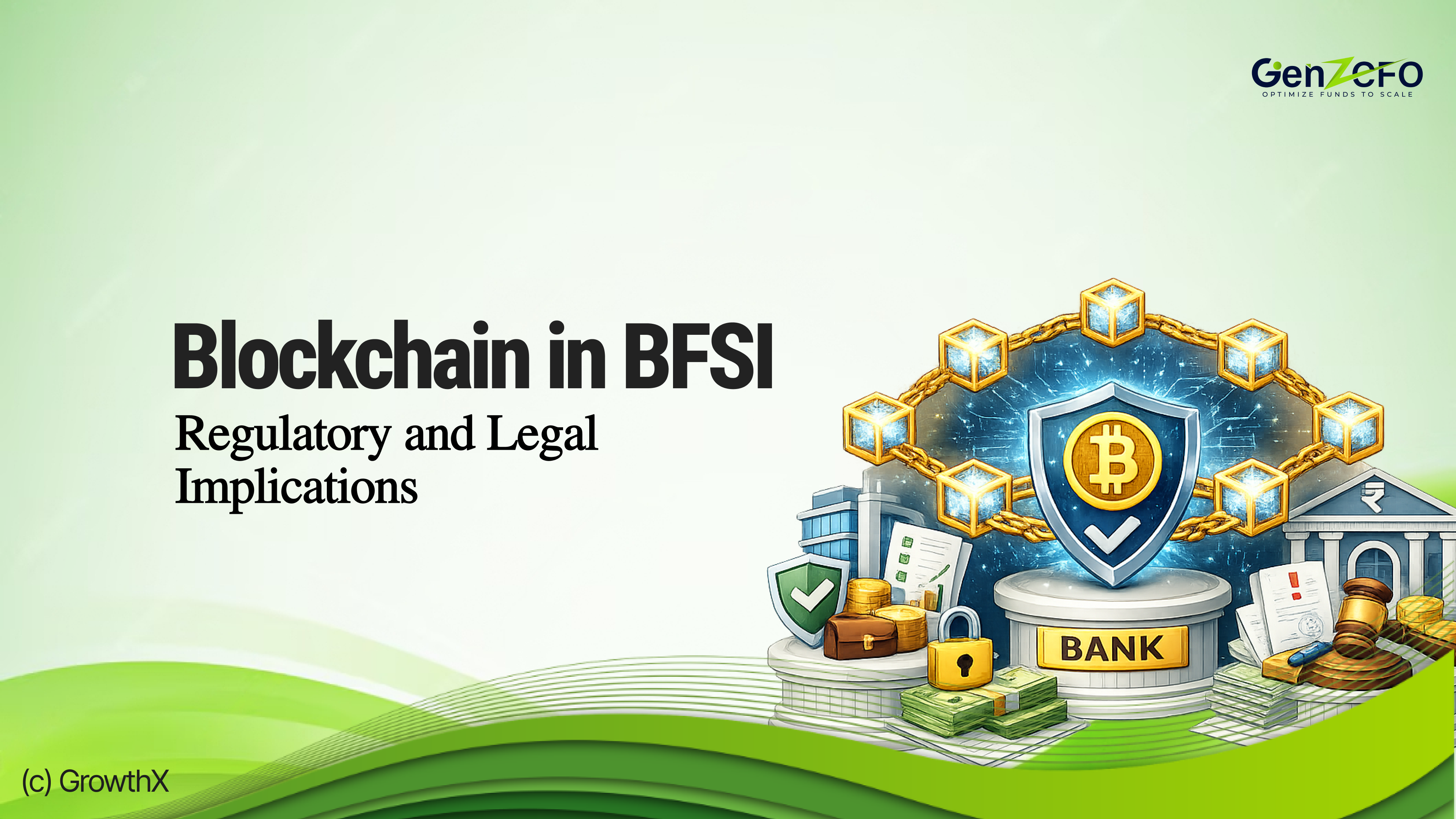
Blockchain in BFSI means using distributed ledger technology in banking, financial services, and insurance operations to store and verify records in a secure and transparent manner. It allows authorised participants to access the same verified data, which reduces manual reconciliation, improves trust, and lowers the chances of fraud or duplication. In banking, blockchain can support payment processing, trade finance documentation, customer verification, settlement systems, and audit trails. However, banks must continue to follow RBI guidelines, KYC norms, cybersecurity rules, and customer protection requirements.
In insurance, blockchain can help insurers verify policy records, process claims faster, detect fraud, and use smart contracts for automatic claim settlement where suitable. In the securities market, it can support ownership tracking, securities settlement, corporate actions, debenture monitoring, and record maintenance. However, if blockchain is used for issuing, trading, or transferring securities, SEBI regulations will apply. A digital token representing shares, bonds, or investment rights may be treated as a regulated security.
In this article, CA Manish Mishra talks about Blockchain in BFSI: Regulatory and Legal Implications.
Legal Position of Blockchain in India
Blockchain technology is not banned in India when used for lawful purposes. However, its use depends on the nature of the activity. If blockchain supports regulated activities such as payments, lending, securities, insurance, or virtual digital assets, existing laws apply. Technology cannot be used to avoid licensing or compliance requirements.
Blockchain Is a Technology, Not a Licence
Using blockchain does not automatically allow a business to offer financial services. If the activity is banking, payment, insurance, investment advice, securities trading, or lending, the business must obtain required approvals. Regulators look at the actual service provided, not only the technology used behind the service.
Difference Between Blockchain and Cryptocurrency
Blockchain is the technology used to record and verify transactions, while cryptocurrency is a digital asset that may use blockchain. India allows lawful blockchain use but closely regulates virtual digital assets. BFSI entities must understand this difference before designing any product involving tokens, wallets, or digital assets.
Regulatory Approach in India
Indian regulators support responsible technology adoption but remain cautious where customer money, investment products, data, or digital assets are involved. RBI, SEBI, IRDAI, and FIU focus on investor protection, financial stability, KYC, anti-money laundering, privacy, and cybersecurity. Therefore, compliance must be built into blockchain projects from the beginning.
RBI Regulations and Banking Compliance
RBI regulates banks, NBFCs, payment aggregators, payment system operators, and several fintech activities. If blockchain is used in banking or payments, RBI compliance becomes important. Businesses must follow licensing rules, KYC directions, outsourcing rules, digital lending norms, cybersecurity requirements, and customer grievance procedures.
Blockchain in Payment Systems
If blockchain is used to transfer money, clear payments, or settle transactions, it may fall under payment system regulation. Such platforms may require RBI approval. A business cannot operate a payment system freely only because it is blockchain-based. Customer fund safety and settlement control remain legally important.
Blockchain in NBFC Operations
NBFCs can use blockchain for loan documentation, collateral tracking, repayment monitoring, fraud checks, and credit verification. However, lending activity remains regulated. NBFCs must follow RBI’s fair practice rules, digital lending guidelines, borrower consent norms, recovery practices, data privacy requirements, and grievance redressal mechanisms.
Digital Rupee and CBDC
The Digital Rupee is issued by RBI and is different from private cryptocurrency. It represents central bank money in digital form. It may support retail payments, wholesale settlement, government benefit transfer, and programmable use cases. Banks and fintech partners involved in CBDC systems must follow RBI instructions and customer protection standards.
SEBI Regulations and Securities Law
SEBI regulates securities markets, intermediaries, investment products, and investor protection. Blockchain can improve transparency in securities settlement, ownership records, and covenant monitoring. However, if blockchain is used to issue, trade, or transfer securities, SEBI rules become applicable. Tokenised products must be legally examined before launch.
Tokenisation of Securities
Tokenisation means converting an asset or right into a digital token. If a token gives ownership, repayment rights, dividend rights, profit share, or investment return, it may be treated as a security. Such token issuance may require SEBI compliance, investor disclosures, recognised market infrastructure, and proper regulatory approval.
Blockchain in Debt Market Monitoring
Blockchain can help monitor security creation, asset cover, debenture covenants, repayment records, and charge status in the debt market. It improves transparency for investors and regulators. However, issuers, debenture trustees, credit rating agencies, and intermediaries must still follow SEBI regulations and disclosure obligations.
Investor Protection Requirements
Blockchain-based securities products must not mislead investors. Proper disclosures, risk warnings, grievance redressal systems, and compliance checks are required. Businesses should avoid claims such as guaranteed profits, risk-free returns, or regulator-approved tokens unless legally correct. Investor protection remains a major SEBI concern.
IRDAI Regulations and Insurance Compliance
Blockchain can improve insurance operations by making policy records secure, claim processing faster, and fraud detection stronger. However, insurance remains a regulated sector. Any blockchain-based insurance system must comply with the Insurance Act, IRDAI regulations, product approval rules, premium norms, claim settlement timelines, and policyholder protection requirements.
Smart Contracts in Insurance
Smart contracts can automatically trigger claims when predefined conditions are met. For example, a travel delay claim may be processed using verified flight data. However, insurance claims often require human review. Insurers must provide appeal rights, grievance redressal, and manual verification wherever facts are disputed.
Fraud Detection in Insurance
Blockchain can reduce duplicate claims and fake policy records by maintaining tamper-resistant data. It can help insurers verify claim history and documents. However, fraud checks must be conducted lawfully. Insurers must protect customer data, avoid excessive surveillance, and follow privacy and confidentiality obligations.
Policyholder Protection
Policyholders must understand how blockchain-based claim processing works. The policy document should explain claim triggers, data sources, exclusions, timelines, and complaint procedures. Automated systems should not deny claims unfairly. IRDAI’s policyholder protection approach requires transparency, fairness, and timely claim settlement.
PMLA and Anti-Money Laundering Compliance
Blockchain-based financial services may create money laundering risks because value can move quickly across wallets and borders. BFSI entities must follow the Prevention of Money Laundering Act, KYC norms, beneficial ownership verification, transaction monitoring, record keeping, and suspicious transaction reporting obligations.
KYC Obligations
KYC is mandatory for regulated financial entities. Banks, NBFCs, insurers, securities intermediaries, and virtual digital asset platforms must verify customer identity and address. Blockchain systems should not allow anonymous financial transactions where KYC is legally required. Proper onboarding protects institutions from fraud and regulatory penalties.
Transaction Monitoring
Blockchain transactions should be monitored for suspicious patterns, high-risk wallets, unusual transfers, layering, and cross-border fund movement. Regulated entities must maintain proper records and report suspicious transactions where required. Technology should support compliance teams by providing traceability, alerts, and investigation records.
VDA Service Providers
Virtual digital asset service providers dealing with crypto assets, tokens, exchanges, wallets, or transfers may fall under AML compliance. They may need to register with the relevant authority, appoint compliance officers, maintain KYC records, and report suspicious transactions. Non-compliance can invite serious regulatory action.
Data Protection and Privacy Implications
Blockchain creates privacy challenges because records are generally permanent and difficult to erase. BFSI entities process sensitive personal and financial data, so they must follow data protection principles. Consent, purpose limitation, data minimisation, security safeguards, access control, and lawful processing are essential for blockchain projects.
Avoiding Personal Data on Blockchain
Financial institutions should avoid storing raw personal data directly on blockchain. Since blockchain records may be difficult to delete, storing Aadhaar, PAN, bank details, or customer documents on-chain can create privacy risks. A safer approach is to store encrypted references or hash values with off-chain data storage.
Consent and Data Use
Customers should be informed about how their data will be collected, stored, shared, and used in blockchain systems. Consent should be clear where required. BFSI entities must not use customer data for unrelated purposes without proper legal basis. Data usage should match the purpose explained to the customer.
Access Control and Security
Only authorised persons should access blockchain records in BFSI use cases. Permissioned blockchain systems are often better for financial institutions because access can be restricted. Encryption, private keys, role-based access, audit logs, and cybersecurity controls are necessary to protect customer data and prevent misuse.
Cybersecurity and Technology Risk
Blockchain systems can still face cyber risks despite being secure by design. Risks may arise from private key theft, coding errors, wallet hacking, smart contract bugs, phishing, insider misuse, or weak vendor controls. BFSI entities must treat blockchain as a critical technology system requiring strong security governance.
Smart Contract Audit
Smart contracts should be technically audited before deployment. A small coding error can trigger wrong payments, claim rejection, or financial loss. Legal teams should also review whether the code matches the written contract. Technical audit and legal review should work together for safer implementation.
Private Key Management
Private keys are used to access blockchain assets or records. If a key is lost or stolen, the loss may be irreversible. BFSI entities must use secure custody systems, multi-signature controls, backup procedures, access restrictions, and incident response plans to manage private key risk.
Incident Response
Blockchain systems should have a clear incident response plan. The plan should explain how the entity will respond to hacking, unauthorised access, data breach, failed smart contract, system downtime, or customer loss. Regulators may expect timely reporting, customer communication, and corrective action.
Smart Contracts and Legal Enforceability
Smart contracts are self-executing digital arrangements where actions happen automatically once conditions are met. In BFSI, they can be used for insurance claims, escrow, lending, collateral release, repayment triggers, and settlement. However, smart contracts should satisfy Indian contract law principles to be legally enforceable.
Contract Law Requirements
For a smart contract to be legally valid, there should be offer, acceptance, lawful consideration, lawful object, free consent, and capacity of parties. Code alone may not prove all these elements. Therefore, a written legal agreement should support the smart contract arrangement.
Risk of Automated Execution
Automated execution can create problems if the data source is wrong, the code has an error, or the customer disputes the transaction. Once executed, reversal may be difficult. BFSI entities should define correction, reversal, dispute resolution, and manual review mechanisms in advance.
Written Agreement with Code
A smart contract should be supported by a written agreement explaining rights, obligations, liability, governing law, dispute resolution, service failure, data usage, and regulatory compliance. This helps avoid confusion if the code behaves differently from the intention of the parties.
Taxation of Blockchain and Digital Assets
Taxation becomes important when blockchain is used for virtual digital assets, tokens, NFTs, digital rewards, or tokenised assets. Income tax, TDS, GST, and accounting implications may arise depending on the nature of the transaction. BFSI entities must maintain proper records and comply with tax laws.
Tax on Virtual Digital Assets
Income from transfer of virtual digital assets is taxable under Indian tax law. Businesses dealing with digital assets must check tax rates, deduction restrictions, loss treatment, and reporting obligations. Proper accounting of purchase price, sale value, gains, and transaction history is necessary.
TDS Compliance
Certain transfers of virtual digital assets may attract tax deduction at source. Platforms facilitating such transfers must examine whether they have TDS obligations. Failure to deduct or report tax properly can lead to interest, penalties, and compliance notices from tax authorities.
GST Implications
GST may apply to blockchain-related services depending on the nature of the activity. Technology service fees, platform charges, exchange services, wallet services, and advisory services may have different GST treatment. Businesses should classify services carefully and maintain invoices, agreements, and transaction records.
FEMA and Cross-Border Legal Issues
Blockchain networks often operate across different countries, which creates foreign exchange and jurisdictional issues. If blockchain is used for cross-border payments, remittances, investment, settlement, or offshore digital asset transfers, FEMA compliance becomes important. Businesses must ensure transactions follow permitted routes and reporting requirements.
Cross-Border Payments
Blockchain may speed up cross-border payments, but it cannot bypass foreign exchange law. Any outward remittance, inward remittance, foreign currency settlement, or overseas payment must follow RBI and FEMA rules. Businesses should verify whether the transaction is legally permitted before processing it.
Jurisdictional Challenges
A blockchain network may involve users, validators, servers, and counterparties in different countries. This creates questions about governing law, dispute resolution, enforcement, taxation, and data transfer. Contracts should clearly mention applicable law, court or arbitration forum, and regulatory responsibility.
Overseas Token Transactions
If Indian residents buy, sell, or transfer overseas tokens, FEMA and tax implications may arise. Businesses should not facilitate offshore digital asset transactions without legal review. Cross-border tokenisation may involve securities law, foreign investment rules, remittance limits, and reporting obligations.
Outsourcing and Vendor Risk
Many BFSI entities depend on external vendors for blockchain infrastructure, cloud hosting, wallet services, APIs, cybersecurity, software development, and smart contract coding. Outsourcing does not remove regulatory responsibility. The regulated entity remains accountable for customer protection, data security, compliance, and service continuity.
Vendor Due Diligence
Before hiring a blockchain vendor, the BFSI entity should check the vendor’s technical capability, cybersecurity standards, financial stability, past record, data handling practices, and regulatory experience. Weak vendor selection can expose the institution to operational, legal, financial, and reputational risk.
Contractual Safeguards
Vendor agreements should include confidentiality, data protection, audit rights, cybersecurity obligations, service levels, incident reporting, business continuity, termination rights, and liability clauses. The contract should also allow regulatory inspection support if required by RBI, SEBI, IRDAI, or other authorities.
Responsibility of Regulated Entity
Even if the technology is outsourced, the bank, NBFC, insurer, or intermediary remains responsible for compliance. Customers and regulators will hold the regulated entity accountable for failures. Therefore, outsourcing must be monitored through audits, reports, controls, and senior management oversight.
Consumer and Investor Protection
Blockchain products can confuse customers because technical terms may hide financial risks. BFSI entities must provide clear disclosures about product nature, risk, fees, liability, grievance process, data usage, and regulatory status. Misleading claims can attract regulatory action and damage customer trust.
Clear Risk Disclosure
Customers should be told about risks such as transaction finality, wallet loss, cyberattack, smart contract failure, token volatility, and regulatory uncertainty. Disclosures should be written in simple language. The business should not use technical words to make risky products appear safe.
No Guaranteed Returns
Blockchain-based investment products should not promise guaranteed returns unless legally backed and permitted. Claims like risk-free income, assured profit, fixed gain, or regulator-approved token can mislead investors. Such statements may violate securities law, consumer protection law, and unfair trade practice principles.
Grievance Redressal
Customers must have a proper complaint mechanism. Blockchain systems may be automated, but customer support cannot be ignored. The entity should provide complaint email, escalation matrix, response timelines, refund process, and dispute resolution support. This is important for trust and regulatory compliance.
Compliance Checklist for BFSI Entities
A BFSI entity planning to use blockchain should first identify the exact use case and legal classification. It should check whether the activity involves banking, payments, insurance, securities, lending, data processing, outsourcing, virtual digital assets, or cross-border transactions. Compliance planning should start before product launch.
Legal Classification
The first step is to classify the blockchain product legally. The entity must check whether it is a payment instrument, security, insurance product, lending product, virtual digital asset, technology service, or data-sharing platform. Legal classification decides which regulator and compliance requirements apply.
Policy Documentation
The entity should prepare KYC policy, AML policy, data protection policy, cybersecurity policy, outsourcing policy, record maintenance policy, grievance policy, and smart contract governance policy. These documents help prove that the blockchain system is not only innovative but also compliant and controlled.
Regulatory Review
Before launch, the entity should take a regulatory review. It should check whether RBI, SEBI, IRDAI, FIU, tax authority, or any other authority approval is required. For innovative products, regulatory sandbox testing may be considered to reduce future compliance risk.
Conclusion
Blockchain can bring major improvement in the BFSI sector by making financial transactions faster, records more transparent, and compliance systems stronger. It can help banks, NBFCs, insurers, fintech companies, and securities market participants reduce manual work, improve audit trails, prevent fraud, and build trust among customers and regulators. However, blockchain should not be treated only as a technology upgrade. Its use must be planned with proper legal and regulatory review. Depending on the business model, RBI, SEBI, IRDAI, PMLA, FEMA, tax laws, data protection rules, contract law, and cybersecurity requirements may apply.
The most important point is that blockchain does not provide any shortcut around the law. If the underlying activity is regulated, the same legal requirements will continue to apply even if the service is delivered through blockchain. The future of blockchain in BFSI is promising, especially in payments, KYC, insurance claims, securities settlement, trade finance, and compliance reporting, but successful adoption will depend on privacy protection, AML controls, cybersecurity, legal enforceability, and regulator-ready documentation.
Frequently Asked Questions (FAQs)
Q1. What is blockchain in BFSI?
Ans. Blockchain in BFSI means using distributed ledger technology in banking, financial services, and insurance activities. It helps institutions record transactions securely, verify information faster, reduce manual reconciliation, and improve transparency. It can be used in payments, KYC, insurance claims, securities settlement, lending, trade finance, and regulatory reporting.
Q2. Is blockchain legal in India?
Ans. Yes, blockchain technology is legal in India when it is used for lawful purposes. However, if blockchain is used for regulated financial activities such as payments, lending, insurance, securities, investment products, or virtual digital assets, the business must follow the applicable RBI, SEBI, IRDAI, PMLA, tax, FEMA, and data protection rules.
Q3. Is blockchain the same as cryptocurrency?
Ans. No, blockchain and cryptocurrency are not the same. Blockchain is the technology used to record and verify transactions, while cryptocurrency is a type of digital asset that may run on blockchain. A business may use blockchain for legal record keeping or compliance purposes without dealing in cryptocurrency.
Q4. Can banks use blockchain in India?
Ans. Yes, banks can use blockchain for lawful and regulated purposes such as trade finance, settlement, fraud detection, digital identity, document verification, and internal record keeping. However, banks must continue to follow RBI rules, KYC norms, cybersecurity standards, outsourcing guidelines, customer protection norms, and reporting obligations.
Q5. Does a blockchain-based payment system require RBI approval?
Ans. If a blockchain platform enables fund transfer, clearing, settlement, wallet-based payment, or payment system operations, RBI approval may be required. A company cannot avoid payment system regulations simply by using blockchain technology. The legal requirement depends on the actual activity performed by the platform.
Q6. What is the role of SEBI in blockchain-based financial products?
Ans. SEBI becomes relevant when blockchain is used for securities, investment products, tokenised securities, settlement, ownership records, debenture monitoring, or investor-facing market products. If a digital token represents shares, bonds, debentures, profit rights, or investment returns, securities law compliance may be required.
Q7. Can securities be tokenised through blockchain?
Ans. Securities can be represented digitally through tokenisation only if the structure complies with applicable securities laws. If a token gives ownership rights, repayment rights, profit share, interest, dividend, or voting rights, it may be treated as a security. Such products require proper legal review and SEBI compliance.
Q8. How can blockchain be used in insurance?
Ans. Blockchain can be used in insurance for policy record keeping, claim verification, fraud detection, reinsurance settlement, and automated claim triggers. For example, travel delay claims or weather-based insurance claims may be processed using verified external data. However, insurers must comply with IRDAI rules and policyholder protection requirements.
Q9. Are smart contracts legally valid in India?
Ans. Smart contracts may be legally valid if they satisfy the basic requirements of Indian contract law, such as offer, acceptance, lawful consideration, lawful object, free consent, and capacity of parties. However, smart contracts should be supported by written agreements to cover liability, dispute resolution, data use, and reversal conditions.
Q10. What are the AML risks in blockchain-based BFSI services?
Ans. Blockchain can create AML risks because value can move quickly through wallets, digital assets, and cross-border networks. Regulated entities must conduct KYC, verify beneficial ownership, monitor transactions, maintain records, and report suspicious transactions. Anonymous or high-risk blockchain transactions can create serious compliance concerns.
- 04 Jun, 2026
 CA Manish Mishra
- Easing Finance
CA Manish Mishra is the Co-Founder & CEO at GenZCFO. He is the most sought professional for providing virtual CFO services to startups and established businesses across diverse sectors, such as retail, manufacturing, food, and financial services with over 20 years of experience including strategic financial planning, regulatory compliance, fundraising and M&A.