Search GrowthX Learning Content


CFO Frameworks for Regulated BFSI Growth and Governance
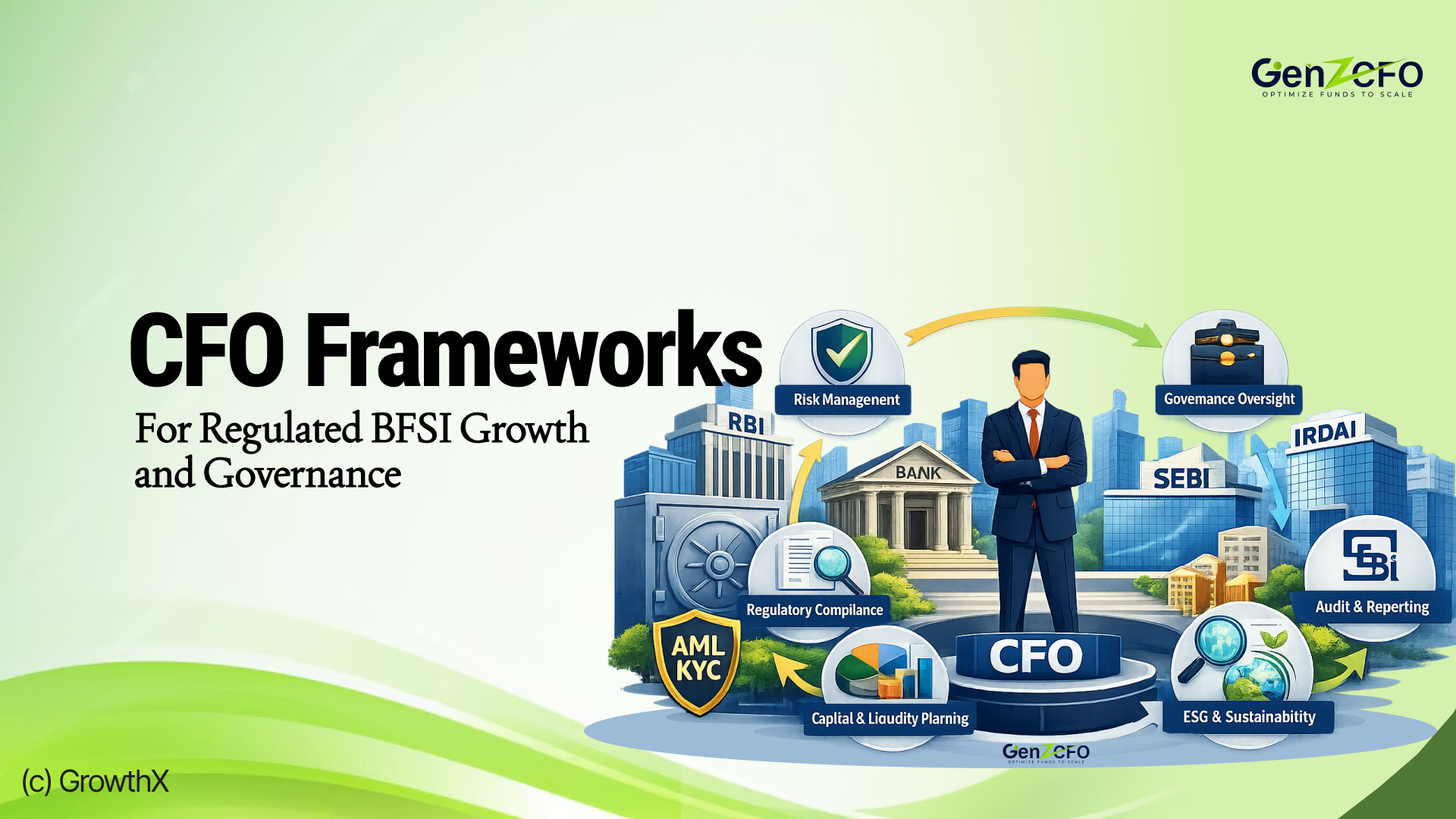
The BFSI sector operates in one of the most tightly regulated environments, where financial stability, risk management, and transparency are essential for sustainable growth. In this, the Chief Financial Officer plays a pivotal role in ensuring that business expansion aligns with regulatory expectations, capital adequacy norms, and governance standards. The modern CFO is no longer limited to financial reporting but functions as a strategic leader responsible for compliance, internal controls, and stakeholder confidence.
A well-defined CFO framework integrates financial governance, prudential compliance, risk oversight, and regulatory reporting across banking, insurance, and capital market institutions. By strengthening capital planning, liquidity management, and disclosure practices, the CFO supports institutional resilience and long-term value creation. In a sector governed by multiple regulators and evolving legal requirements, an effective CFO framework is essential for balancing growth objectives with regulatory discipline and maintaining market trust.
In this article, CA Manish Mishra talks about CFO Frameworks for Regulated BFSI Growth and Governance.
Evolving Role of the CFO in BFSI
Strategic Partner to the Board
The CFO acts as a strategic advisor to the board by providing financial insights, capital planning inputs, and risk-based analysis for major business decisions. Through budgeting, forecasting, and stress testing, the CFO supports policy formulation and ensures that strategic initiatives remain aligned with prudential norms and long-term financial stability.
Financial Stewardship and Governance Oversight
Financial stewardship now includes maintaining transparency in financial reporting, implementing internal financial controls, and coordinating with auditors and board committees. The CFO ensures accuracy of disclosures, strengthens governance frameworks, and monitors compliance with accounting standards and regulatory requirements, thereby enhancing investor and regulator confidence.
Alignment of Growth with Regulatory Compliance
The CFO evaluates expansion plans, funding strategies, and product launches against capital adequacy, liquidity, and disclosure norms. This ensures that business growth is supported by compliant financial structures and sustainable risk management practices.
Legal Recognition under Companies Act, 2013
Responsibility for Books of Accounts
Under the Companies Act, the CFO is responsible for ensuring that proper books of account are maintained, reflecting all financial transactions accurately and in accordance with applicable accounting standards. This includes safeguarding financial records, ensuring timely updates, and enabling audit verification.
True and Fair Financial Statements
The CFO plays a key role in preparing financial statements that present a true and fair view of the company’s financial position and performance. This involves ensuring compliance with accounting standards, accurate classification of assets and liabilities, and proper disclosure of financial information.
Internal Financial Controls Implementation
The CFO is responsible for establishing and monitoring internal financial controls to prevent errors, fraud, and misstatements. This includes designing control frameworks, implementing approval mechanisms, and ensuring periodic testing and documentation of control effectiveness.
Board Report Financial Disclosures
Financial information included in the board’s report must be accurate and compliant with statutory requirements. The CFO supports the board by providing detailed financial data, explanations of performance, and disclosures on internal controls and risk management systems.
SEBI Governance Framework for Listed BFSI
CEO/CFO Certification of Financial Results
Under SEBI (LODR) Regulations, the CFO is required to jointly certify quarterly and annual financial results along with the CEO. This certification confirms that financial statements are accurate, free from material misstatements, and supported by effective internal controls. It also ensures that all material information has been disclosed to the stock exchanges in a timely manner.
Related Party Transaction Monitoring
The CFO plays a critical role in identifying, reviewing, and disclosing related party transactions. This includes ensuring that such transactions are conducted at arm’s length, approved by the audit committee, and reported transparently in financial statements to prevent governance risks.
Audit Committee Coordination
The CFO regularly interacts with the audit committee by presenting financial results, internal audit findings, risk assessments, and compliance updates. This coordination strengthens financial oversight, improves internal control effectiveness, and ensures adherence to regulatory requirements.
Insider Trading Financial Controls
The CFO supports the implementation of financial controls to prevent misuse of unpublished price-sensitive information. This includes monitoring financial data access, maintaining structured digital databases, and ensuring timely disclosures in accordance with insider trading regulations.
RBI Prudential Compliance for Banks and NBFCs
Basel III Capital Adequacy Monitoring
The CFO is responsible for ensuring that the institution maintains the minimum capital adequacy ratio as prescribed under Basel III norms. This involves continuous monitoring of risk-weighted assets, capital buffers, and Tier I and Tier II capital to support lending growth while meeting regulatory thresholds.
Liquidity Coverage Ratio Compliance
Maintaining adequate high-quality liquid assets to meet short-term obligations is a key prudential requirement. The CFO monitors liquidity coverage ratios, funding patterns, and cash flow mismatches to ensure the institution can withstand liquidity stress scenarios.
Asset Classification and Provisioning Oversight
The CFO oversees the classification of assets into standard, sub-standard, doubtful, and loss categories and ensures that appropriate provisioning is made for non-performing assets. This supports accurate financial reporting and regulatory compliance.
ICAAP and Stress Testing Governance
Through the Internal Capital Adequacy Assessment Process, the CFO evaluates capital requirements under various stress scenarios. Stress testing helps assess resilience to economic shocks and supports capital planning.
Supervisory Returns and Regulatory Filings
Timely submission of financial and prudential returns to the regulator is a core responsibility. Accurate reporting strengthens regulatory confidence and ensures ongoing compliance.
IRDAI Financial Governance in Insurance
Solvency Margin Monitoring
The CFO is responsible for ensuring that the insurer maintains the required solvency margin as prescribed by the regulator. Continuous monitoring of capital levels, liabilities, and risk exposure ensures that the company has sufficient financial strength to meet policyholder obligations and unexpected claims.
Actuarial and Financial Data Alignment
Close coordination between the finance and actuarial functions is essential for accurate valuation of liabilities and premium reserves. The CFO ensures that actuarial assumptions are properly reflected in financial statements and regulatory filings, maintaining consistency and transparency.
Investment Norm Compliance
Insurance companies are required to invest policyholder funds in accordance with prescribed investment limits and asset categories. The CFO monitors portfolio allocation, exposure limits, and valuation practices to ensure compliance with regulatory norms.
Policyholder Fund Protection Disclosures
The CFO ensures clear and accurate disclosure of policyholder funds, segregated accounts, and solvency positions in financial statements. Transparent reporting strengthens trust and supports regulatory oversight.
Three Lines of Defence Model
Risk Ownership by Business Units
In the first line of defence, business and operational teams are responsible for identifying and managing risks arising from their activities. They must follow approved policies, maintain proper documentation, and ensure that transactions comply with internal and regulatory guidelines. This creates primary accountability for risk at the operational level.
Finance and Compliance Monitoring Controls
The second line of defence consists of finance, risk, and compliance functions that monitor adherence to policies and regulatory requirements. The CFO oversees financial controls, risk reporting, and compliance reviews to ensure that business activities remain within approved risk limits.
Independent Internal Audit Assurance
The third line of defence is the internal audit function, which provides independent evaluation of financial controls, governance processes, and regulatory compliance. Audit findings are reported to the audit committee for corrective action.
CFO Reporting to Board Committees
The CFO consolidates risk and financial information and presents it to audit and risk management committees, enabling effective board oversight and governance.
Capital and Liquidity Management
Asset-Liability Management
The CFO oversees the asset-liability management process to ensure that the maturity profile of assets and liabilities is properly matched. This helps control liquidity risk, manage interest rate exposure, and maintain stable cash flows, ensuring the institution can meet its short-term and long-term obligations without stress.
Funding and Leverage Strategy
Developing a balanced funding strategy is a key responsibility. The CFO monitors sources of funds, cost of capital, and leverage ratios to ensure that growth is supported by sustainable financing while remaining within regulatory limits and maintaining financial stability.
Provisioning Buffers and Credit Risk
The CFO ensures that adequate provisioning buffers are created for potential credit losses. Proper recognition of non-performing assets and timely provisioning strengthens balance sheet resilience and supports accurate financial reporting.
Scenario Analysis for Capital Planning
Through scenario analysis and stress testing, the CFO evaluates the impact of adverse economic conditions on capital adequacy. This enables proactive capital planning and ensures compliance with prudential requirements during periods of financial stress.
Technology Governance and RegTech
Automated Regulatory Reporting Systems
The CFO oversees the implementation of automated reporting tools that generate accurate and timely regulatory returns. These systems reduce manual errors, improve efficiency, and ensure consistency in financial data submitted to regulators and stakeholders.
Financial Data Integrity Controls
Maintaining the accuracy and reliability of financial data is essential. The CFO establishes validation checks, reconciliation processes, and access controls to ensure that data used for reporting and decision-making is complete and error-free.
Audit Trails and Documentation
Proper audit trails are required to track every financial transaction and system change. The CFO ensures that documentation is maintained for verification, regulatory inspections, and internal audits, supporting transparency and accountability.
Cybersecurity in Financial Reporting
Financial reporting systems must be protected against unauthorised access and data breaches. The CFO works with technology and risk teams to implement cybersecurity controls that safeguard sensitive financial information and maintain regulatory compliance.
AML, KYC, and Fraud Risk Oversight
Transaction Monitoring Systems
The CFO supports the implementation and oversight of financial transaction monitoring systems that identify unusual patterns, high-risk transactions, and potential money laundering activities. These systems analyse large volumes of financial data and generate alerts for further review by compliance and risk teams.
Suspicious Activity Financial Reporting
When suspicious transactions are identified, the CFO ensures that financial records are accurately documented and reported in accordance with regulatory requirements. Proper financial tracking and documentation support timely filing of suspicious activity reports and strengthen audit readiness.
Integration with Compliance Functions
The CFO works closely with compliance, risk, and internal audit teams to ensure that AML and KYC controls are embedded within financial processes. This integration improves monitoring, enhances regulatory reporting accuracy, and reduces the risk of financial fraud and penalties.
ESG and Sustainability Reporting
Climate Risk Financial Impact Assessment
The CFO evaluates the financial impact of climate-related risks such as credit exposure to carbon-intensive sectors, asset impairment, and long-term investment risks. Integrating these assessments into financial planning helps institutions align with sustainability goals and regulatory expectations on climate disclosures.
Green Financing Disclosures
The CFO is responsible for reporting green loans, sustainable investments, and environmentally aligned funding in financial statements and regulatory disclosures. Transparent reporting of green finance activities enhances investor confidence and demonstrates commitment to responsible banking and financial practices.
Governance Metrics Integration
ESG reporting requires the inclusion of governance indicators such as board oversight, risk management frameworks, and compliance structures. The CFO ensures that these governance metrics are supported by reliable data and integrated into overall financial and sustainability reporting systems.
Board-Level Governance Structure
Audit Committee Financial Reporting
The CFO plays a central role in presenting quarterly and annual financial results to the audit committee, along with internal audit observations, control effectiveness reports, and compliance updates. This enables the committee to review the accuracy of financial statements, assess internal controls, and ensure adherence to regulatory and accounting standards.
Risk Committee Capital Oversight
The CFO provides capital adequacy reports, stress testing results, liquidity positions, and provisioning analysis to the risk management committee. These inputs help the committee evaluate the institution’s risk profile, monitor capital buffers, and ensure that growth strategies remain within approved risk limits.
Policy Formulation Support by CFO
The CFO supports the board and its committees in developing financial policies related to capital management, liquidity planning, provisioning norms, and disclosure practices. By providing data-driven insights and regulatory guidance, the CFO ensures that policies are aligned with prudential requirements and governance standards.
Regulatory Reporting and Compliance Calendar
Quarterly Financial Filings
The CFO is responsible for ensuring timely preparation and submission of quarterly financial results in accordance with applicable accounting standards and regulatory disclosure norms. These filings include financial statements, limited review reports, and management certifications, which are critical for maintaining market transparency and investor confidence.
Prudential Returns to Regulators
In regulated BFSI entities, the CFO oversees the preparation and submission of prudential returns such as capital adequacy reports, liquidity statements, asset classification data, and provisioning details. Accurate and timely reporting ensures compliance with supervisory requirements and supports ongoing regulatory monitoring.
Investor and Rating Agency Disclosures
The CFO manages financial disclosures to investors and credit rating agencies, including performance analysis, capital position, risk exposure, and funding strategies. Transparent communication strengthens market credibility, supports credit ratings, and enhances stakeholder trust.
Recent Regulatory Developments
Strengthened Fit and Proper Criteria
Regulators have introduced stricter fit and proper requirements for senior management, including CFOs, to ensure integrity, competence, and financial expertise. This places greater responsibility on institutions to conduct due diligence and maintain strong governance standards in leadership appointments.
Enhanced Disclosure Norms
Recent regulatory changes emphasise more detailed and frequent financial disclosures, including related party transactions, risk exposures, and capital adequacy positions. The CFO must ensure accuracy, completeness, and timely reporting to meet these transparency requirements.
Control Function Independence
There is an increased focus on the independence of finance, risk, and compliance functions from business operations. The CFO must ensure that financial reporting and control mechanisms operate without undue influence, strengthening governance and accountability.
Industry Compliance Standardisation
Standardised compliance frameworks across BFSI sectors require institutions to align internal policies with regulatory expectations and industry best practices, enhancing consistency and supervisory oversight.
Strategic Importance of CFO Framework
Balancing Growth with Prudential Norms
The CFO ensures that business expansion, lending strategies, and investment decisions are aligned with capital adequacy, liquidity requirements, and provisioning norms. This balance prevents excessive risk-taking and supports sustainable growth within regulatory limits.
Enhancing Investor and Regulator Confidence
Accurate financial reporting, transparent disclosures, and strong internal controls build trust among investors, regulators, and credit rating agencies. The CFO’s governance framework ensures reliability of financial data and compliance with statutory requirements, strengthening market credibility.
Strengthening Institutional Stability
Through capital planning, stress testing, and risk monitoring, the CFO enhances the institution’s ability to withstand economic shocks and financial volatility, maintaining long-term stability.
Enabling Sustainable BFSI Expansion
A structured CFO framework supports strategic growth by integrating compliance, risk management, and financial discipline, ensuring that expansion is resilient, well-capitalised, and aligned with regulatory expectations.
Conclusion
The CFO framework in regulated BFSI institutions serves as a governance backbone that integrates financial reporting, regulatory compliance, capital planning, and risk oversight. By ensuring adherence to prudential norms, maintaining transparent disclosures, and implementing strong internal controls, the CFO supports institutional credibility and regulatory trust. The role extends beyond accounting to strategic coordination with board committees, audit functions, and compliance teams, enabling informed decision-making and financial discipline.
A well-structured CFO framework also strengthens capital resilience, liquidity management, and technological reporting systems, ensuring readiness for regulatory scrutiny and economic stress. The inclusion of ESG reporting, RegTech adoption, and enhanced disclosure practices further expands the scope of financial governance. By aligning growth strategies with compliance requirements, the CFO enables sustainable expansion, protects stakeholder interests, and contributes to long-term stability and value creation in the BFSI sector.
Frequently Asked Questions (FAQs)
Q1. What is the role of a CFO in the BFSI sector?
Ans. The CFO is responsible for financial reporting, regulatory compliance, capital planning, liquidity management, and governance oversight. The role also includes coordinating with regulators, managing risk frameworks, and supporting board-level decision-making.
Q2. Why is the CFO framework important for regulated financial institutions?
Ans. A structured CFO framework ensures compliance with prudential norms, improves financial transparency, strengthens internal controls, and supports sustainable growth while maintaining regulatory and investor confidence.
Q3. How does the CFO support regulatory compliance in BFSI?
Ans. The CFO ensures timely regulatory filings, monitors capital adequacy and liquidity ratios, oversees provisioning norms, and implements internal financial controls aligned with sectoral regulations.
Q4. What is the three-lines-of-defence model in CFO governance?
Ans. It is a risk management structure where business units manage risks, finance and compliance functions monitor controls, and internal audit provides independent assurance, all coordinated through CFO reporting.
Q5. How does the CFO contribute to capital and liquidity management?
Ans. The CFO manages asset-liability matching, funding strategies, leverage levels, and stress testing to ensure adequate capital buffers and financial resilience.
Q6. What is the CFO’s role in ESG reporting for BFSI entities?
Ans. The CFO integrates sustainability metrics, climate risk disclosures, and governance indicators into financial reporting to meet regulatory and investor expectations.
Q7. How does technology impact the CFO framework in BFSI?
Ans. RegTech and automated reporting systems improve accuracy, reduce manual errors, and strengthen audit trails, while the CFO ensures data integrity and cybersecurity in financial reporting.
Q8. How does the CFO enhance investor confidence?
Ans. Through accurate disclosures, transparent reporting, strong internal controls, and compliance with governance norms, the CFO builds trust among investors and regulators.
Q9. How does the CFO framework support risk management in BFSI institutions?
Ans. The CFO framework integrates financial risk monitoring, capital adequacy analysis, provisioning controls, and stress testing. It ensures that credit, liquidity, and market risks are measured and reported to the board, supporting timely corrective actions and regulatory compliance.
Q10. What is the role of the CFO in regulatory reporting accuracy?
Ans. The CFO establishes validation controls, reconciliation processes, and automated reporting systems to ensure that financial data submitted to regulators is accurate, complete, and timely, reducing the risk of penalties, supervisory observations, and reputational concerns.
- 02 Mar, 2026
 CA Manish Mishra
- CFO Services
CA Manish Mishra is the Co-Founder & CEO at GenZCFO. He is the most sought professional for providing virtual CFO services to startups and established businesses across diverse sectors, such as retail, manufacturing, food, and financial services with over 20 years of experience including strategic financial planning, regulatory compliance, fundraising and M&A.