Search GrowthX Learning Content


FFMC Licence Application Process: Complete RBI Guide
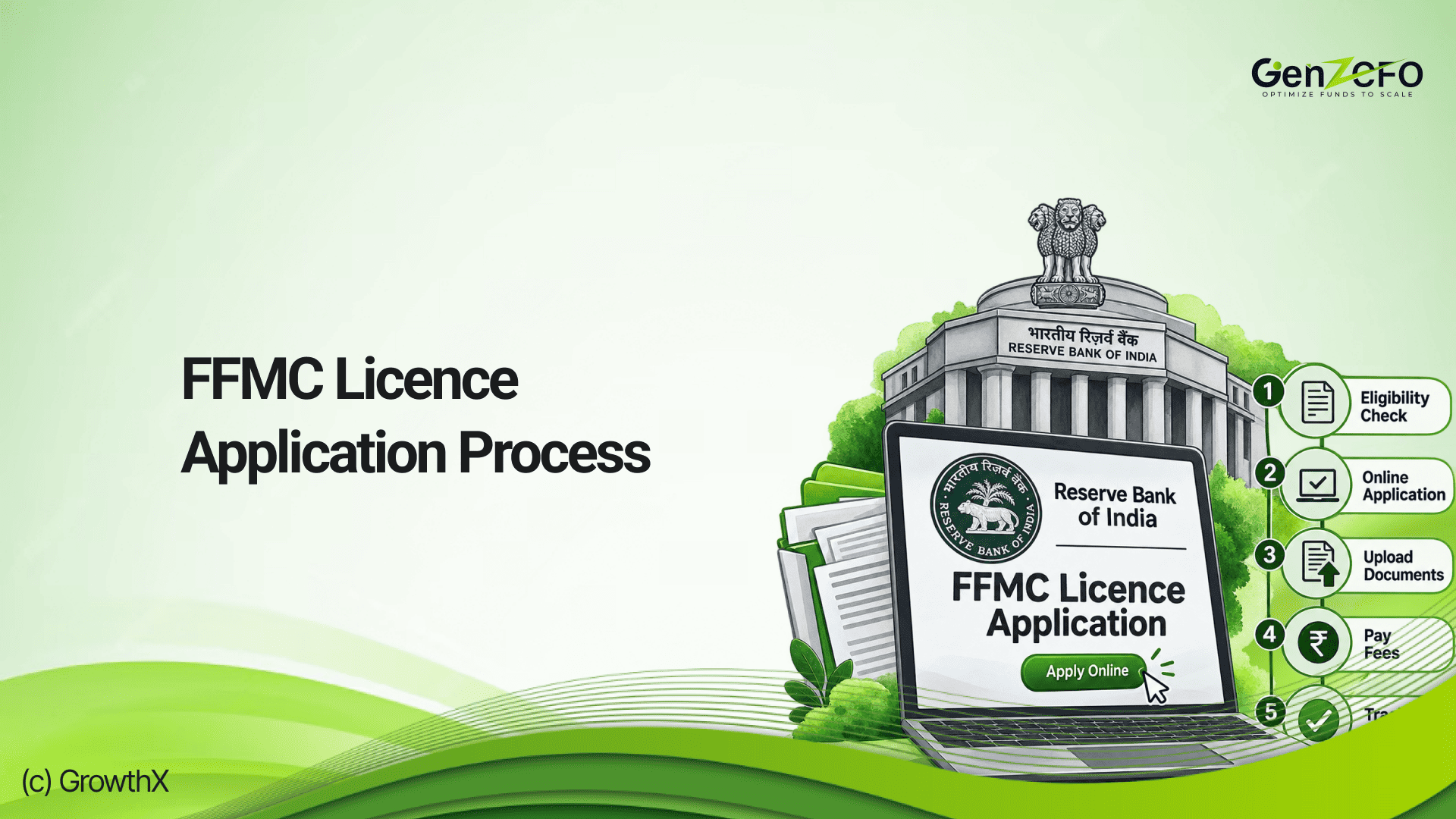
From 6 May 2026, the Reserve Bank of India (RBI) stopped considering fresh Full Fledged Money Changer (FFMC) licence applications. The exception applies to applications that were already under process when the new regulations took effect. Existing FFMCs can apply for renewal, and new businesses that want to offer retail currency exchange can explore appointment as a Forex Correspondent through an eligible Authorised Dealer.
This change affects how a business should plan its entry into the currency exchange market. A company that applied before the change needs to check its application status and any RBI queries. A company that already holds an FFMC licence needs to track its renewal date. A new travel or forex business can start by identifying an Authorised Dealer that appoints Forex Correspondents.
In this article, CA Manish Mishra talks about FFMC Licence Application Process: Complete RBI Guide.
What Is an FFMC Licence?
FFMC stands for Full Fledged Money Changer. RBI authorises money changers under Section 10(1) of the Foreign Exchange Management Act, 1999 (FEMA). Under the Foreign Exchange Management (Authorised Persons) Regulations, 2026, an FFMC can purchase foreign currency notes and travellers’ cheques, sell them for foreign travel, and act as an agent under the Money Transfer Service Scheme (MTSS), subject to the applicable rules and conditions.
For example, a traveller returning to India may visit an FFMC to exchange unused US dollars for Indian rupees. Another traveller may visit the same counter to buy foreign currency before a business trip. The FFMC must handle each transaction within the scope of its authorisation and follow the applicable customer verification and recordkeeping requirements.
Which Route Applies to Your Business?
|
Your situation |
Route to follow |
First step |
|
You want to open a new currency exchange counter |
Forex Correspondent appointment |
Check whether an AD Category-I or AD Category-II entity is onboarding correspondents. |
|
Your FFMC application was under process on 6 May 2026 |
Transitional FFMC application |
Find the original application reference and review RBI’s correspondence. |
|
You already hold an FFMC licence |
Renewal under Regulation 5 |
Check the expiry date and prepare to apply at least two months before it. |
|
You are an established FFMC or Forex Correspondent seeking wider permissions |
AD Category-II authorisation, if eligible |
Review the operating history, forex turnover and net worth requirements. |
FFMC Licence Application Process for Pending Cases
Step 1. Confirm that RBI was already processing the application
Regulation 3(6) of the 2026 regulations allows RBI to consider a fresh FFMC application only if it was already under process on 6 May 2026. Start with the original acknowledgement, application number and any communication from the concerned RBI Regional Office. If your team prepared the documents before that date, use the acknowledgement and application record to establish whether the case was actually under process.
Where RBI had sought additional information or documents, the regulation gave applicants 30 days from the date the regulations came into force to provide them. The application was deemed rejected if the applicant missed that window. If there is uncertainty about the status, refer to the original application number and check what RBI requested, when the company responded and whether it has proof of submission.
Step 2. Review the company’s incorporation documents
The company should have its Certificate of Incorporation, Memorandum of Association (MOA) and Articles of Association (AOA) ready. Its constitutional documents should provide for money changing. If the company amended them to include this activity, keep the updated documents and evidence of the relevant filing together.
Check that the legal name, registered office address and other company particulars match across the application, audited accounts, banker’s report and board resolution. If the company changed its name or office after submitting the application, keep records that explain the difference.
Step 3. Calculate and certify Net Owned Funds
For pending applications processed under the transitional Annex, the minimum Net Owned Funds (NOF) depend on the number of branches proposed.
|
Proposed operation |
Minimum NOF |
|
Single branch FFMC |
₹25 lakh |
|
Multiple branch FFMC |
₹50 lakh |
The NOF calculation starts with paid-up equity, eligible reserves and other relevant balances. It then accounts for items such as accumulated losses, intangible assets and prescribed exposures to group entities and NBFCs. The statutory auditor certifies NOF as of the application date.
For instance, suppose a company has ₹30 lakh in paid-up equity and ₹8 lakh in accumulated losses, with no other relevant balances. Its funds after that adjustment would be ₹22 lakh. In this example, it would fall below the ₹25 lakh single-branch threshold. This is why the auditor’s calculation matters even when the paid-up capital appears sufficient.
Step 4. Prepare the supporting documents
The transitional Annex specifies the following documents for pending FFMC applications.
|
Document |
What to prepare |
|
Certificate of Incorporation |
A copy showing the company’s registered identity. |
|
MOA and AOA |
Copies showing the provision for money changing and any relevant amendment. |
|
Latest audited accounts |
Financial statements supporting the company’s capital and financial position. |
|
Statutory auditor’s NOF certificate |
A certificate showing NOF as of the application date. |
|
Earlier audited financial statements |
Balance sheets and profit and loss accounts for the last three years, wherever applicable. |
|
Confidential banker’s report |
Arrange the sealed report and follow RBI’s instructions for submission. |
|
Declaration on enforcement and criminal proceedings |
Verify the facts for the applicant company and its directors before signing. |
|
KYC policy declaration |
Confirm that the company will implement the required customer verification policy before starting operations. |
|
Details of associated financial businesses |
Identify relevant sister and associated concerns, including NBFCs where applicable. |
|
Certified board resolution |
Record the board’s decision to undertake money changing. |
Keep these documents together with the original application and all later correspondence. This makes it easier to answer a query about a particular date, financial figure or declaration without relying on different versions of the same document.
Step 5. Complete fit-and-proper checks and respond to RBI queries
The transitional Annex requires checks on the directors’ qualifications, experience, track record and integrity. The company should obtain the prescribed declarations and document their review through the nomination committee process. It should also check how any enforcement or criminal proceedings affect the applicant’s eligibility under the Annex.
Reply to RBI through the channel specified for the pending case. A point-by-point response is easier to review. For example, if RBI asks why the NOF figure differs from a figure in the balance sheet, provide a reconciliation that identifies each adjustment and includes the auditor’s supporting explanation. The concerned RBI Regional Office considers the application based on clearance from the Empowered Committee.
Step 6. Prepare to start operations after authorisation
Once RBI issues the authorisation, review the permitted activities and any specific conditions before opening the counter. A non-bank authorised person must commence operations within six months from the date of issuance and inform the concerned RBI Regional Office.
Use the time before opening to put customer identification procedures in place, train staff and set up transaction records. Give counter staff clear instructions on the documents to check, the transactions they can handle and whom to contact when a transaction needs further review.
How to Renew an Existing FFMC Licence
An existing FFMC should apply for renewal at least two months before its authorisation expires. If it applies within this period, the existing authorisation continues until RBI grants the renewal or rejects the application. Regulation 5 prescribes minimum net worth of ₹25 lakh for a single branch and ₹50 lakh for multiple branches. The applicable fit-and-proper and investigation-related requirements also apply. For renewal, review the financial statements, branch details and any changes involving promoters, directors or key managerial personnel before preparing the application.
The figures are the same as those in the transitional application rules, but the calculation differs. Renewal uses net worth under Regulation 5. Pending fresh FFMC applications use Net Owned Funds under the transitional Annex. Ask the statutory auditor to confirm the appropriate calculation before relying on a figure from an earlier filing.
How New Businesses Can Become Forex Correspondents
The Forex Correspondent Scheme allows an AD Category-I or AD Category-II entity to appoint a business as its agent for permitted money changing activities. The Authorised Dealer acts as the principal. It sets its onboarding criteria under a board-approved policy, decides what the correspondent can do and issues permission for each outlet.
A business interested in this route can take the following steps.
-
Define what the outlet will offer: Identify the proposed location and whether the business intends to buy foreign currency, sell it for foreign travel, or do both.
-
Approach an eligible Authorised Dealer: Ask whether it appoints Forex Correspondents and what it requires for financial eligibility, premises, staffing and operating controls.
-
Prepare the due diligence documents: Keep company and ownership records, financial statements, premises details and a description of the proposed operations ready. Use the dealer’s checklist for the exact documents.
-
Review the appointment terms and outlet permission: Confirm which transactions the outlet may handle, how it will report them, what charges apply and how it will address customer complaints. Display the principal’s permission at the outlet as required.
Suppose a travel agency in Delhi wants to offer currency exchange at its existing office. It can approach an eligible Authorised Dealer with the location, expected customer base and proposed services. If the dealer appoints the agency as a Forex Correspondent, the agency can conduct the permitted activities under that arrangement. Its transactions are reflected in the principal’s books.
Ongoing Compliance for FFMCs
|
Compliance area |
What the FFMC should monitor |
|
Customer verification and records |
Follow applicable RBI requirements for KYC, anti-money laundering, transaction documentation and reporting. |
|
Annual forex turnover |
Achieve at least ₹10 crore within two years from the date the regulations came into force or the start of forex business, whichever is later. Maintain the threshold thereafter. |
|
Minimum net worth |
Monitor the applicable threshold and inform RBI immediately if the company falls below it. The regulations provide six months to restore it, subject to any additional time RBI grants. |
|
Changes in management, control or ownership |
Seek prior RBI approval for changes covered by Regulation 8, including changes in management or control and ownership changes of more than 50%. |
|
Outlet openings, closures and registered office moves |
Report specified changes through APConnect or another RBI-designated system within seven calendar days of the relevant event. |
|
Existing franchisee arrangements |
Plan to discontinue arrangements that were valid when the regulations came into force within the prescribed two-year transition. Eligible franchisees may be considered for appointment as Forex Correspondents. |
Conclusion
The RBI’s 2026 rules change how businesses enter India’s currency exchange market. Since 6 May 2026, RBI has considered fresh FFMC licence applications only if they were already under process on that date. Companies with pending applications should review their original acknowledgement, check whether RBI requested further documents and confirm their application status. Existing FFMCs should verify their net worth and submit their renewal application at least two months before their authorisation expires.
A business planning its first currency exchange counter can explore appointment as a Forex Correspondent through an eligible Authorised Dealer. Before committing to premises or staffing, confirm the dealer’s onboarding criteria, the transactions it will permit and the requirements for each outlet. Once operations begin, clear customer verification procedures, accurate transaction records and timely reporting help the business meet its obligations. Identifying the applicable route early helps avoid unnecessary paperwork and gives the business
Frequently Asked Questions (FAQ’s)
Q1. Is RBI accepting new FFMC licence applications?
Ans. RBI stopped considering fresh FFMC applications from 6 May 2026. The exception covers applications already under process on that date.
Q2. Can I submit a new FFMC licence application through PRAVAAH?
Ans. PRAVAAH is the application channel specified under the 2026 regulations for fresh authorisations in eligible Authorised Dealer categories. The restriction on fresh FFMC applications applies regardless of the portal.
Q3. Is ₹25 lakh enough to start a currency exchange business?
Ans. ₹25 lakh is the single-branch NOF threshold for qualifying pending FFMC applications and the single-branch net worth threshold for renewal. A prospective Forex Correspondent should check the financial criteria set by its Authorised Dealer.
Q4. What happens if I missed RBI’s deadline for documents in a pending case?
Ans. For applications covered by the transition, Regulation 3(6) allowed 30 days from commencement of the regulations to provide additional documents or information sought by RBI. Missing the applicable window results in deemed rejection.
Q5. Can an existing FFMC operate while its renewal is pending?
Ans. Yes. When it applies at least two months before expiry, its existing authorisation continues until RBI grants the renewal or rejects the application.
Q6. Who appoints a Forex Correspondent
Ans. An AD Category-I or AD Category-II entity may appoint a Forex Correspondent under its board-approved policy. The dealer sets the permitted activities and issues permission for the outlet.
Q7. Can an FFMC or Forex Correspondent become an AD Category-II?
Ans. An FFMC or Forex Correspondent that has operated for at least two years and averaged ₹50 crore in annual forex turnover over the previous two financial years may qualify to apply. Other conditions also apply, including ₹10 crore minimum net worth at commencement as an AD Category-II.
Q8. Can a company appeal against RBI’s rejection or revocation?
Ans. Regulation 9 provides an appeal route for rejection of an authorisation application or revocation of an authorisation. The appeal must be filed within 45 calendar days of receiving the relevant letter. Check the decision letter to establish the receipt date and the route applicable to the case.
Q9. Can an existing forex franchisee become a Forex Correspondent?
Ans. Yes. An existing franchisee may be appointed as a Forex Correspondent by an eligible AD Category-I or AD Category-II entity, subject to its onboarding requirements. The appointment is separate from the old franchise agreement.
Q10. Do inward remittances count towards an FFMC’s annual forex turnover?
Ans. No. Annual forex turnover counts eligible foreign exchange purchases and sales, including transactions through agents or correspondents where applicable. The value of inward remittances processed is excluded from this calculation.
- 07 Nov, 2026
 CA Manish Mishra
- Corporate Actions
CA Manish Mishra is the Co-Founder & CEO at GenZCFO. He is the most sought professional for providing virtual CFO services to startups and established businesses across diverse sectors, such as retail, manufacturing, food, and financial services with over 20 years of experience including strategic financial planning, regulatory compliance, fundraising and M&A.