Search GrowthX Learning Content


KYC and AML Compliance Requirements for NBFCs
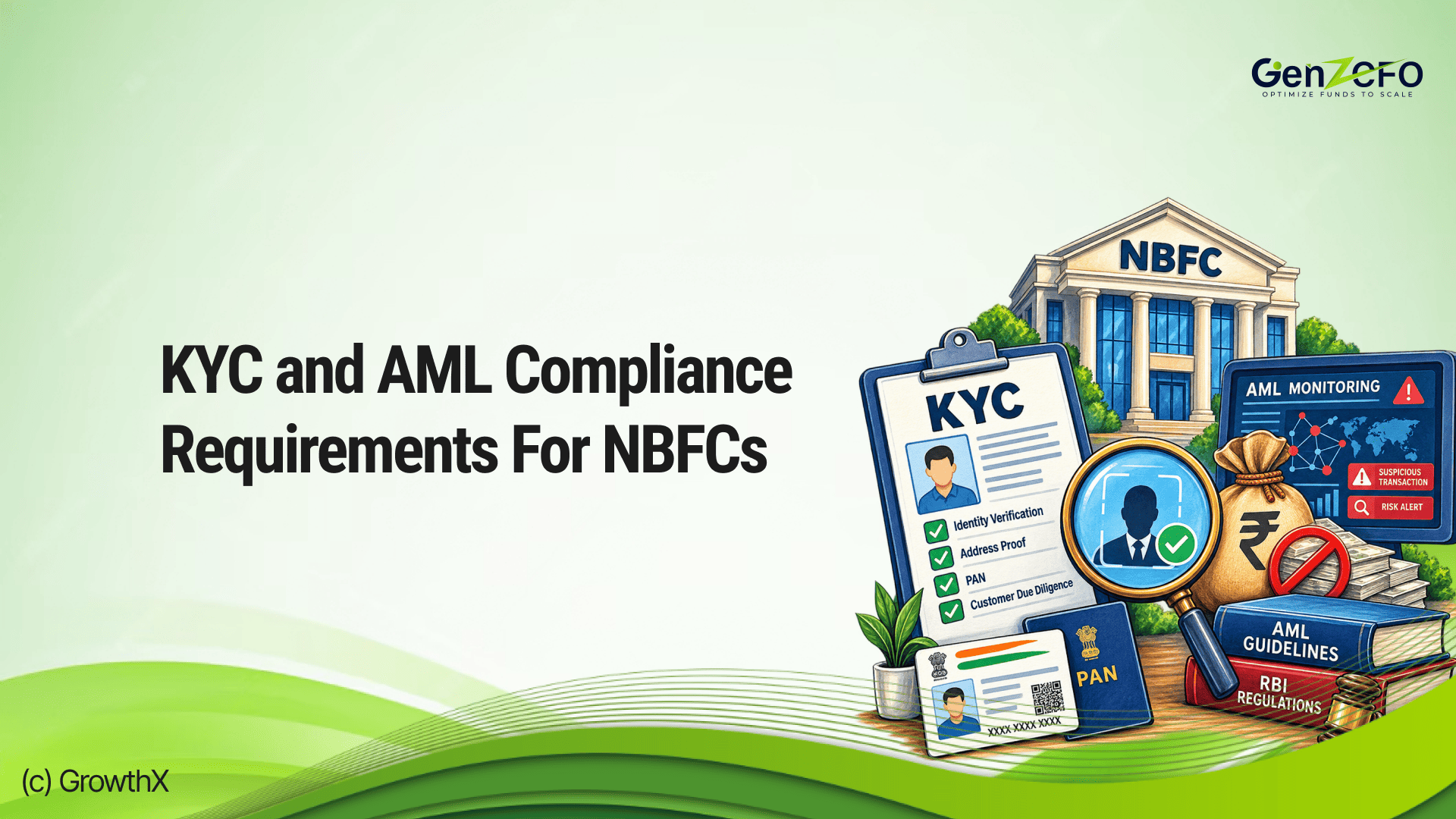
Non-Banking Financial Companies (NBFCs) have become an important part of India's financial system by providing loans, credit facilities, and other financial services to individuals, businesses, and various sectors. With the rapid growth of digital lending and financial transactions, NBFCs face increasing risks related to fraud, identity theft, money laundering, and misuse of financial services.
To address these risks, the Reserve Bank of India (RBI) has made Know Your Customer (KYC) and Anti-Money Laundering (AML) compliance mandatory for NBFCs. These regulations ensure that financial institutions properly verify their customers, understand their financial activities, monitor transactions, and prevent illegal use of financial channels. A strong KYC and AML framework helps NBFCs maintain transparency, protect customer interests, reduce operational risks, and comply with regulatory obligations under the RBI guidelines and the Prevention of Money Laundering Act, 2002 (PMLA).
In this article, CA Manish Mishra talks about KYC and AML Compliance Requirements for NBFCs.
Understanding KYC and AML Compliance for NBFCs
What is KYC Compliance?
Know Your Customer (KYC) is a mandatory process through which NBFCs verify the identity and background information of their customers before providing financial services. The primary objective of KYC compliance is to ensure that NBFCs know who their customers are and that their financial activities are legitimate.
During the KYC process, NBFCs collect and verify essential customer details such as name, address, identity proof, PAN details, business information, and other relevant documents. This process helps prevent fraudulent accounts, impersonation, and misuse of NBFC services. KYC compliance is not limited to customer onboarding; it also includes periodic updating of customer information, reviewing customer risk profiles, and ensuring that records remain accurate throughout the business relationship.
What is AML Compliance?
Anti-Money Laundering (AML) compliance refers to the policies and procedures adopted by NBFCs to detect and prevent money laundering activities and illegal financial transactions. Money laundering involves disguising illegally obtained funds as legitimate income through complex financial transactions.
Under AML requirements, NBFCs must establish systems to identify suspicious activities, monitor customer transactions, maintain proper records, and report suspicious transactions to regulatory authorities. AML compliance helps NBFCs prevent their platforms from being used for activities such as financial fraud, terrorist financing, and movement of illegal funds.
Regulatory Governing KYC and AML Compliance for NBFCs
RBI Master Direction – Know Your Customer (KYC) Direction
The Reserve Bank of India issues detailed KYC guidelines through the Master Direction – Know Your Customer (KYC) Direction. These guidelines provide the compliance framework that NBFCs must follow while establishing customer relationships and conducting financial activities.
The RBI directions specify requirements related to customer identification, due diligence, risk classification, record maintenance, and monitoring of financial transactions. NBFCs are required to develop internal policies and procedures based on these directions to ensure effective implementation. Regular updates issued by RBI require NBFCs to continuously review and modify their compliance systems according to changing regulatory expectations.
Prevention of Money Laundering Act, 2002 (PMLA)
The Prevention of Money Laundering Act, 2002 establishes legal obligations for financial institutions, including NBFCs, to prevent money laundering activities. Under PMLA requirements, NBFCs must verify customer identities, maintain transaction records, monitor suspicious activities, and provide necessary information to authorities whenever required. Compliance with PMLA ensures that NBFCs actively participate in preventing financial crimes and maintain a secure financial environment.
Key KYC Requirements for NBFCs
Customer Identification Process (CIP)
Customer Identification Process is the first step of KYC compliance, where NBFCs verify the identity of customers before establishing any financial relationship. During this process, NBFCs collect customer information and validate documents submitted by customers.
The purpose is to ensure that the person applying for financial services is genuine and that the provided information is accurate. NBFCs cannot open accounts or provide services using anonymous, fictitious, or improperly verified identities. Proper identification reduces the possibility of fraud and financial misuse.
Customer Due Diligence (CDD)
Customer Due Diligence is a detailed verification process through which NBFCs understand their customers and assess the risks associated with them. For individual customers, NBFCs generally verify identity documents, address details, income information, and other relevant details.
For businesses and legal entities, NBFCs examine incorporation documents, ownership details, financial information, and controlling persons. CDD helps NBFCs determine whether the customer's profile matches their financial activities and whether any additional verification is required.
Identification of Beneficial Owner
Beneficial ownership identification is an important requirement when NBFCs deal with companies, partnerships, trusts, or other legal entities. The beneficial owner refers to the individual who ultimately owns, controls, or benefits from the entity.
NBFCs must identify such individuals to understand the actual source of control behind a business structure. This requirement prevents misuse of companies or legal entities for hiding ownership details, transferring illegal funds, or conducting unauthorized financial activities.
Risk-Based Customer Classification
Low-Risk Customers
Low-risk customers are individuals or entities whose identity, background, and financial activities are transparent and easily verifiable. Examples may include salaried individuals with stable income sources and customers having a consistent financial history. Such customers generally require standard KYC procedures without additional investigation.
Medium-Risk Customers
Medium-risk customers require a moderate level of monitoring due to their business nature, transaction volume, or financial profile. NBFCs may conduct additional verification and monitor their activities periodically to ensure that transactions remain consistent with their declared profile.
High-Risk Customers
High-risk customers require enhanced due diligence because their activities may involve higher compliance risks. Examples include politically exposed persons (PEPs), customers having complex ownership structures, or individuals connected with high-risk jurisdictions. NBFCs must perform additional checks, collect more information, and conduct closer monitoring for such customers.
Digital KYC Requirements for NBFCs
Aadhaar-Based Verification
Digital KYC methods have simplified customer onboarding by allowing NBFCs to verify customers electronically. Aadhaar-based authentication can be used according to applicable legal requirements and regulatory permissions. It enables faster verification while reducing paperwork and improving customer convenience.
Video-Based Customer Identification Process (V-CIP)
Video-Based Customer Identification Process allows NBFCs to complete customer verification remotely through a secure video interaction. During V-CIP, NBFC officials verify customer identity documents, record the interaction, and maintain digital records as required under RBI guidelines. This process has become highly useful for digital lending platforms by enabling faster onboarding while maintaining compliance standards.
AML Compliance Requirements for NBFCs
Establishing AML Policies
Every NBFC must create and maintain a comprehensive AML policy approved by senior management. The policy should define procedures for customer acceptance, risk assessment, transaction monitoring, suspicious activity identification, and reporting responsibilities. A properly designed AML policy ensures that employees understand their roles and that compliance activities are performed consistently across the organization.
Appointment of Principal Officer and Designated Director
NBFCs must appoint responsible persons to manage AML compliance requirements. The Principal Officer handles daily AML activities, including monitoring transactions, reviewing suspicious activities, and filing reports with FIU-IND. The Designated Director supervises overall compliance and ensures that the NBFC follows obligations prescribed under PMLA and RBI guidelines.
Transaction Monitoring System
Transaction monitoring is a key part of AML compliance that helps NBFCs identify unusual financial activities. NBFCs must analyse customer transactions to detect patterns such as unusual repayments, sudden increases in loan activity, transactions inconsistent with customer profiles, or movement of funds through suspicious channels. Technology-based monitoring systems help NBFCs analyse large volumes of transactions and identify potential risks effectively.
Record Maintenance Requirements
NBFCs are required to maintain proper records of customer identification documents, transactions, and compliance activities. Maintaining accurate records helps NBFCs during RBI inspections, regulatory reviews, and investigations. Proper record management also ensures that customer information can be retrieved whenever required by authorised authorities.
Role of Technology in KYC and AML Compliance
Technology plays an important role in improving the efficiency and accuracy of KYC and AML processes. NBFCs increasingly use automated verification tools, artificial intelligence-based monitoring systems, digital document management platforms, and fraud detection solutions to strengthen compliance. These technologies help reduce manual errors, improve customer onboarding speed, and enable faster identification of suspicious activities.
Challenges in KYC and AML Compliance for NBFCs
NBFCs face several challenges while implementing KYC and AML requirements, including managing large volumes of customer data, preventing digital fraud, adapting to regulatory changes, and maintaining customer convenience.
With increasing digital lending activities, NBFCs must continuously improve their systems to identify fake identities, fraudulent applications, and suspicious transaction patterns.
Best Practices for Effective KYC and AML Compliance
NBFCs should regularly review their compliance policies, conduct employee training programs, perform internal audits, strengthen customer verification procedures, and adopt advanced technology solutions. A proactive compliance approach helps NBFCs reduce regulatory risks and build customer confidence.
Conclusion
KYC and AML compliance are essential components of responsible NBFC operations. These regulations not only help NBFCs meet RBI and PMLA requirements but also protect them from financial fraud, regulatory penalties, and reputational risks.
By implementing strong customer identification procedures, maintaining effective transaction monitoring systems, and regularly updating compliance frameworks, NBFCs can create a secure and transparent financial environment. A robust KYC and AML framework ultimately supports sustainable growth and strengthens trust between NBFCs, customers, and regulators.
Frequently Asked Questions (FAQs)
Q1. What is KYC compliance for NBFCs?
Ans. KYC compliance refers to the process through which NBFCs verify the identity and background details of their customers before providing financial services. It includes customer identification, document verification, risk assessment, and periodic updating of customer information as per RBI guidelines.
Q2. Why is KYC mandatory for NBFCs?
Ans. KYC is mandatory for NBFCs to prevent fraud, identity theft, money laundering, and misuse of financial services. It helps NBFCs establish the identity of customers, understand their financial activities, and ensure that business relationships are maintained with genuine individuals and entities.
Q3. What is AML compliance in NBFCs?
Ans. AML (Anti-Money Laundering) compliance refers to the policies and procedures followed by NBFCs to detect, prevent, and report suspicious financial activities. It helps prevent illegal fund transfers, money laundering, terrorist financing, and other financial crimes.
Q4. Which regulations govern KYC and AML compliance for NBFCs?
Ans. KYC and AML compliance for NBFCs are governed mainly by the RBI Master Direction – Know Your Customer (KYC) Direction, Prevention of Money Laundering Act, 2002 (PMLA), and reporting requirements issued by the Financial Intelligence Unit – India (FIU-IND).
Q5. What documents are required for KYC verification by NBFCs?
Ans. NBFCs generally require officially valid documents such as PAN, Aadhaar, passport, voter ID, driving licence, address proof, and other relevant documents. For businesses, incorporation documents, ownership details, and beneficial ownership information may also be required.
Q6. What is Customer Due Diligence (CDD) in NBFC compliance?
Ans. Customer Due Diligence is a detailed verification process used by NBFCs to understand customer identity, business activities, ownership structure, and financial profile. CDD helps NBFCs assess risks and ensure that customers are not involved in suspicious financial activities.
Q7. What is the role of a Principal Officer in NBFC AML compliance?
Ans. The Principal Officer is responsible for managing AML-related activities within an NBFC. The officer monitors transactions, reviews suspicious activities, ensures regulatory reporting, and coordinates with authorities such as FIU-IND for compliance-related matters.
Q8. What is a Suspicious Transaction Report (STR)?
Ans. A Suspicious Transaction Report (STR) is a report submitted by NBFCs to FIU-IND when they identify transactions that appear unusual or suspicious. Such reporting helps authorities investigate possible cases of money laundering or financial crimes.
Q9. What is beneficial ownership identification in KYC?
Ans. Beneficial ownership identification involves determining the individual who ultimately owns or controls a legal entity. NBFCs must identify beneficial owners of companies, partnerships, and trusts to prevent misuse of business structures for hiding illegal activities.
Q10. Can NBFCs conduct digital KYC verification?
Ans. Yes, NBFCs can conduct digital KYC through permitted methods such as Aadhaar-based verification and Video-Based Customer Identification Process (V-CIP). These methods allow faster customer onboarding while ensuring compliance with RBI requirements.
- 01 Sep, 2026
 CA Manish Mishra
- Corporate Actions
CA Manish Mishra is the Co-Founder & CEO at GenZCFO. He is the most sought professional for providing virtual CFO services to startups and established businesses across diverse sectors, such as retail, manufacturing, food, and financial services with over 20 years of experience including strategic financial planning, regulatory compliance, fundraising and M&A.