Search GrowthX Learning Content


Minimum Corpus and Investment Requirements for AIFs
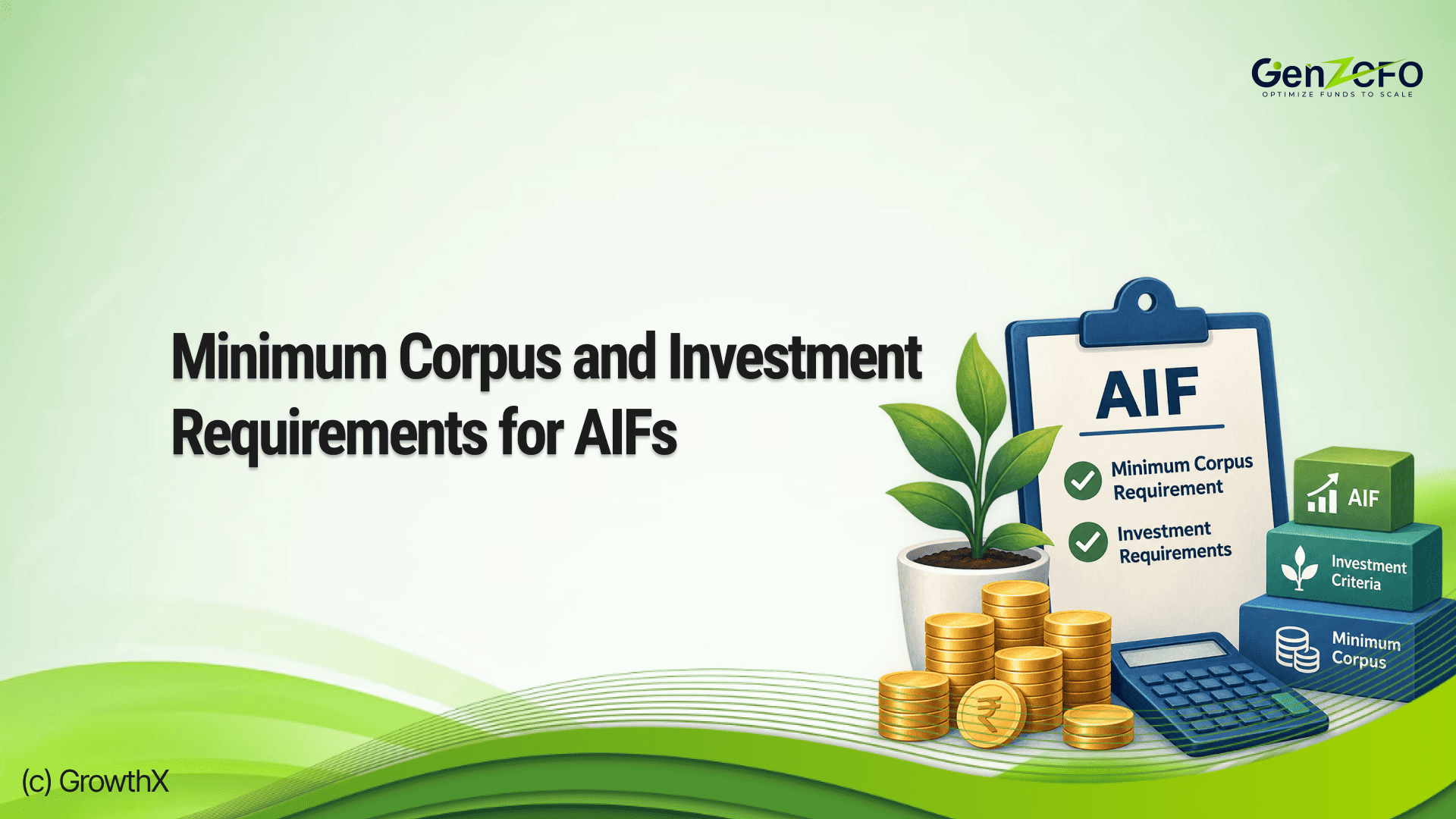
Alternative Investment Funds (AIFs) pool money from investors and invest it according to a defined strategy. In India, they are regulated by the Securities and Exchange Board of India (SEBI). Anyone planning to establish or invest in an AIF must understand three separate financial requirements: the minimum corpus of a scheme, the minimum investment accepted from an investor, and the continuing investment required from the manager or sponsor.
These requirements apply at different levels. A fund may have enough total commitments to satisfy its corpus requirement, but an individual investor’s commitment could still fall below the permitted minimum. Similarly, meeting both thresholds does not remove the manager’s or sponsor’s obligation to maintain its own investment in the fund.
In this article, CA Manish Mishra talks about Minimum Corpus and Investment Requirements for AIFs.
What Is the Corpus of an AIF?
The corpus of an AIF is the total amount investors have committed to contribute under written agreements or similar documents. It is based on commitments, so the entire amount does not necessarily have to be deposited with the fund immediately. For example, if ten investors each commit ₹2 crore, the committed corpus is ₹20 crore even if the manager has initially collected only part of that amount.
AIFs often collect committed money through capital calls or drawdowns when investments are ready to be made. The manager must therefore keep clear records of both the commitments received and the money actually collected. Corpus should also be distinguished from investible funds, which broadly refers to the corpus after estimated administration and management expenses.
Minimum Corpus Required for an AIF Scheme
As a general rule, each AIF scheme must have a corpus of at least ₹20 crore. The requirement applies to each scheme separately. If an AIF operates two schemes, it cannot combine their commitments to show that a scheme with less than the required corpus meets the threshold. For example, if Scheme A has commitments of ₹25 crore and Scheme B has commitments of ₹15 crore, Scheme B does not meet the general ₹20 crore minimum merely because the two schemes together have raised ₹40 crore.
The manager must plan fundraising and assess compliance for each scheme on its own. The ₹20 crore requirement is a regulatory minimum, not necessarily the amount a fund needs to carry out its strategy effectively. A fund planning investments across many businesses, follow-on funding or a long investment period may set a substantially higher target corpus.
Minimum Investment Required from Each Investor
The general minimum investment accepted from an investor in an ordinary AIF scheme is ₹1 crore. This requirement applies to the investor’s commitment and is separate from the scheme’s ₹20 crore corpus requirement. A scheme cannot accept a smaller commitment from an investor simply because its overall corpus exceeds ₹20 crore, unless an applicable exception permits it.
A ₹1 crore commitment does not necessarily mean that the investor must pay the entire amount at once. The contribution agreement may allow the manager to call the money in instalments. For instance, an investor could commit ₹1 crore and initially contribute only the portion requested under the first capital call. The agreement should clearly state the payment terms and the consequences of failing to meet later calls.
Investment by Employees and Directors
A lower minimum investment of ₹25 lakh applies to eligible employees or directors of the AIF and employees or directors of its manager. This exception allows qualifying people associated with the fund or its management to participate with a smaller commitment.
The exception is based on the investor’s qualifying role. It is not a general ₹25 lakh investment option for other individuals, advisers or associates. Before accepting a commitment under this provision, the manager should verify and document the investor’s eligibility.
Investment by Accredited Investors
The ordinary ₹1 crore minimum does not apply in the same way to an investor who qualifies as an accredited investor under SEBI’s framework. Accredited status must be established through the applicable verification process. An investor should not be treated as accredited merely because they have substantial wealth or investment experience.
This distinction is especially relevant when an AIF proposes to accept a smaller commitment from an accredited investor or establish a specialised structure for accredited investors. The manager must check both the investor’s status and the rules applicable to the particular scheme.
Continuing Investment by the Manager or Sponsor
The manager or sponsor must maintain an investment in the AIF. For a Category I or Category II AIF, the general requirement is 2.5% of the corpus or ₹5 crore, whichever is lower. For a Category III AIF, it is 5% of the corpus or ₹10 crore, whichever is lower. This requirement must be met through an actual investment in the AIF. The manager cannot replace it by waiving its management fee. Its investment must also be disclosed to the fund’s investors.
For example, if a Category II scheme has a corpus of ₹20 crore, 2.5% amounts to ₹50 lakh. Since that is lower than ₹5 crore, the general continuing-interest requirement would be ₹50 lakh. If the same type of scheme has a corpus of ₹300 crore, 2.5% would be ₹7.5 crore, so the ₹5 crore cap would apply. The manager should recalculate the requirement where relevant and check for any provisions specific to its fund.
Requirements Across AIF Categories
AIFs are broadly classified into Category I, Category II and Category III. Category I includes specified strategies such as venture capital, infrastructure, SME and social impact investing. Category II commonly includes private equity and debt strategies that do not fall under Category I or III. Category III includes funds that may use more complex trading strategies.
For an ordinary scheme in any of these categories, the starting point is generally a ₹20 crore minimum corpus and a ₹1 crore minimum investment per investor, subject to the available exceptions. A notable difference is the continuing-interest requirement: Category III has a higher percentage and rupee cap than Categories I and II. Specialised funds, including angel funds, certain Social Impact Funds and Large Value Funds, require a separate review of their specific conditions.
Special Requirements for Angel Funds
Angel funds operate under a distinct framework. Older descriptions of a fixed ₹5 crore corpus and a ₹25 lakh minimum investment for angel investors should not be used without checking the revised rules. Under the framework introduced in 2025, angel funds focus on participation by accredited investors and must onboard at least five accredited investors before declaring their first close. This replaced the earlier fixed minimum-corpus approach.
For a proposed angel fund, the manager must therefore consider who its investors are, whether their accreditation has been verified, and whether the conditions for first close have been satisfied. Existing angel funds must also consider the applicable transition arrangements and subsequent timeline relaxation. It is important to distinguish an investor’s contribution to an angel fund from the amount the angel fund invests in a startup. These are separate transactions with separate regulatory conditions.
Minimum Investment in Social Impact Funds
A Social Impact Fund is a Category I AIF focused on eligible social-purpose investments. A specific exception allows an individual to invest a smaller amount where the fund invests only in securities of Not for Profit Organisations registered or listed on a Social Stock Exchange. In that qualifying situation, the minimum investment by an individual was reduced in 2026 from ₹2 lakh to ₹1,000.
This exception has a narrow scope. It does not mean that every Social Impact Fund can accept ₹1,000 from every investor. The fund’s investments and the investor’s status must meet the conditions of the provision. The scheme must also comply with its other applicable AIF requirements.
Large Value Funds for Accredited Investors
A Large Value Fund for Accredited Investors, or LVF, is a specialised AIF structure intended for accredited investors making substantial commitments. The minimum investment for an eligible investor is ₹25 crore, reduced from the earlier ₹70 crore threshold.
The ₹25 crore figure is an investor-level requirement for this type of fund. It should not be confused with the general minimum corpus of an ordinary AIF scheme. The manager must verify accreditation and assess the conditions attached to the LVF structure. The treatment of investments by the manager, sponsor and certain employees or directors should also be checked when preparing the scheme documents.
How Commitments, First Close and Drawdowns Work
AIFs generally raise commitments before collecting all the money promised by investors. Once the initial investors have been accepted and the applicable conditions are met, the manager may declare the scheme’s first close. It can then collect committed capital through drawdowns in accordance with the contribution agreements.
Suppose a scheme has signed commitments totalling ₹30 crore but has collected only ₹6 crore through its first capital call. Its committed corpus and available cash are different figures. Informal interest from potential investors should not be counted as a commitment. The manager must also monitor defaults, withdrawals where permitted, and changes to commitments because they may affect the scheme’s compliance with applicable thresholds.
Planning the Requirements Before Launch
Before launching a scheme, the manager should identify its AIF category, investment strategy and intended investors. It should then assess the requirements at three levels: whether the scheme meets the applicable corpus threshold, whether each investor meets the applicable investment minimum, and whether the manager or sponsor will maintain the required continuing interest.
The placement memorandum and contribution agreements should accurately describe the target corpus, minimum commitment and drawdown terms. Where an investor relies on an exception, such as employee status or accreditation, the manager should verify that status before accepting the investment. These checks should continue after launch if commitments or investor circumstances change.
Conclusion
For an ordinary AIF scheme in India, the principal starting requirements are a minimum corpus of ₹20 crore and a general minimum investment of ₹1 crore per investor. The manager or sponsor must separately maintain its prescribed investment in the fund. The amount depends on the AIF category and the scheme’s corpus.
These figures require careful application. Accredited investors, eligible employees and directors, angel funds, qualifying Social Impact Funds and Large Value Funds are subject to important exceptions or additional conditions. The proposed structure and scheme documents should therefore be reviewed against the current rules before fundraising begins or an investor’s commitment is accepted.
Frequently Asked Questions (FAQ’s)
Q1. What is the minimum corpus required for an AIF in India?
Ans. An ordinary AIF scheme must generally have a minimum corpus of ₹20 crore. The requirement applies to each scheme separately. If an AIF launches multiple schemes, commitments raised for one scheme cannot simply be combined with another scheme’s commitments to meet its minimum.
Q2. Does the entire ₹20 crore have to be collected before the scheme starts investing?
Ans. Corpus is based on the amount investors have committed under the fund documents, which may differ from the cash already collected. An AIF can call committed money through drawdowns according to its agreements. The manager must still satisfy the applicable conditions for the scheme and its first close before beginning operations.
Q3. What is the minimum investment required from an individual investor?
Ans. The general minimum investment in an ordinary AIF scheme is ₹1 crore per investor. Certain exceptions apply, including those for eligible employees or directors and accredited investors. The manager must confirm that an exception applies before accepting a smaller commitment.
Q4. Can an investor commit ₹1 crore but pay it in instalments?
Ans. Yes. An investor’s commitment can be ₹1 crore even when the manager collects the money through capital calls over time. The contribution agreement should specify when payments may be requested and what happens if the investor fails to pay an instalment.
Q5. What is the minimum investment for employees or directors of an AIF?
Ans. Eligible employees or directors of the AIF, and employees or directors of its manager, may invest a minimum of ₹25 lakh. This lower amount is available only where the investor meets the specified eligibility conditions. It is not a general minimum for all people connected with the fund.
Q6. Do accredited investors have to invest at least ₹1 crore?
Ans. The general ₹1 crore minimum does not apply to accredited investors in the same way as it applies to ordinary investors. The investor must, however, hold valid accredited status under the applicable framework, and the manager must check the conditions of the particular scheme before accepting the commitment.
Q7. How much must the manager or sponsor invest in an AIF?
Ans. For a Category I or Category II AIF, the general continuing-interest requirement is 2.5% of the corpus or ₹5 crore, whichever is lower. For a Category III AIF, it is 5% of the corpus or ₹10 crore, whichever is lower. This must be an investment in the fund; waiving management fees does not satisfy the requirement.
Q8. Is the minimum corpus for an angel fund also ₹20 crore?
Ans. Angel funds operate under a separate framework. Under the revised rules, an angel fund must onboard at least five accredited investors before declaring its first close, rather than relying on the earlier fixed minimum-corpus approach. Managers should also check the transition provisions applicable to an existing angel fund.
Q9. Can someone invest ₹1,000 in a Social Impact Fund?
Ans. An individual may invest a minimum of ₹1,000 under a specific exception for a Social Impact Fund that invests only in securities of Not for Profit Organisations registered or listed on a Social Stock Exchange. The amount is not a general entry threshold for every Social Impact Fund.
Q10. What is the minimum investment in a Large Value Fund for Accredited Investors?
Ans. The minimum investment for an eligible investor in a Large Value Fund for Accredited Investors (LVF) is ₹25 crore. The investor must also meet the accreditation requirement. This investor-level threshold should be considered alongside the fund’s other applicable conditions.
- 24 Sep, 2026
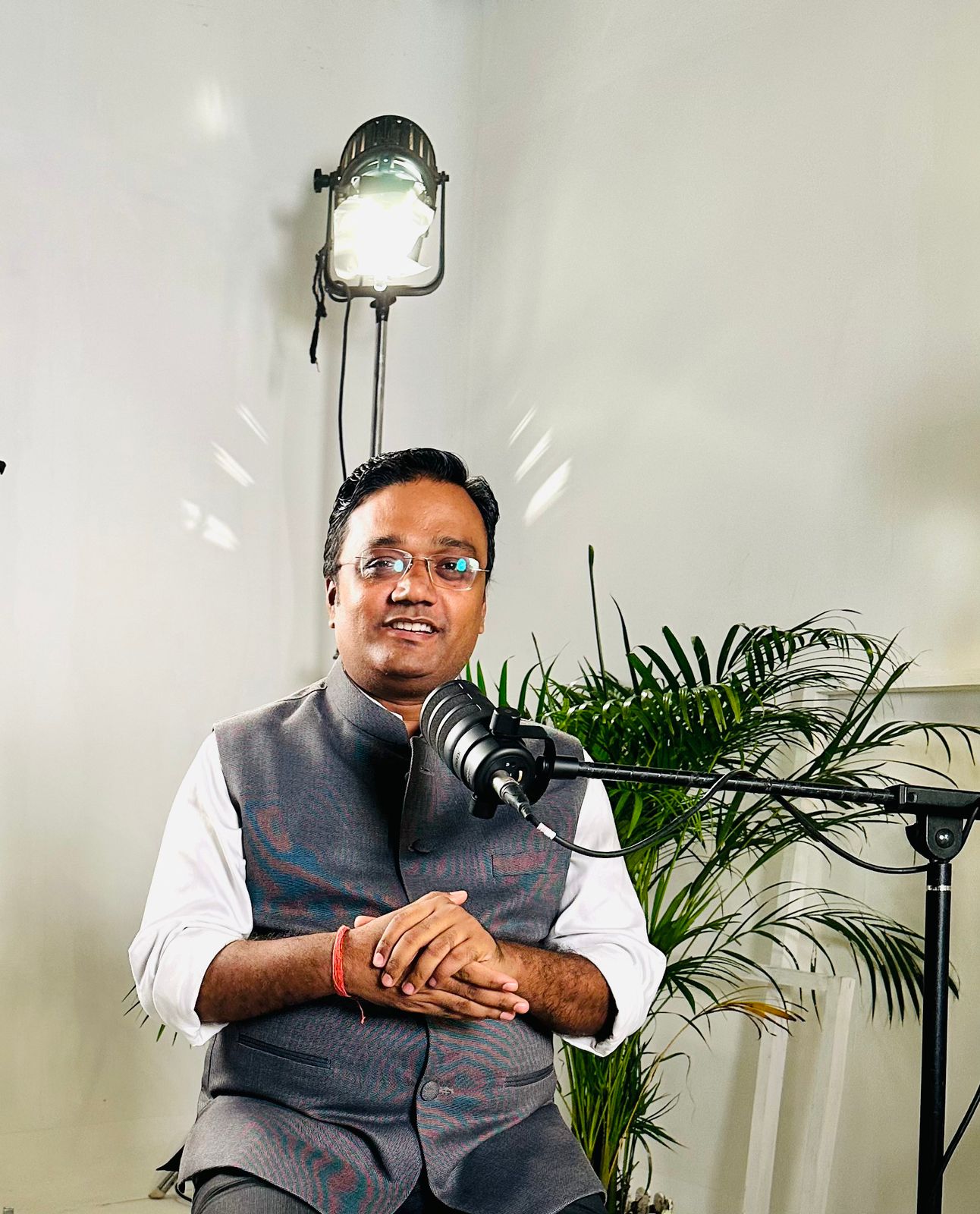 CA Manish Mishra
- Easing Finance
CA Manish Mishra is the Co-Founder & CEO at GenZCFO. He is the most sought professional for providing virtual CFO services to startups and established businesses across diverse sectors, such as retail, manufacturing, food, and financial services with over 20 years of experience including strategic financial planning, regulatory compliance, fundraising and M&A.