Search GrowthX Learning Content


45 Days That Never End: Reforming MSME Payment Delays
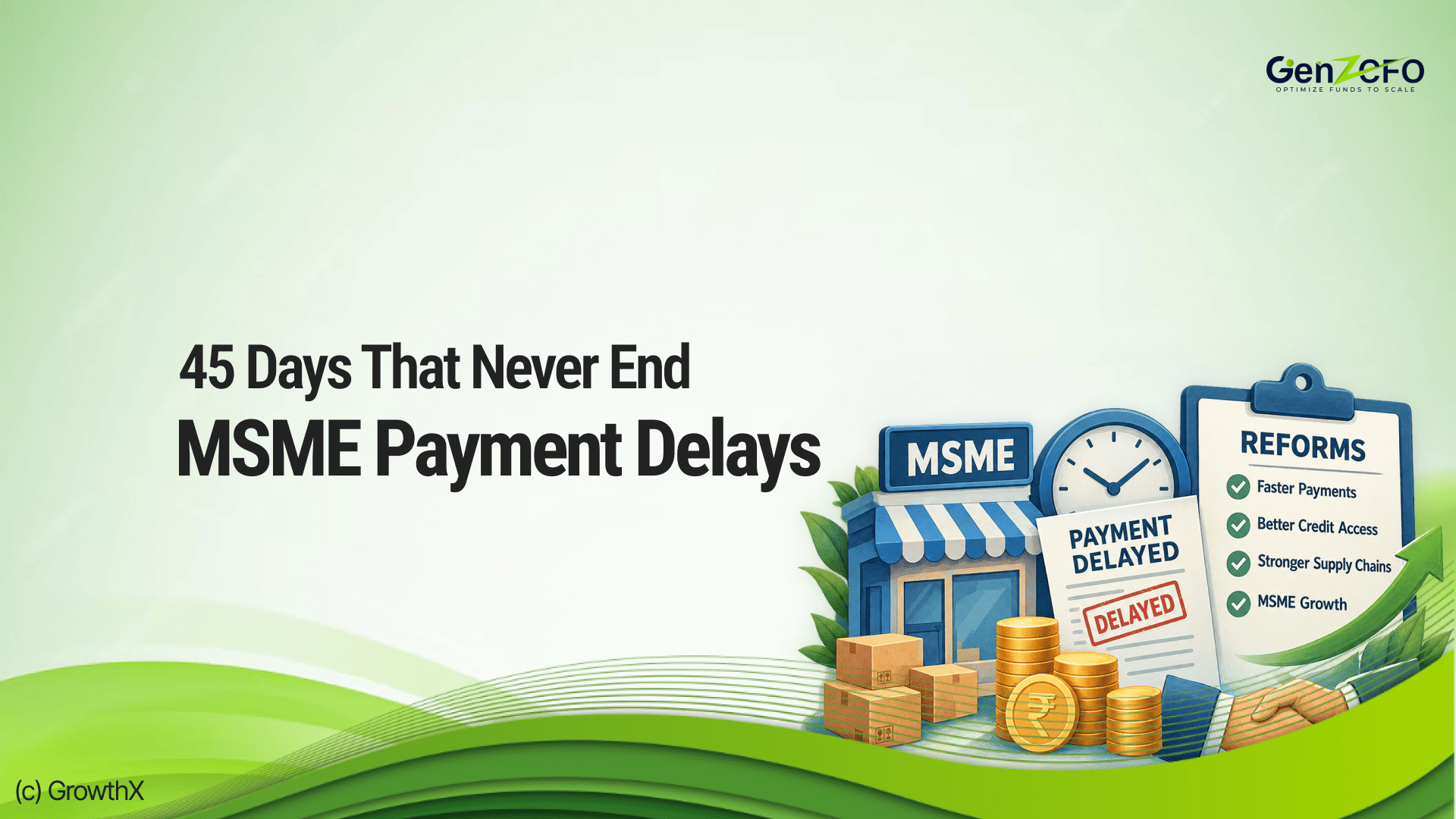
Micro, Small and Medium Enterprises (MSMEs) constitute the backbone of India’s economy, playing a pivotal role in driving employment, fostering innovation and contributing substantially to the nation’s economic growth. These enterprises operate across manufacturing, services and trade, generating employment while supporting larger industries through extensive supply chains. By encouraging entrepreneurship at the grassroots level, MSMEs also contribute to inclusive growth and regional development.
In this context, ensuring timely payments to MSME suppliers is critical for sustaining their operations, maintaining liquidity and improving overall business resilience. When payments flow on time, businesses can invest in technology, develop their workforce, expand capacity and take on new opportunities. When payments are delayed, the impact can extend across the entire supply chain.
In this article, Pankaj Dadhich discusses MSME payment delays, the 45-day payment framework, existing mechanisms, and reforms to strengthen timely payments.
The 45-Day Payment Framework for MSMEs
The legislative foundation for protecting MSME interests in payment matters is well established through the Micro, Small and Medium Enterprises Development (MSMED) Act, 2006. The Act provides specific timelines for payments to Micro and Small Enterprises. Where there is no written agreement, payment should be made within 15 days from the date of acceptance or deemed acceptance of goods or services. Where a written agreement exists, the agreed payment period cannot exceed 45 days from the date of acceptance or deemed acceptance.
The law also provides for compound interest with monthly rests at three times the bank rate notified by the Reserve Bank of India in cases of delayed payment. These provisions are intended to ensure that MSMEs are not forced to carry the financial burden of delayed payments for extended periods. For a business operating with limited working capital, receiving an invoice payment on time can directly affect its ability to pay employees, suppliers, lenders and other operating expenses.
Section 43B(h) Adds a Tax Dimension
The delayed payment issue is not limited to the MSMED Act. Section 43B(h) of the Income Tax Act, introduced through the Finance Act, 2023, adds a tax consequence for payments due to Micro and Small Enterprises.
Broadly, where a buyer fails to make payment within the period prescribed under Section 15 of the MSMED Act, the related expenditure may not be allowed as a deduction for tax purposes in the relevant year. The deduction becomes available in the year in which the payment is actually made, subject to the applicable provisions.
This has made MSME payment tracking an important issue for finance and accounts teams. Businesses now need to look beyond outstanding invoices and assess whether their payment timelines could have tax implications. As a result, MSME vendor classification, invoice tracking and payment reconciliation should form part of regular financial controls rather than being addressed only at the end of the financial year.
MSME Samadhaan: A Digital Mechanism for Delayed Payment Claims
The government introduced the MSME Samadhaan Portal in 2017 to provide Micro and Small Enterprises with a structured mechanism for raising delayed payment claims. The portal allows eligible enterprises to file applications relating to delayed payments and track the progress of their cases. These matters can be taken up by the Micro and Small Enterprises Facilitation Councils, or MSEFCs.
The scale of applications shows the extent of the issue. According to the Ministry of MSME Annual Report 2025-26, up to 31 December 2025, 2,56,892 applications had been filed by MSEs involving approximately ₹55,244.31 crore. Of these, 24,238 cases had been resolved through mutual settlements involving around ₹3,018.37 crore, while 53,911 cases had been disposed of by MSEFCs involving approximately ₹14,638.38 crore.
The government has also introduced an Online Dispute Resolution mechanism for delayed payment cases, with new cases being filed through the ODR portal from October 2025. These developments indicate a gradual shift towards technology-enabled dispute resolution. However, the continued volume of applications also shows that delayed payments remain a significant business issue.
Why Delayed Payments Continue to Be a Challenge
The legal framework provides a clear payment timeline, but implementation can become complicated in actual business transactions. Disputes may arise over the date of acceptance of goods or services, incomplete documentation, quality issues, purchase order terms, invoice reconciliation or internal approval processes. In some cases, suppliers may also hesitate to pursue claims against large customers because of concerns about commercial relationships. This creates a gap between the statutory payment timeline and actual business practices.
For an MSME, the consequences can be significant. A delayed ₹10 lakh receivable, for example, may require the business to borrow additional funds to meet its immediate working capital requirements. The cost of financing then becomes an indirect consequence of the buyer's delayed payment.
This is why improving payment discipline requires more than simply creating another dispute resolution mechanism. The system needs to identify and address payment delays earlier.
Reforms That Can Make MSME Payments More Efficient
One promising approach is deeper integration between invoice tracking, GST systems and digital invoicing. If relevant transaction information can be connected, businesses could establish a clearer digital trail covering invoice issuance, delivery, acceptance, payment due date and actual settlement. Such integration could also reduce disputes about when the payment clock begins.
Another useful reform would be an automated interest calculation mechanism within the Samadhaan framework. If the system can identify the applicable payment date and calculate delayed payment interest automatically, it could reduce manual calculations and disagreements between buyers and suppliers. Greater transparency can also encourage better payment behaviour. Large companies and Public Sector Undertakings could publish payment performance through digital dashboards, showing indicators such as average payment time and outstanding MSME dues. Public visibility of payment practices could create an additional incentive for businesses to improve their payment discipline.
Clearer electronic contracts would also help. Payment terms, acceptance conditions and statutory requirements should be clearly documented at the beginning of a commercial relationship. This can reduce disputes later.
Pre-litigation mediation can provide another layer of support. Mediation cells through appropriate institutional mechanisms could help buyers and suppliers resolve issues involving documentation, reconciliation or acceptance before they develop into prolonged proceedings.
The MSEFC system could also benefit from stronger time-bound case management and better digital tracking. Faster disposal would improve the usefulness of the mechanism for businesses that are already facing cash flow pressure.
Learning From International Payment Practices
International experience provides several useful reference points for India. The United Kingdom's Prompt Payment Code focuses on encouraging responsible payment practices through transparency and recognition of businesses that maintain strong payment records. The European Union's Late Payment Directive provides a framework for interest and compensation in cases of delayed commercial payments.
Singapore's PEPPOL-based e-invoicing framework has helped create a more connected digital invoicing environment. Australia uses payment reporting requirements for large businesses to improve transparency around payment practices, while New Zealand has adopted shorter payment timelines for government departments.
These examples highlight the value of combining digital systems with transparency and time-bound processes. India can adapt relevant elements of these approaches to its own regulatory and commercial environment.
TReDS Can Help Address the Working Capital Gap
Improving payment discipline is one part of the solution. MSMEs also need access to liquidity while they wait for buyers to settle their invoices. The Trade Receivables Discounting System, or TReDS, provides an important mechanism for this purpose. Through TReDS, eligible receivables can be discounted, allowing MSMEs to access funds before the buyer's original payment date.
Greater adoption of TReDS can help reduce the working capital pressure caused by long payment cycles. Awareness among MSME entrepreneurs, wider participation by buyers and smoother onboarding can further strengthen its use. TReDS should therefore be viewed as a complementary solution. Faster payments address the underlying problem, while receivables financing can help businesses manage liquidity during the period before payment.
What Businesses Can Do Now
The responsibility for improving payment discipline does not rest with policymakers alone. Buyers and MSMEs can both strengthen their internal processes. For MSMEs, maintaining proper documentation is particularly important. Businesses should keep their Udyam registration details, purchase orders, invoices, delivery records, acceptance documents, and payment follow-ups properly organised. These records can become important if a payment dispute arises.
Buyers should identify Micro and Small Enterprise suppliers in their vendor records and regularly review outstanding invoices. Finance teams should monitor statutory payment timelines and assess the implications of Section 43B(h) while closing accounts. A simple internal payment dashboard can help businesses track invoices approaching their statutory due dates and identify overdue amounts before they become disputes.
The Economic Impact of Faster MSME Payments
The benefits of improving payment discipline extend beyond individual businesses. Faster payments can release working capital into the MSME ecosystem, reduce dependence on expensive short-term borrowing and improve the ability of businesses to invest in technology, capacity and employees.
Stronger payment discipline can also improve relationships between large buyers and smaller suppliers. When suppliers have greater confidence in their cash flows, they can plan production and expansion more effectively. At an economy-wide level, reducing payment delays can strengthen supply chains, support employment and help MSMEs participate more effectively in domestic and international markets. Estimates of the potential working capital that could be unlocked through better payment discipline vary, but the underlying economic opportunity is significant.
From a 45-Day Rule to a 45-Day Payment Culture
India has already established a legal framework for protecting Micro and Small Enterprises from prolonged payment delays. The MSMED Act, MSME Samadhaan, MSEFCs, Section 43B(h) and TReDS provide important building blocks.
The next challenge is implementation. The 45-day limit should not become a deadline that businesses remember only after an invoice becomes overdue. It should become part of routine accounts payable and receivables management.
Technology can help track payment timelines. Digital contracts can reduce disputes. Automated interest calculations can improve transparency. TReDS can provide liquidity. Mediation can help resolve disputes earlier. Better monitoring can strengthen accountability. Together, these measures can help shift the system from reacting to delayed payments towards preventing them.
Conclusion
Timely payments are more than a compliance requirement. They are an important part of MSME financial stability and supply chain efficiency. The existing framework provides several mechanisms to address delayed payments, but its effectiveness depends on how efficiently these mechanisms work in practice. Greater digital integration, faster dispute resolution, better payment transparency and wider adoption of receivables financing can make the ecosystem more responsive.
For MSMEs, timely payment means better cash flow and greater business certainty. For buyers, it supports stronger supplier relationships. For the wider economy, it can release working capital and strengthen supply chains. The objective should be simple: the 45-day statutory promise should translate into actual payment discipline, rather than another cycle of invoices, follow-ups, and disputes.
Frequently Asked Questions (FAQs)
Q1. What is the maximum payment period for MSMEs?
Ans. Where a written agreement exists, the payment period cannot exceed 45 days from the date of acceptance or deemed acceptance of goods or services. Where there is no written agreement, payment is generally required within 15 days.
Q2. What happens if a buyer delays payment to an MSME?
Ans. The MSMED Act provides for compound interest with monthly rests at three times the bank rate notified by the RBI on delayed payments to eligible Micro and Small Enterprises.
Q3. Does Section 43B(h) apply to all MSMEs?
Ans. Section 43B(h) specifically concerns payments due to Micro and Small Enterprises covered by the relevant provisions of the MSMED Act. It does not apply simply because a supplier falls under the broader MSME category.
Q4. What is the MSME Samadhaan Portal?
Ans. MSME Samadhaan is a government platform that allows eligible Micro and Small Enterprises to file delayed payment claims and track their cases through the applicable dispute resolution mechanism.
Q5. How can an MSME recover delayed payments?
Ans. An eligible Micro or Small Enterprise can use the MSME Samadhaan mechanism and approach the appropriate Micro and Small Enterprises Facilitation Council (MSEFC), subject to the applicable requirements.
Q6. What is TReDS and how does it help MSMEs?
Ans. TReDS, or Trade Receivables Discounting System, allows eligible MSMEs to discount their trade receivables and access funds before the buyer's payment due date. It can help reduce working capital pressure caused by delayed payments.
Q7. How can businesses prevent MSME payment disputes?
Ans. Businesses can reduce disputes by maintaining clear contracts, purchase orders, invoices, delivery records and acceptance documentation. Buyers should also regularly monitor outstanding invoices and statutory payment timelines.
Q8. Why are timely MSME payments important for the economy?
Ans. Timely payments improve MSME cash flow, reduce dependence on short-term borrowing and help businesses invest in production, technology, employees and expansion. Better payment discipline can also strengthen wider supply chains.
- 29 Sep, 2026
 Pankaj Dadhich
- Easing Finance
Pankaj Dadhich is the Chief Manager (Research) at the Centre of Excellence for MSME, State Bank Academy, Gurugram. He has over 14 years of experience in General Banking, Agriculture Credit, SME Credit and Research. He holds an MBA (Finance), PGDFA, PGDLFS and CAIIB, along with certifications in Commercial Credit, SME Credit, Foreign Exchange, KYC, AML-CFT, IT Security and Fraud Management.