Search GrowthX Learning Content


AIF Registration Process and SEBI Approval Timeline
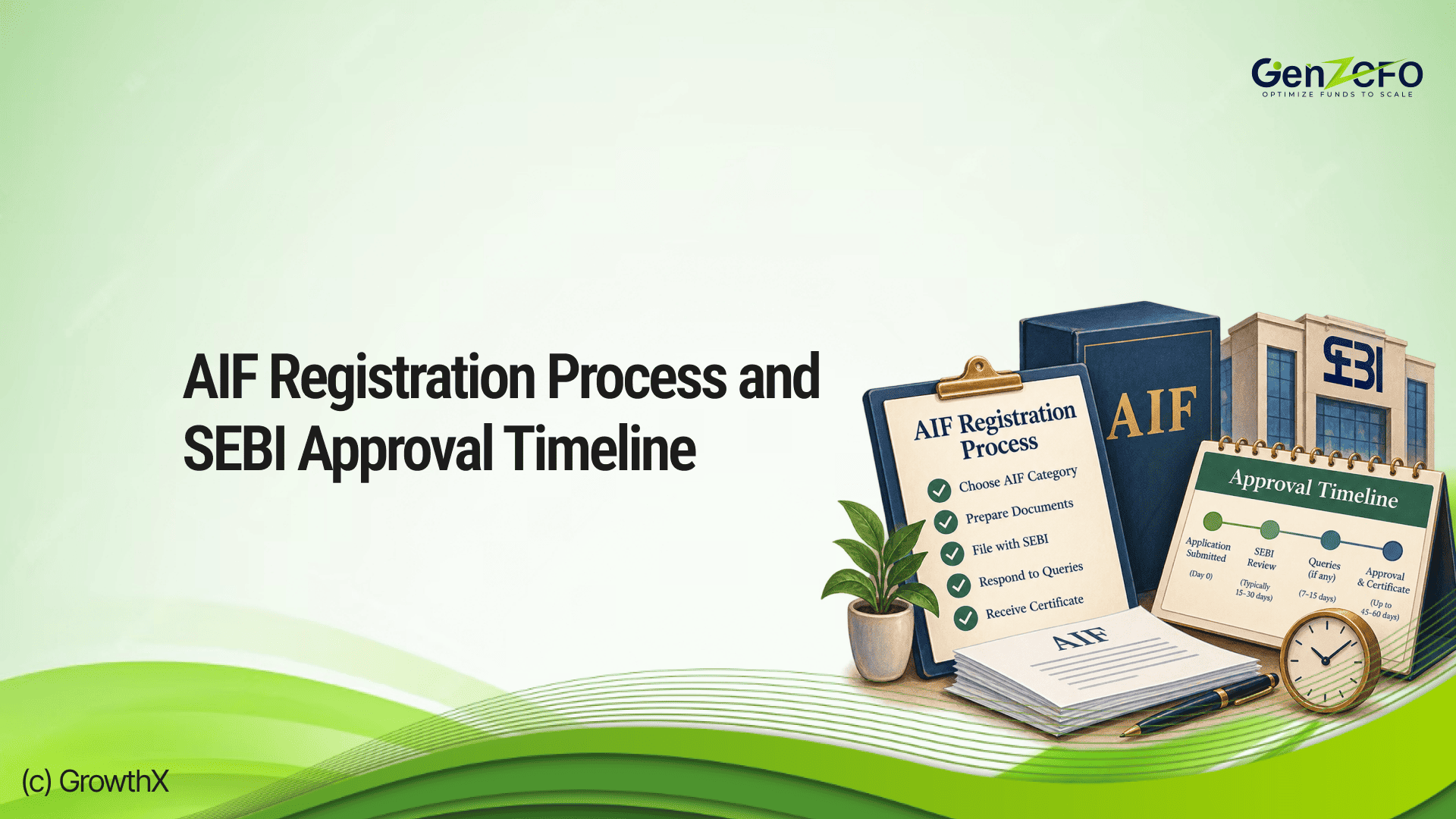
An Alternative Investment Fund (AIF) pools capital from investors and invests it according to a defined strategy. In India, a proposed AIF must obtain registration from the Securities and Exchange Board of India (SEBI) under the SEBI (Alternative Investment Funds) Regulations, 2012. The applicant must choose a suitable category and legal structure, such as a trust, company or limited liability partnership. These decisions shape the fund’s investment rules, governance and the documents it must submit for review.
Registration is one stage in bringing a fund to market. The applicant must also identify a sponsor and investment manager, demonstrate that they meet the applicable requirements, and prepare accurate disclosures. Its first scheme needs a private placement memorandum (PPM) explaining the strategy, risks, fees and investor terms. SEBI’s review may involve questions and revised documents, so the approval timeline depends on how complete and consistent the application is when filed and how promptly the applicant responds.
In this article, CA Manish Mishra talks about AIF Registration Process and SEBI Approval Timeline.
Understanding AIF Categories
SEBI registers AIFs under three broad categories. Category I generally covers funds investing in sectors or activities considered socially or economically desirable, such as venture capital, infrastructure and social impact strategies. Category II includes funds whose strategies do not fall under Category I or III; private equity and private credit funds commonly fall here. Category III covers funds that may employ complex trading strategies and permitted leverage.
The category must reflect the fund’s actual investment approach. It affects the applicable investment rules, scheme structure, disclosures and registration fee. Applicants should therefore settle their strategy before drafting the application. A mismatch between the category selected in Form A and the strategy described in the PPM is likely to invite clarification.
Who Can Apply for AIF Registration?
An AIF may be set up as a trust, company, limited liability partnership (LLP) or body corporate. Its constitutive document must allow it to conduct the proposed AIF activity and raise funds through private placement rather than a public invitation. The application must identify the fund’s sponsor, investment manager and, where applicable, trustee. SEBI examines their ownership, control, financial capacity, regulatory history and ability to carry out their respective responsibilities. The applicant must also provide information about its key investment personnel and demonstrate that it has suitable resources and infrastructure.
Many applicants choose a trust structure, but the right structure depends on the proposed governance, investor arrangements and operational needs. This decision should be made early because it determines which documents must be executed and who must sign the registration undertakings.
Eligibility Checks Before Filing
Before submitting an application, the proposed fund should verify that its investment team meets the applicable professional qualification and certification requirements. The applicant must identify the relevant key personnel and provide supporting details. The sponsor or manager must also be able to maintain the prescribed continuing interest in the scheme, with financial evidence supporting that commitment.
SEBI also assesses whether the applicant and relevant persons are fit and proper. Disclosures about past regulatory action, litigation, previous registration refusals and other regulated activities must be accurate and complete. Where the sponsor or manager has a layered ownership structure, the application should clearly identify controlling persons and ultimate beneficial owners. These checks are more than filing formalities. If a certification, ownership record, financial document or declaration is incomplete, resolving it after submission may extend the review.
Documents Required for AIF Registration
A typical registration file includes signed Form A; the fund’s registered trust deed, LLP agreement or company documents; incorporation and PAN records; and identity and address documents for the relevant entities and individuals. It also includes details of the sponsor, manager, trustee, directors or partners, key investment team and ownership structure. Financial statements, a net-worth certificate and a commitment letter help demonstrate the sponsor or manager’s ability to maintain continuing interest. The applicant must provide the prescribed undertakings and declarations concerning eligibility, compliance and regulatory history.
The PPM for the first scheme is another central document. It explains the investment objective, strategy, risk factors, governance, fees, distribution terms, conflicts and other material conditions offered to investors. Depending on the type of scheme and the applicable filing route, a due-diligence certificate or other prescribed undertaking may be required. The PPM and Form A should be reviewed together so that names, roles, investment terms and disclosures remain consistent.
Step-by-Step AIF Registration Process
Step 1: Finalise the fund structure and investment strategy
The promoters should decide the legal form of the AIF, its category, the role of the sponsor and manager, and the proposed first scheme. At this point, they should also consider the target investors, proposed corpus, investment instruments, decision-making process and key commercial terms. A clear strategy makes the rest of the filing easier. If the fund’s purpose remains uncertain, the constitutive documents, Form A and PPM may need repeated revisions.
Step 2: Establish the entity and assemble supporting records
The applicant should execute and register its constitutive document as applicable, obtain its PAN and prepare the relevant entity and ownership records. Documents for the sponsor, manager, trustee and key personnel should be collected and checked for consistent names and details. This is also the stage to confirm qualifications, certifications, financial capacity and the proposed continuing-interest commitment. Any regulatory or litigation disclosures should be verified against records before declarations are signed.
Step 3: Prepare Form A and the first scheme’s PPM
Form A is the prescribed application for AIF registration. It contains information about the applicant, its proposed category, sponsor, manager, personnel and investment activities. Supporting declarations and undertakings must be signed by the appropriate persons according to the fund’s legal structure. The PPM should explain the investment offering in terms an investor can assess. Its strategy and governance provisions must agree with the registration application. Particular care is needed where the PPM describes investment restrictions, fees, conflicts, investor rights or the role of an investment committee.
Step 4: Submit the application and pay the application fee
The applicant files its registration application through the SEBI Intermediary Portal under the AIF fresh-registration process. It enters the required information, uploads supporting documents and pays the ₹1,00,000 application fee plus applicable GST. After final submission, an application number is generated for tracking. Applicants should check the filing instructions in force when they submit. Portal fields, document formats and submission requirements may be updated.
Step 5: Address SEBI’s queries
SEBI reviews the application and may request clarification or additional documents. Questions may concern the selected category, ownership and control, qualifications, financial capacity, regulatory history or PPM terms. Responses should be complete and consistent. If an answer changes a material point in Form A, the same point may need correction in the PPM, an undertaking or another attachment. Keeping one record of SEBI’s queries, responses and revised documents helps prevent contradictory submissions.
Step 6: Pay the registration fee and obtain the certificate
After SEBI approves the application, the applicant must pay the registration fee applicable to its category. The published fee amounts are ₹5 lakh for Category I AIFs other than angel funds, ₹2 lakh for Category I angel funds, ₹10 lakh for Category II AIFs and ₹15 lakh for Category III AIFs, plus applicable GST. These amounts are separate from the application fee. SEBI grants the registration certificate after the required fee is received and the grant process is completed. The applicant should confirm the amount shown in the applicable payment demand before remitting it.
SEBI Approval Timeline for AIF Registration
SEBI has stated that it endeavours to complete AIF registration applications within 30 working days. This is an administrative endeavour, not a guaranteed deadline for every applicant or a promise that a fund can launch within 30 working days of starting the project. The period spent establishing the fund, preparing documents and obtaining signatures comes before submission. During SEBI’s review, the time needed to obtain comments from another regulator or department, and the time an applicant takes to answer queries fully, can affect completion.
Payment of the registration fee and steps relating to the first scheme also need to be accounted for when planning a launch. For this reason, founders should track three separate dates: application submission, grant of the AIF registration certificate, and readiness of the first scheme to approach investors. Combining them into a single “approval date” can create unrealistic commitments to investors and service providers.
AIF Registration and Scheme Launch Are Different Stages
AIF registration concerns the regulatory status of the fund. The scheme’s PPM concerns the particular offering through which investors will commit capital. A registered AIF may have more than one scheme, with scheme-level requirements applying to each proposed launch.
SEBI introduced measures in 2026 to streamline the processing of certain AIF placement memoranda, including a fast-track mechanism and the GARUDA mechanism. These measures relate to the applicable scheme and PPM process; they do not automatically grant registration to a new fund. The filing route should be determined according to the proposed scheme’s type and the rules in force when it is launched.
Why Do AIF Applications Get Delayed?
An application may take longer if the ownership structure is unclear, key personnel details are incomplete, or financial evidence does not adequately support the sponsor or manager’s commitments. SEBI may also need clarification where disclosures about regulatory action or connected entities are incomplete. Document inconsistencies can create another review cycle. For example, a strategy described one way in Form A and another way in the PPM needs to be reconciled.
Likewise, changing a manager, investment term or governance provision in one document may require updates throughout the file. Applicants can reduce avoidable delays by completing an internal review before submission, assigning responsibility for each supporting document and responding promptly to queries. A fast response should still be checked carefully: an incomplete answer can take longer to resolve than a thorough one.
Conclusion
AIF registration is a process of showing that the proposed fund is ready to operate responsibly. Before filing Form A, the applicant must select the category and legal structure that fit its investment strategy. It must also establish the sponsor’s and manager’s roles, verify the qualifications of key personnel, demonstrate the required financial capacity and prepare accurate ownership and regulatory disclosures. The first scheme’s private placement memorandum should clearly explain the investment strategy, risks and investor terms. Consistency across these documents helps SEBI understand how the fund will function in practice.
SEBI endeavours to complete AIF registration applications within 30 working days, but this is not a guaranteed approval or launch date. Time is also needed to prepare the application, answer any queries, pay the registration fee and complete the requirements for the first scheme. Applicants should therefore plan the fund’s launch in stages and keep supporting records ready. Thorough preparation can reduce avoidable delays and make the approval process more predictable.
Frequently Asked Questions (FAQs)
Q1. Is SEBI registration mandatory for an AIF in India?
Ans. Yes. An entity proposing to operate as an Alternative Investment Fund in India must obtain registration under the SEBI (Alternative Investment Funds) Regulations, 2012. Forming a trust, LLP or company by itself does not authorise it to operate as an AIF.
Q2. Can an AIF be registered as an LLP?
Ans. Yes. An AIF may be established as a trust, company, LLP or body corporate. The chosen entity must have constitutive documents that permit the proposed AIF activity and meet the applicable regulatory conditions.
Q3. What is the difference between Category I, II and III AIFs?
Ans. The categories are based on the fund’s investment strategy. Category I broadly covers specified venture capital, infrastructure and similar strategies. Category II includes strategies such as private equity and private credit that do not fall under Category I or III. Category III covers strategies that may use complex trading approaches and permitted leverage. The selected category must match what the fund actually intends to do.
Q4. Which form is used to apply for AIF registration?
Ans. The applicant submits Form A with supporting documents through the SEBI Intermediary Portal. The application includes details of the fund, sponsor, manager, investment team, ownership structure and proposed activity.
Q5. How much is the AIF application fee?
Ans. The application fee is ₹1,00,000 plus applicable GST. It is paid when filing the application and is separate from the category-specific registration fee payable after SEBI approves the application.
Q6. What is the SEBI registration fee for an AIF?
Ans. The registration fee is ₹5 lakh for a Category I AIF other than an angel fund, ₹2 lakh for a Category I angel fund, ₹10 lakh for a Category II AIF and ₹15 lakh for a Category III AIF, plus applicable GST. Applicants should verify the fee demand applicable when payment is requested.
Q7. Does SEBI approve AIF applications within 30 working days?
Ans. SEBI has stated that it endeavours to complete AIF registration applications within 30 working days. This is not a guaranteed deadline. Queries, incomplete documents, responses from the applicant and any required interdepartmental or regulatory review can affect the actual time taken.
Q8. Does the 30-working-day period include preparing the application?
Ans. No. Work such as establishing the entity, arranging the investment team, collecting records, drafting Form A and preparing the first scheme’s PPM takes place before submission. It should be included separately when planning the fund’s overall launch schedule.
Q9. Can an AIF start raising funds as soon as it files Form A?
Ans. Filing Form A is not the same as receiving registration. The applicant must complete SEBI’s registration process and comply with the requirements applicable to its scheme and PPM before approaching investors under that scheme.
Q10. What is a PPM in AIF registration?
Ans. A private placement memorandum (PPM) is the principal disclosure document for an AIF scheme. It sets out information such as the investment strategy, risks, governance, fees, conflicts and key investor terms. Its contents should be consistent with Form A and the fund’s constitutive documents.
- 29 Sep, 2026
 CA Manish Mishra
- Starting Up
CA Manish Mishra is the Co-Founder & CEO at GenZCFO. He is the most sought professional for providing virtual CFO services to startups and established businesses across diverse sectors, such as retail, manufacturing, food, and financial services with over 20 years of experience including strategic financial planning, regulatory compliance, fundraising and M&A.