Search GrowthX Learning Content


Category I, II and III AIFs: Key Differences Explained
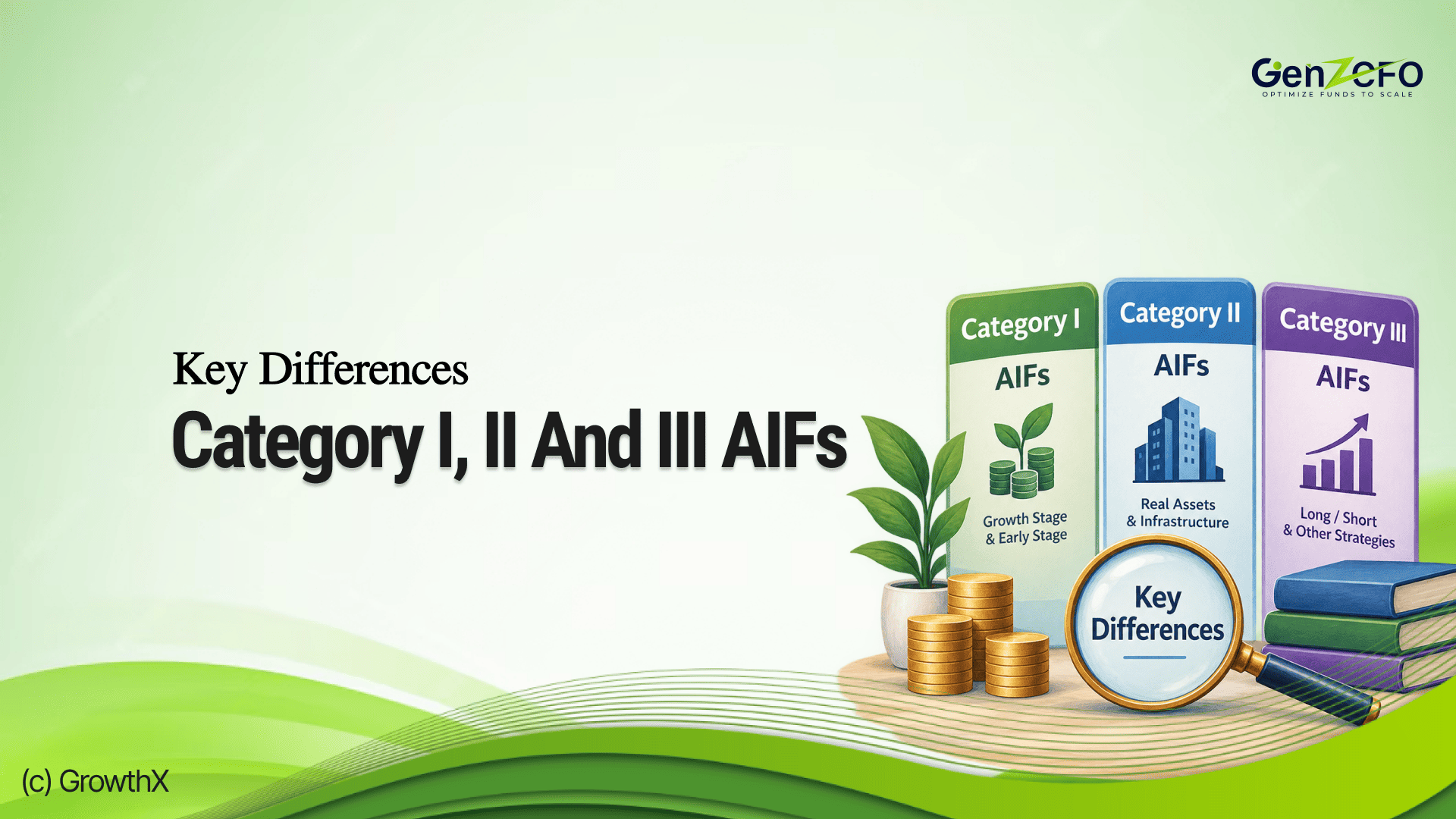
Alternative Investment Funds, commonly known as AIFs, have become an important part of India's investment ecosystem. They provide sophisticated investors with access to investment opportunities that may not ordinarily be available through conventional products such as mutual funds. Depending on their strategy, AIFs can invest in start-ups, private companies, infrastructure projects, debt opportunities, listed securities, derivatives and other alternative assets.
However, all AIFs do not operate in the same manner. The Securities and Exchange Board of India (SEBI) classifies AIFs into different categories based primarily on their investment objectives, strategies and regulatory characteristics. The three traditional categories are Category I AIF, Category II AIF and Category III AIF. Each category has a different investment focus, borrowing, tenure structure and regulatory approach. SEBI's AIF Regulations were most recently amended on July 14, 2026, and SEBI also issued its consolidated Master Circular for AIFs on June 3, 2026. Understanding these differences is important not only for investors but also for fund managers, sponsors, trustees and businesses planning to establish an AIF in India.
In this article, CA Manish Mishra talks about Category I, II and III AIFs: Key Differences Explained.
What is an Alternative Investment Fund?
An Alternative Investment Fund is essentially a privately pooled investment vehicle established or incorporated in India that collects funds from investors and invests those funds according to a defined investment policy for the benefit of its investors. Unlike a mutual fund, an AIF is generally structured for sophisticated investors who understand the risks associated with private equity, venture capital, alternative debt, hedge-fund strategies and other specialised investments.
The investment strategy, purpose and methodology of an AIF are required to be disclosed to investors through its fund documents and placement memorandum. AIFs are regulated principally under the SEBI (Alternative Investment Funds) Regulations, 2012, along with amendments, circulars, master circulars and other directions issued by SEBI from time to time. As of September 2026, the consolidated AIF Regulations available on SEBI's website are stated to have been last amended on July 14, 2026.
Why Has SEBI Divided AIFs into Different Categories?
The three-category structure allows SEBI to apply different regulatory conditions depending on how a fund invests and the nature of the risks involved. A venture capital fund investing in early-stage businesses, for example, operates very differently from a hedge-fund-style AIF trading derivatives and taking positions.
Similarly, a private equity fund purchasing substantial stakes in unlisted businesses requires a different regulatory from a fund undertaking frequent trading in listed markets. Therefore, AIF classification is not simply a ranking from low risk to high risk. It primarily reflects the purpose of investment, permitted strategy, asset profile,and structure of the fund.
Category I Alternative Investment Fund
What is a Category I AIF?
Category I AIFs generally invest in sectors or businesses that are considered socially or economically desirable. The regulatory concept behind Category I is that these funds channel private capital into areas that can contribute to entrepreneurship, infrastructure development, employment generation, SME financing or other economically significant activities.
Under the AIF, Category I includes specified fund types such as venture capital funds, SME funds, infrastructure funds, social impact funds, angel funds and special situation funds, subject to the specific conditions applicable to each sub-category. Category I funds are therefore usually sector-oriented or purpose-oriented rather than unrestricted investment vehicles.
Venture Capital Funds
A Venture Capital Fund generally provides capital to start-ups, emerging businesses and early-stage ventures. Such companies may not have a long financial track record or easy access to traditional bank financing, making venture capital an important source of growth funding.
VCFs commonly invest in equity or equity-linked instruments and seek value creation by participating during the early stages of a company's business journey. Because these investments are predominantly in private businesses, the investment horizon can be comparatively long and liquidity may remain limited until an exit opportunity arises.
SME Funds
SME Funds are intended to channel capital into small and medium enterprises. These businesses may require equity or growth capital to increase production, enter new markets, strengthen technology, improve distribution or eventually access public capital markets. By providing capital to SMEs, these funds can participate in the expansion of businesses that may otherwise find it difficult to raise substantial institutional investment.
Infrastructure Funds
Infrastructure Funds concentrate their investments in infrastructure-related businesses, projects, companies or special purpose vehicles, subject to the applicable regulatory conditions. Infrastructure assets often involve large capital requirements and long development periods. Consequently, these funds are generally designed for investors who can accept longer investment horizons and lower immediate liquidity in exchange for exposure to infrastructure-related opportunities.
Social Impact Funds
Social Impact Funds are designed around investments that seek measurable social impact alongside the applicable financial or investment objectives of the relevant scheme. They may invest in eligible social enterprises or other permitted structures in accordance with SEBI's regulatory. These funds have a specialised role because investment decisions can involve assessment not only of financial considerations but also of the intended social outcome.
Special Situation Funds
Special Situation Funds are another specialised form of Category I AIF. They are intended for investment in special situations, including eligible stressed or distressed opportunities, within the prescribed by SEBI. Such funds can play an important role in situations involving stressed businesses, restructuring and resolution opportunities. Because these investments may involve financially distressed assets or businesses, detailed due diligence and risk assessment become particularly important.
Investment and Borrowing Characteristics of Category I AIFs
Category I AIFs are fundamentally intended to deploy investor capital rather than rely on fund-level as a regular investment strategy. Borrowing is therefore restricted and permitted only within the situations and limits specified by the AIF Regulations and SEBI's subsequent.
SEBI has also introduced detailed guidelines permitting Category I and II AIFs to borrow in certain circumstances to meet a shortfall in a drawdown called from investors when an investment opportunity is imminent, subject to prescribed limits, disclosures and a cooling-off period between borrowings.
Tenure of Category I AIF
Category I AIFs are close-ended and their schemes are required to have a minimum tenure of three years. In practice, many venture capital, infrastructure and private-market strategies may operate for a considerably longer period because investments require time for development and exit. The close-ended structure is important because investors ordinarily commit capital for the scheme's defined life rather than expect daily liquidity or frequent redemption opportunities.
Category II Alternative Investment Fund
What is a Category II AIF?
Category II is generally the residual AIF category for funds that do not fall within Category I or Category III and that do not undertake or borrowing except as permitted under the regulatory.
Private equity funds and debt funds are common examples of Category II AIFs. These funds do not need to satisfy the specific developmental or sector-based objectives associated with Category I and do not use the complex trading strategies characteristic of Category III. As a result, Category II has become particularly relevant for private-market investment strategies.
Private Equity Funds
Private Equity Funds typically invest in established or growing businesses that are not publicly listed. Investment may take the form of equity, equity-linked instruments or other permitted structures depending upon the fund's strategy.
Unlike early-stage venture capital, private equity may focus on companies that already have substantial operations, customers and revenue. The fund manager may seek to enhance the value of the business through expansion, restructuring, improved governance, strategic acquisitions or operational changes before ultimately exiting the investment.
Debt Funds
Debt-oriented Category II AIFs generally invest in permitted debt instruments and private credit opportunities in accordance with their placement memorandum and the applicable regulatory. Such funds can provide financing to businesses that require customised debt solutions not necessarily available through conventional banking channels. Credit quality, collateral, cash flow, security structure and repayment capacity are therefore important considerations in these strategies.
Category II and Unlisted Investments
The regulatory provides that Category II AIFs should invest primarily in unlisted investee companies or in units of other AIFs as permitted and disclosed in the placement memorandum. This makes Category II particularly relevant for private equity, private credit and similar strategies where investment opportunities arise outside conventional listed equity markets.
Borrowing and Control Under Category II
Category II AIFs are not designed to use as a regular return-enhancement strategy. Borrowing and are restricted except where specifically permitted under the AIF. SEBI's borrowing guidelines provide limited operational flexibility, including circumstances involving temporary shortfalls in investor drawdowns. Such borrowing is subject to conditions concerning purpose, quantum, disclosure and cooling-off requirements. Category II AIFs may also undertake hedging in accordance with the regulatory.
Tenure of Category II AIF
Like Category I, Category II AIFs are close-ended and must generally have a minimum tenure of three years. A close-ended structure aligns well with private equity and private credit investments because an unlisted business or privately structured investment cannot normally be exited immediately. Fund managers therefore require adequate time to invest capital, manage portfolio companies and realise investments before distributing proceeds to investors.
Category III Alternative Investment Fund
What is a Category III AIF?
Category III AIFs are fundamentally different from Category I and Category II because they are allowed to employ diverse or complex trading strategies and may use, including through investments in listed or unlisted derivatives. Hedge-fund-style strategies are among the most common examples associated with Category III. These funds may invest in listed securities, unlisted securities, derivatives, structured products and other permitted instruments depending upon the strategy disclosed to investors. Category III is consequently suitable for strategies that require greater trading flexibility than traditional private-market AIFs.
Use of Derivatives
Category III AIFs can use derivatives not only for conventional hedging but also as an integral part of an investment or trading strategy, subject to applicable regulations and risk controls. Depending upon the scheme, derivatives may be used to create long or short exposure, manage market risk, implement arbitrage strategies or execute other sophisticated investment approaches. This flexibility distinguishes Category III from the primarily private-market focus of many Category I and II schemes.
Control in Category III AIF
One of the clearest differences between the categories is the ability of Category III AIFs to undertake subject to regulatory restrictions and investor consent. SEBI's 2026 Master Circular provides that leverage for a Category III AIF is calculated by reference to exposure relative to the fund's NAV and states that the leverage must not exceed two times the NAV of the fund.
Thus, where a scheme has an NAV of ₹100 crore, exposure after permitted offsetting cannot exceed ₹200 crore under this. It can magnify gains but can also magnify losses and liquidity requirements. Consequently, Category III AIFs using are subject to enhanced risk-management, compliance and reporting requirements.
Open-Ended and Close-Ended Structures
Unlike Category I and Category II schemes, which are required to be close-ended, a Category III scheme may be structured as open-ended or close-ended. An open-ended structure can provide periodic subscription and redemption opportunities subject to the scheme documents. However, actual liquidity depends upon redemption terms, notice periods, lock-ins, gates and other conditions disclosed by the particular scheme.
Investment Approach of Category III AIFs
Category III strategies may include long-only equity, long-short strategies, market-neutral approaches, arbitrage, derivative-based strategies and other complex investment techniques permitted under the regulatory.
However, Category III should not automatically be understood as synonymous with speculative trading. Different funds can use very different strategies. The level of market risk depends on the scheme's actual portfolio construction, investment philosophy and risk-management practices.
Category I vs Category II vs Category III AIF: Key Differences
The essential difference between the categories lies in what they invest in and how they are allowed to manage investor capital.
|
Basis |
Category I AIF |
Category II AIF |
Category III AIF |
|
Main Focus |
Start-ups, SMEs, infrastructure, social impact and specified economically desirable areas |
Private equity, private credit and other strategies not falling under Category I or III |
Complex or diverse investment and trading strategies |
|
Common Examples |
VCF, SME Fund, Infrastructure Fund, Social Impact Fund, Special Situation Fund |
Private Equity Fund, Debt Fund |
Hedge-fund-style, long-short and other complex trading funds |
|
Listed/Unlisted Orientation |
Depends on sub-category, often private/unlisted or specialised assets |
Primarily private/unlisted investments |
May invest extensively across listed/unlisted securities and derivatives |
|
Leverage |
Restricted; borrowing only as permitted |
Restricted; borrowing only as permitted |
Permitted within SEBI limits and conditions |
|
Derivatives |
Limited to what is permitted for the relevant purpose/strategy |
Hedging permitted within applicable |
Derivatives can form an important part of investment strategy |
|
Fund Structure |
Close-ended |
Close-ended |
Open-ended or close-ended |
|
Minimum Tenure |
At least 3 years |
At least 3 years |
Depends on scheme where applicable |
|
Typical Investment Horizon |
Generally longer term |
Generally medium to long term |
May range from short to long depending on strategy |
|
Tax Pass-Through |
Covered by statutory investment-fund regime, subject to applicable tax provisions |
Covered by statutory investment-fund regime, subject to applicable tax provisions |
Not covered by the same Category I/II statutory definition; treatment depends on structure and applicable tax law |
The classification and structural distinctions arise from the SEBI AIF, while the income-tax legislation specifically defines an “investment fund” for the statutory pass-through by reference to Category I and Category II AIFs.
Minimum Investment and Corpus Requirements
Minimum Investment by an Investor
As a general rule, an AIF cannot accept an investment of less than ₹1 crore from an investor, although the regulations provide specific exceptions. For certain employees or directors of the AIF or its manager, the minimum is ₹25 lakh, while separate provisions apply to accredited investors and certain specialised schemes.
The relatively high investment threshold reflects the sophisticated nature of AIF products and distinguishes them from retail-oriented investment products such as conventional mutual funds.
Minimum Corpus of a Scheme
The general regulatory rule requires an AIF scheme to have a corpus of at least ₹20 crore, although specialised categories such as social impact funds can be subject to different requirements under the regulations. The corpus represents the total amount committed by investors to the scheme pursuant to the fund documents.
Investment Concentration Limits
AIFs are also subject to regulatory restrictions intended to limit excessive exposure to a single investee company. Under the applicable, Category I and Category II AIFs are generally subject to a limit of 25% of investable funds in an investee company, directly or through permitted investment in units of other AIFs, subject to specific relaxations or separate provisions applicable to large value funds for accredited investors.
Category III AIFs generally operate with a 10% concentration limit, subject to the detailed regulatory methodology and additional provisions applicable to large value funds for accredited investors and listed equity exposure. These restrictions help prevent a fund from concentrating an excessive portion of investor capital in one company.
Tax Treatment of AIF Categories
Tax treatment is another important distinction between the AIF categories. Under the statutory investment-fund taxation, the definition of an “investment fund” includes qualifying Category I and Category II AIFs. Income accruing to unit holders through such an investment fund is generally addressed under the specific pass-through, subject to exceptions and the nature of the income concerned.
The position of Category III AIFs is different because they are not included within that same statutory definition of an investment fund. Consequently, taxation of a Category III AIF can depend significantly upon its legal form, nature of income, investment strategy and applicable provisions of tax law. Tax treatment should therefore be analysed separately before establishing or investing in any AIF rather than assuming that all three categories receive identical tax treatment.
Risk Differences Between the Three Categories
Risk in Category I AIF
Category I funds can carry substantial business and liquidity risk because they often invest in early-stage ventures, SMEs, infrastructure or special situations. An early-stage company may fail to scale its business, while infrastructure investments can face long gestation periods and project-related risks. Therefore, the absence of regular leverage does not mean Category I AIFs are automatically low-risk products. Their risks arise primarily from the nature and liquidity of their underlying investments.
Risk in Category II AIF
Category II risk depends considerably on whether the fund pursues private equity, growth capital, private credit or another permitted strategy. A private equity fund may face valuation, exit and business-performance risks, while a debt fund may face credit and recovery risk. Since investments are frequently unlisted, investors may also have limited ability to exit before the end of the fund's tenure.
Risk in Category III AIF
Category III funds may be exposed to market movements, derivatives risk, liquidity risk and strategy-specific risks. Where is used, relatively small movements in the value of underlying assets can have a magnified impact on the fund's NAV. SEBI consequently requires Category III AIFs using to maintain risk-management and compliance systems and comply with prudential requirements.
Valuation and NAV Requirements
Valuation is particularly important in the AIF industry because many Category I and II portfolios contain unlisted securities for which observable market prices may not always be available. SEBI's prescribes valuation-related obligations and requires appropriate disclosure of valuation procedures and methodologies.
Category III funds have additional NAV-related requirements because many schemes invest in frequently traded securities and may provide periodic redemptions. Fund managers must therefore establish valuation policies consistent with the regulations, applicable valuation standards and SEBI's subsequent circulars.
Which Category is Suitable for Which Investment Strategy?
The correct AIF category is determined by the fund's proposed strategy rather than simply by the preference of the sponsor or manager. A fund intending to finance start-ups or eligible SMEs may fall within an appropriate Category I sub-category. A conventional private equity or private credit fund will generally be structured as Category II where its strategy satisfies the relevant conditions.
A fund intending to actively trade securities, use derivatives extensively or undertake may require Category III registration. Therefore, the fund's investment objective, eligible assets, tenure, requirements, liquidity model and target investors should be analysed before deciding the category under which registration is sought.
Common Compliance Requirements Applicable to AIFs
Although the investment rules differ across Categories I, II and III, all AIFs operate within a broader SEBI compliance. An AIF must maintain appropriate fund documentation, disclose its investment strategy, manage conflicts of interest, comply with valuation requirements, undertake regulatory reporting, maintain investor records and follow applicable due-diligence and governance requirements.
The fund manager, sponsor, trustee and key personnel also have important responsibilities under the regulatory. Consequently, operating an AIF requires continuous compliance rather than simply obtaining registration once and commencing investments.
Important AIF Regulatory Developments in 2026
SEBI continued to update the AIF regulatory during 2026. A consolidated Master Circular for AIFs was issued on June 3, 2026, bringing together applicable operational guidance. The AIF Regulations were subsequently amended again, with the consolidated regulations reflecting amendments through July 14, 2026.
SEBI also introduced the Green-Channel: AIF Rollout Upon Document Acknowledgement (GARUDA) mechanism through a circular dated July 30, 2026 for processing eligible placement memoranda filed by AIFs. These developments indicate an ongoing effort to streamline AIF operations while maintaining regulatory safeguards. Fund managers and sponsors should therefore avoid relying only on the original 2012 Regulations and should review the latest amendments, Master Circular and category-specific directions before establishing or operating a scheme.
How Category I, II and III AIFs Differ in Simple Terms
The distinction can be understood by looking at the primary purpose of each category.
Category I generally directs capital toward areas such as venture capital, SMEs, infrastructure, social impact and other specified sectors. The emphasis is largely on long-term capital formation and sectors regarded as economically or socially significant.
Category II generally covers traditional private-market strategies such as private equity and debt funds that do not qualify as Category I and do not employ the complex trading strategies associated with Category III.
Category III gives managers greater flexibility to use listed-market strategies, derivatives and leverage. This flexibility is accompanied by additional prudential, disclosure and risk-management requirements.
Therefore, one category is not universally “better” than another. The appropriate category depends upon the proposed investment strategy, liquidity profile, portfolio assets, risk management approach and regulatory structure.
Conclusion
Category I, Category II and Category III AIFs serve very different purposes within India's alternative investment market. Category I AIFs primarily channel capital into areas such as start-ups, SMEs, infrastructure, social impact and specialised opportunities. Category II AIFs are widely used for private equity, private debt and other private-market investment strategies, while Category III AIFs provide greater flexibility for complex trading, derivatives and regulated.
The differences extend beyond the underlying investments. The categories also vary in terms of tenure, borrowing, liquidity, taxation, concentration limits and risk-management requirements. For fund sponsors and managers, choosing the correct category is therefore one of the most important decisions in establishing an AIF. With SEBI continuing to update the AIF, including the 2026 Master Circular, amendments to the AIF Regulations and the GARUDA mechanism, managers, sponsors and investors should evaluate the latest regulatory requirements before structuring or participating in an AIF.
Frequently Asked Questions
Q1. What are the three main categories of AIFs in India?
Ans. The traditional AIF classifies funds into Category I, Category II and Category III based primarily on their investment strategy and regulatory characteristics. Category I focuses on specified socially or economically desirable sectors, Category II generally covers private-market funds, and Category III permits complex strategies and subject to regulatory conditions.
Q2. What is a Category I AIF?
Ans. Category I AIFs generally invest in areas such as start-ups, SMEs, infrastructure, social impact and other specified sectors. Venture Capital Funds, SME Funds, Infrastructure Funds, Social Impact Funds and Special Situation Funds are examples within the Category I.
Q3. What is a Category II AIF?
Ans. Category II AIFs are funds that do not fall within Category I or Category III and do not undertake except as specifically permitted. Private Equity Funds and Debt Funds are common examples of Category II AIFs.
Q4. What is a Category III AIF?
Ans. Category III AIFs employ diverse or complex trading strategies and may use leverage, including through derivatives. Hedge-fund-style strategies, long-short strategies and other sophisticated market strategies can operate within this category subject to SEBI requirements.
Q5. Can Category I and Category II AIFs use leverage?
Ans. They cannot ordinarily use leverage as a regular investment strategy. However, limited borrowing is permitted for specified purposes and subject to regulatory conditions, including SEBI's concerning temporary funding and certain investor-drawdown shortfalls.
Q6. How much leverage can a Category III AIF undertake?
Ans. Under SEBI's current prudential, leverage of a Category III AIF must not exceed two times the NAV of the fund, calculated in accordance with the prescribed methodology.
Q7. Are all AIFs close-ended?
Ans. No. Category I and Category II schemes are close-ended and generally have a minimum tenure of three years. Category III schemes may be either open-ended or close-ended depending upon their structure.
Q8. What is the minimum investment in an AIF?
Ans. The general minimum investment is ₹1 crore per investor, subject to regulatory exceptions. Different thresholds or exemptions may apply to specified employees/directors, accredited investors and certain specialised AIF structures.
Q9. Which AIF categories receive statutory tax pass-through treatment?
Ans. The statutory definition of an “investment fund” for the specific pass-through covers qualifying Category I and Category II AIFs. Category III AIFs are not included within that same definition, so their tax position needs to be considered separately based on structure and applicable tax law.
Q10. Are Category III AIFs riskier than Category I and Category II AIFs?
Ans. Category III AIFs can involve additional market and risk because of the strategies they are permitted to employ, but risk cannot be determined by category alone. Category I can carry substantial start-up or project risk, while Category II can involve private-equity, liquidity or credit risks. Investors should therefore examine the actual strategy and portfolio rather than relying solely on the AIF category.
- 23 Sep, 2026
 CA Manish Mishra
- Easing Finance
CA Manish Mishra is the Co-Founder & CEO at GenZCFO. He is the most sought professional for providing virtual CFO services to startups and established businesses across diverse sectors, such as retail, manufacturing, food, and financial services with over 20 years of experience including strategic financial planning, regulatory compliance, fundraising and M&A.