Search GrowthX Learning Content


Due Diligence Checklist Before Acquiring an NBFC
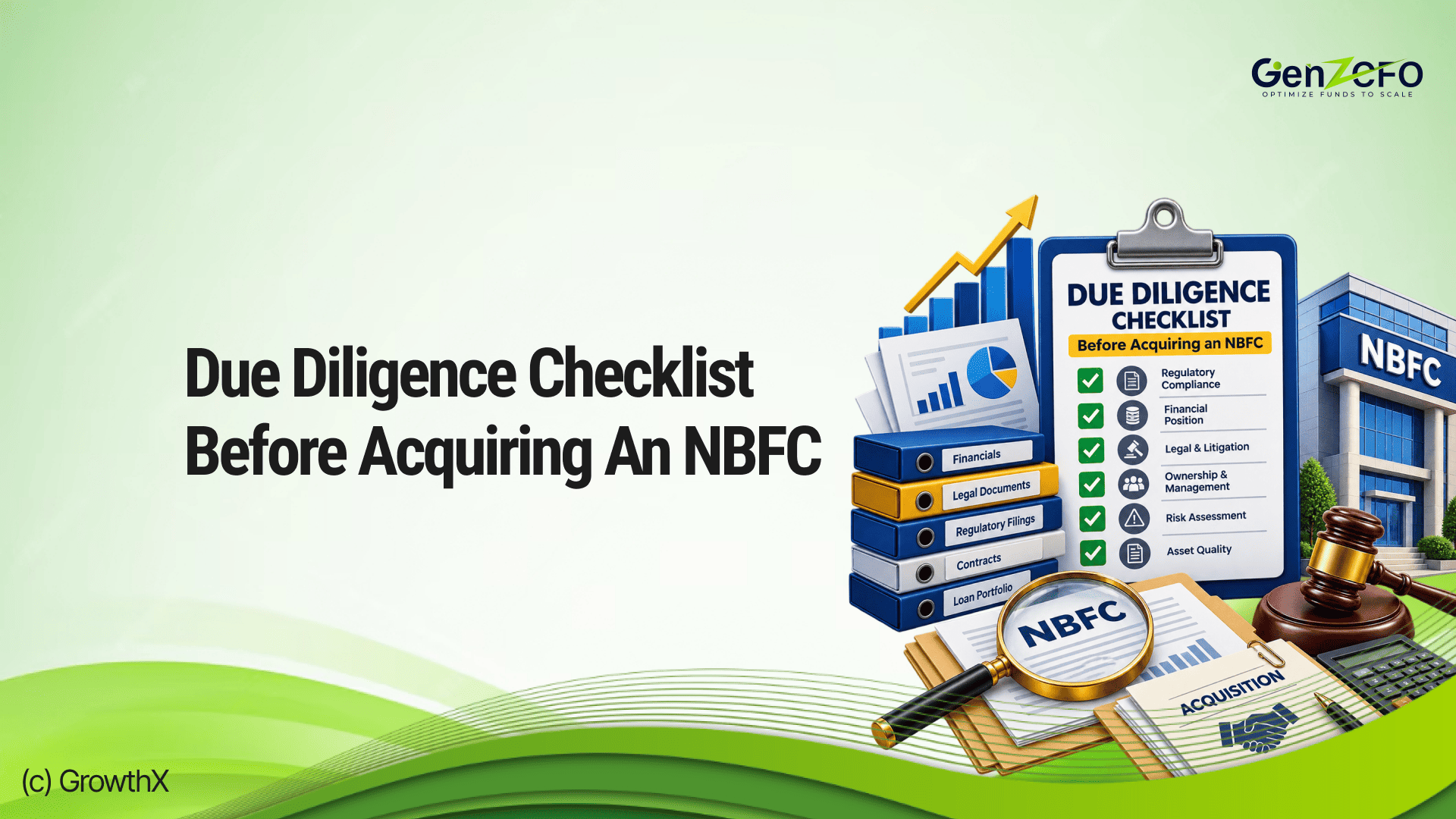
Acquiring a Non-Banking Financial Company (NBFC) is a significant commercial and regulatory transaction. Unlike the acquisition of an ordinary company, an NBFC takeover involves a business that operates under the supervision of the Reserve Bank of India (RBI). Therefore, the buyer must examine not only the company's financial position but also its regulatory status, compliance history, quality of loan assets, management practices, taxation, litigation, technology and contractual liabilities.
A detailed due diligence exercise helps the purchaser understand whether the NBFC is genuinely compliant and commercially viable or whether it carries hidden liabilities that may arise after the acquisition. The following areas should be examined carefully before proceeding with the acquisition.
In this article, CA Manish Mishra talks about Due Diligence Checklist Before Acquiring an NBFC.
Verify the RBI Certificate of Registration
Verification of the NBFC Registration
The first step in NBFC due diligence is to verify whether the target company holds a valid Certificate of Registration issued by the Reserve Bank of India. The purchaser should not rely solely on a copy of the registration certificate provided by the seller. The registration number, date of registration, current status and category of the NBFC should be independently checked. It is also important to confirm whether the NBFC is authorised to carry on the type of financial activity currently undertaken by it.
Check for Restrictions, Cancellation or Deregistration
The purchaser should investigate whether RBI has imposed any restrictions on the NBFC or whether any proceedings relating to cancellation, surrender or deregistration of the Certificate of Registration are pending. Where the company has remained inactive for a significant period or has changed its business model, the buyer should determine whether it continues to satisfy the conditions necessary to operate as an NBFC. This is particularly important because the commercial value of an NBFC can be substantially affected if its registration is under regulatory scrutiny.
Determine the Exact Category of the NBFC
Identification of NBFC Classification
Different categories of NBFCs are subject to different regulatory requirements. Therefore, the buyer should first identify whether the target is an Investment and Credit Company, Micro Finance Institution, Factor, Infrastructure Finance Company, Core Investment Company, Housing Finance Company or another specialised category. The classification determines what activities the NBFC can undertake and what regulatory conditions it must satisfy.
Scale Based Regulation Classification
The purchaser should also determine whether the NBFC falls under the Base Layer, Middle Layer, Upper Layer or any other applicable category under RBI's Scale Based Regulation framework. The regulatory burden increases depending upon the size, risk profile and systemic importance of the NBFC. This classification can affect governance requirements, capital adequacy, risk-management systems, compliance functions and reporting obligations.
Check Whether RBI Approval Is Required
Acquisition of Control
A proposed buyer must examine whether the transaction amounts to a takeover or acquisition of control of the NBFC. Where the transaction results in control over the company, RBI's prior approval may be required before the acquisition is completed. Therefore, the transaction should be structured in a manner that ensures regulatory approval is obtained before ownership or control actually changes.
Change in Shareholding
The parties should also evaluate whether the acquisition results in a significant change in the shareholding of the NBFC. Where the prescribed shareholding threshold is crossed, the transaction may require prior RBI approval. The buyer should therefore calculate both the immediate and cumulative change in shareholding rather than considering only a single share transfer.
Review the Board and Management Structure
Existing Directors and Key Management Personnel
The purchaser should review the existing Board of Directors and key management personnel of the NBFC. Their qualifications, professional experience, regulatory history, reputation and involvement in any litigation or regulatory proceedings should be examined. Since management quality is particularly important in a financial institution, the buyer should determine whether any director or key officer poses a governance or reputational risk.
Proposed Management Changes
Where the buyer proposes to replace existing directors after acquisition, the impact of such changes should be examined from a regulatory perspective. A substantial change in the composition of the Board may require prior RBI approval. The purchaser should therefore prepare a post-acquisition management structure in advance and ensure that proposed directors satisfy applicable fit-and-proper criteria.
Examine Shareholding and Beneficial Ownership
Verification of Share Capital
The authorised, issued, subscribed and paid-up capital of the NBFC should be verified with statutory records. The purchaser should review share certificates, registers of members, allotment records, share transfer documents and filings made with the Registrar of Companies. Any difference between statutory filings and internal records should be investigated before the transaction is completed.
Ultimate Beneficial Ownership
The purchaser should identify the actual individuals or entities that ultimately own or control the NBFC. Beneficial ownership declarations, shareholder agreements and voting arrangements should be examined to determine whether any undisclosed person exercises control. This exercise also helps identify potential regulatory, anti-money laundering or foreign investment concerns.
Encumbrances on Shares
It is necessary to verify whether the shares proposed to be acquired are pledged, charged, subject to a lien or otherwise encumbered. Any existing third-party rights over the shares should ordinarily be released before closing so that the buyer receives clear and marketable title.
Examine the Source of Funds of the Buyer
Documentation of Acquisition Funds
The buyer should maintain proper records demonstrating the source of funds being used for the acquisition. Bank statements, financial statements, tax records and supporting documents should clearly establish where the acquisition consideration originates. This is particularly important where RBI approval is required.
Complex Funding Structures
Where the acquisition is being financed through loans, group companies, overseas investors or multiple entities, the funding structure should be carefully reviewed. Circular transactions, unexplained funds or arrangements lacking commercial substance may result in regulatory concerns and should therefore be avoided.
Review the Net Owned Fund Position
Verification of Capital Strength
An NBFC is required to maintain prescribed minimum capital and Net Owned Fund levels depending upon its category. The buyer should independently calculate the Net Owned Fund instead of relying only on the figures stated in the financial statements. Paid-up capital, eligible reserves, accumulated losses, intangible assets and applicable deductions should be considered while arriving at the correct position.
Future Capital Requirements
The purchaser should also examine whether additional capital may be required after acquisition. If the NBFC is operating close to the minimum regulatory threshold or is planning to significantly expand its lending business, the buyer may need to infuse additional capital soon after completion of the acquisition.
Conduct Detailed Loan Book Due Diligence
Portfolio-Level Review
For an operating NBFC, the quality of its loan portfolio is one of the most important factors affecting valuation. The purchaser should analyse the loan book according to product type, geography, borrower category, industry, maturity, ticket size, security, repayment performance and delinquency levels. Concentration of loans in a particular sector, geographical area or group of borrowers may increase credit risk.
Borrower-Level Verification
A sample of individual borrower files should also be reviewed. These files should contain proper KYC documents, loan applications, credit appraisal reports, sanction letters, executed agreements, security documents, disbursement records and repayment histories. Missing documents or inadequate underwriting practices may indicate weaknesses that are not immediately visible from financial statements.
Review NPAs and Delinquent Accounts
Verification of Asset Classification
The buyer should review overdue and non-performing loan accounts to determine whether the NBFC has correctly classified stressed assets. Ageing reports should be reconciled with the loan-management system and financial statements. Any delay in recognising an account as non-performing may artificially improve the reported profitability and asset quality of the NBFC.
Provisioning and Write-Offs
The purchaser should also review the adequacy of provisions created against bad and doubtful loans. Written-off loans, settlements, restructured accounts and one-time settlement arrangements should be examined separately. If provisions are inadequate, the real net worth of the company may be substantially lower than what appears in its balance sheet.
Evergreening Risk
Transactions indicating evergreening of loans should be treated as a serious red flag. If fresh loans have been provided merely to enable borrowers to repay older overdue facilities, the actual stress in the portfolio may be concealed. Such practices can create significant financial and regulatory exposure after acquisition.
Verify Borrowings and Financial Obligations
Existing Loans and Credit Facilities
An NBFC may have substantial borrowings from banks, financial institutions, debenture holders or other lenders. The purchaser should prepare a complete schedule of all outstanding facilities and verify repayment obligations, interest rates, security and maturity dates. Any overdue borrowing should be specifically investigated.
Change of Control Clauses
Loan agreements often contain provisions requiring lender consent before there is a change in ownership or control. Therefore, the buyer should review financing agreements to identify whether the acquisition may constitute an event of default or require prior written consent from lenders.
Security and Guarantees
All security created by the NBFC should be reviewed, including charges over receivables, movable assets, bank accounts or other assets. Personal guarantees or corporate guarantees given by existing promoters should also be examined because these arrangements may need to be replaced after acquisition.
Review RBI Returns and Filings
Timeliness and Accuracy of Returns
The buyer should verify whether all RBI returns applicable to the NBFC have been filed within the prescribed timelines. Copies of returns for previous years should be examined and reconciled with the audited financial statements and internal records. Repeated delays or incorrect reporting can indicate weak compliance systems.
Differences in Reported Data
Any significant difference between the figures reported to RBI and those appearing in the books of account should be investigated. Such discrepancies can arise from genuine classification issues, but they may also indicate inaccurate regulatory reporting or weaknesses in internal controls.
Examine RBI Inspection Reports and Correspondence
Regulatory Observations
The purchaser should obtain copies of inspection reports, supervisory observations, warning letters, show-cause notices and other correspondence exchanged with RBI. These documents can reveal compliance deficiencies that may not appear in ordinary financial or corporate records.
Pending Corrective Actions
Where RBI has previously identified deficiencies, the buyer should verify whether corrective action was actually completed. An assurance from management should not be considered sufficient unless supported by documentary evidence. Unresolved regulatory observations may become the responsibility of the new owners after acquisition.
Review KYC and AML Compliance
Customer Identification
An NBFC must maintain proper Know Your Customer and anti-money laundering systems. The buyer should examine whether customer identity documents, PAN details, beneficial ownership information and address proofs are properly maintained. Customer files should be sampled to test whether the company's documented policies are actually followed in practice.
Customer Risk Classification
The NBFC's process for classifying customers as low, medium or high risk should be reviewed. Enhanced due diligence should be undertaken for politically exposed persons, high-risk customers and unusual transactions wherever required.
Transaction Monitoring
The purchaser should assess whether the NBFC has adequate systems to identify suspicious transactions, unusual repayment patterns or transactions inconsistent with the customer's profile. Weak transaction monitoring can expose the company to regulatory and reputational risks.
Examine Fraud and Misconduct
Historical Fraud Cases
Details of frauds involving borrowers, employees, vendors, agents or management should be obtained. The buyer should understand the financial loss caused by each material incident and the action taken by the company.
Internal Control Weaknesses
Repeated fraud may indicate broader weaknesses in credit appraisal, verification, collections or employee supervision. Therefore, fraud due diligence should not be restricted merely to calculating past losses. The buyer should determine whether the underlying control weaknesses have actually been corrected.
Review MCA and Companies Act Compliance
Corporate Records
The Certificate of Incorporation, Memorandum of Association, Articles of Association, statutory registers, annual returns, financial statements and Board records should be examined. The main objects in the Memorandum should permit the financial activities undertaken by the company.
Historical Corporate Compliance
The purchaser should check whether share allotments, transfers, appointment of directors, creation of charges and related-party transactions were carried out in accordance with the Companies Act. Historical irregularities can create future legal and regulatory problems if they remain unresolved.
Check Litigation and Legal Proceedings
-
Proceedings Against the NBFC: The buyer should identify all civil, criminal, consumer, regulatory, tax and arbitration proceedings against the NBFC. Each matter should be evaluated based on the amount involved, probability of liability and possible impact on the company's reputation or licence.
-
Recovery Cases Filed by the NBFC: An NBFC may also have numerous recovery proceedings against borrowers. Such cases should be examined to determine the recoverability of outstanding loans and whether the amounts shown as assets in the financial statements are realistic.
-
Promoter and Director Litigation: Cases involving promoters and directors should also be reviewed because serious criminal, fraud or regulatory proceedings can affect their fit-and-proper status and the reputation of the target company.
Tax Due Diligence
-
Examine Direct Tax Compliance: The purchaser should review income-tax returns, tax audit reports, assessment orders, notices, demands and pending appeals. Differences between taxable income, audited accounts and regulatory returns should be investigated. Significant disputed tax liabilities should be quantified before determining the final purchase consideration.
-
Examine GST and Other Statutory Liabilities: The NBFC's GST position should also be examined, particularly with respect to taxable services, input tax credit and return filings. In addition, TDS, professional tax and other statutory dues should be reviewed. Any unpaid or disputed liability should be identified before closing because the acquiring entity may ultimately have to deal with the outstanding demand.
Review Technology and Data Systems
-
Loan Management Technology: The purchaser should understand how loans are originated, approved, disbursed, monitored and collected through the NBFC's technology systems. The reliability of the loan origination system and loan management system should be tested because these systems contain critical financial and customer information.
-
Ownership of Software: It is important to determine whether the technology is owned by the NBFC or licensed from a third party or promoter-related company. If critical software belongs to the outgoing promoter, the acquirer may need to negotiate a fresh licence or technology-transfer arrangement.
-
Cybersecurity and Data Protection: Cybersecurity policies, access controls, backups, disaster recovery arrangements and incident-response procedures should be reviewed. A financial institution handling large volumes of personal and financial data can suffer substantial legal and reputational damage from a cyber incident.
Review Outsourcing and Fintech Arrangements
-
Third-Party Service Providers: Agreements with fintech platforms, direct selling agents, recovery agents, collection agencies, call centres, KYC vendors, cloud providers and other outsourced service providers should be reviewed carefully. The NBFC remains responsible for many activities even when they are outsourced.
-
Contractual and Compliance Risks: The purchaser should examine whether agreements contain adequate confidentiality obligations, audit rights, service standards, termination provisions and business continuity arrangements. Excessive dependency on a single vendor may also create operational risk after acquisition.
Human Resources Due Diligence
-
Review Employee Liabilities: The buyer should obtain a detailed list of employees along with salaries, benefits, incentives, gratuity obligations, provident fund contributions and other statutory dues. Pending employee claims or disputes should also be identified.
-
Identify Key Personnel: Key employees responsible for credit, compliance, finance, collections, risk management and technology should be identified. If the NBFC depends heavily on a small number of senior employees, the buyer should consider retention arrangements to ensure continuity after the acquisition.
Public Notice and Closing Requirements
-
Public Notice Before Transfer of Control: Where applicable, a public notice must be issued after obtaining the required RBI approval and before the transaction is finally completed. The parties should build the mandatory notice period into the acquisition timeline. The notice generally informs the public about the proposed transfer of ownership or control and provides details regarding the transferee and the reasons for the transaction.
-
Closing of the Transaction: The acquisition should be completed only after all regulatory approvals, lender consents, corporate approvals and contractual conditions have been fulfilled. The buyer should ensure that the transfer of shares, payment of consideration, resignation and appointment of directors and handover of corporate records occur in a properly coordinated manner.
Key Red Flags Before Acquiring an NBFC
-
Doubtful Regulatory Status: If the validity of the RBI Certificate of Registration cannot be independently established or there are pending cancellation or restriction proceedings, the acquisition should be treated as high risk.
-
Inadequate Capital: An NBFC operating below prescribed capital or Net Owned Fund requirements may require immediate capital infusion. Such funding requirements should be incorporated into the acquisition valuation.
-
Poor Loan Quality: A high level of overdue accounts, NPAs, restructuring, write-offs or inadequate borrower documentation may indicate that the reported value of the loan portfolio is overstated.
-
Regulatory Non-Compliance: Repeated RBI penalties, unresolved inspection observations, delayed filings or serious KYC deficiencies can expose the buyer to substantial post-acquisition regulatory risk.
-
Undisclosed Liabilities: Hidden borrowings, tax demands, employee liabilities, litigation or related-party transactions can significantly reduce the actual value of the company. The purchaser should therefore insist on comprehensive disclosures and suitable contractual protection.
Important Protections in the Acquisition Agreement
-
Conditions Precedent: The Share Purchase Agreement should provide that the transaction will be completed only after obtaining necessary RBI approval, lender consents, corporate approvals and release of relevant encumbrances. This prevents the buyer from being forced to complete an acquisition before essential regulatory conditions have been satisfied.
-
Representations and Warranties: The sellers should provide detailed representations regarding the validity of the NBFC registration, financial statements, loan book, taxes, litigation, contracts, employees and regulatory compliance. If any representation later proves incorrect, the buyer should have appropriate contractual remedies.
-
Indemnity Protection: The purchaser should obtain indemnities for historical liabilities such as regulatory penalties, tax demands, fraud, undisclosed litigation, customer claims or inaccurate loan-book information. Specific indemnities are especially useful where a risk has already been identified during due diligence.
-
Escrow or Holdback: Where material liabilities cannot be quantified before closing, a portion of the purchase consideration may be retained in escrow or withheld for a defined period. This provides the buyer with financial protection if a historical liability emerges after completion.
Conclusion
Due diligence before acquiring an NBFC should be considerably more detailed than ordinary corporate due diligence because the purchaser is acquiring a regulated financial institution along with its historical obligations. The buyer must verify RBI registration, regulatory classification, shareholding, management, capital adequacy, loan-book quality, NPAs, borrowings, KYC systems, tax compliance, litigation, technology and employee liabilities before determining whether the transaction is commercially viable.
The acquisition agreement should also be structured to protect the purchaser against liabilities that arose before closing. Regulatory approvals, public-notice requirements, lender consents and post-acquisition compliance should be planned at an early stage. A properly conducted due diligence exercise enables the buyer to understand the true financial and regulatory position of the NBFC, negotiate the purchase price appropriately and significantly reduce the risk of inheriting hidden liabilities after the acquisition.
Frequently Asked Questions (FAQs)
Q1. Why is due diligence important before acquiring an NBFC?
Ans. Due diligence is important because an NBFC is a regulated financial entity and may carry hidden financial, regulatory, tax or legal liabilities. A detailed review helps the buyer verify the RBI registration, loan-book quality, capital position, compliance history, pending litigation, borrowings and operational risks before completing the acquisition.
Q2. What should be checked first before acquiring an NBFC?
Ans. The first step should be to verify the NBFC’s RBI Certificate of Registration and confirm its current regulatory status. The buyer should also identify the category of the NBFC, its permitted activities and whether any restrictions, cancellation proceedings or regulatory observations are pending.
Q3. Is RBI approval required for acquisition of an NBFC?
Ans. RBI prior approval may be required where the transaction results in takeover or acquisition of control of the NBFC or where the prescribed shareholding threshold is crossed. The exact requirement depends on the structure of the proposed transaction, so the approval position should be examined before shares are transferred.
Q4. What financial records should be reviewed during NBFC due diligence?
Ans. The buyer should review audited financial statements, bank statements, loan-book data, NPA reports, provisioning records, borrowing schedules, tax returns, capital adequacy records and Net Owned Fund calculations. These records help determine the actual financial strength of the target NBFC.
Q5. Why is loan-book due diligence important in an NBFC acquisition?
Ans. The loan book is often the largest asset of an operating NBFC. Reviewing borrower files, repayment history, security documents, overdue accounts, NPAs, write-offs and restructuring helps the purchaser determine whether the reported loan assets are genuine and recoverable.
Q6. What are the major red flags in an NBFC acquisition?
Ans. Major red flags include unresolved RBI observations, inadequate capital, high NPAs, poor KYC compliance, undisclosed liabilities, related-party transactions, pending tax demands, repeated regulatory penalties, weak borrower documentation and significant litigation. Any of these issues may materially affect the valuation or viability of the acquisition.
Q7. Should RBI inspection reports be reviewed before acquisition?
Ans. Yes. RBI inspection reports, supervisory correspondence, show-cause notices, penalties and compliance reports should be reviewed carefully. These documents can reveal regulatory deficiencies that may not be visible from financial statements or standard corporate records.
Q8. What legal documents should be checked while acquiring an NBFC?
Ans. Important legal documents include the Certificate of Incorporation, Memorandum and Articles of Association, statutory registers, share certificates, Board minutes, shareholder agreements, loan agreements, security documents, vendor contracts, employment agreements and details of ongoing litigation.
Q9. What protections should a buyer include in the NBFC acquisition agreement?
Ans. The buyer should consider conditions precedent, detailed representations and warranties, specific indemnities, purchase-price adjustments, escrow arrangements and holdback provisions. These protections help reduce the financial impact of liabilities arising from periods before the acquisition.
Q10. Can an NBFC acquisition be completed immediately after signing the agreement?
Ans. Not necessarily. The transaction may require RBI approval, lender consents, corporate approvals and compliance with applicable public-notice requirements before completion. Therefore, signing the Share Purchase Agreement and completing the actual transfer of ownership are generally treated as separate stages of the acquisition process.
- 12 Aug, 2026
 CA Manish Mishra
- Starting Up
CA Manish Mishra is the Co-Founder & CEO at GenZCFO. He is the most sought professional for providing virtual CFO services to startups and established businesses across diverse sectors, such as retail, manufacturing, food, and financial services with over 20 years of experience including strategic financial planning, regulatory compliance, fundraising and M&A.