Search GrowthX Learning Content


Embedded Finance in India: Opportunities and Regulations
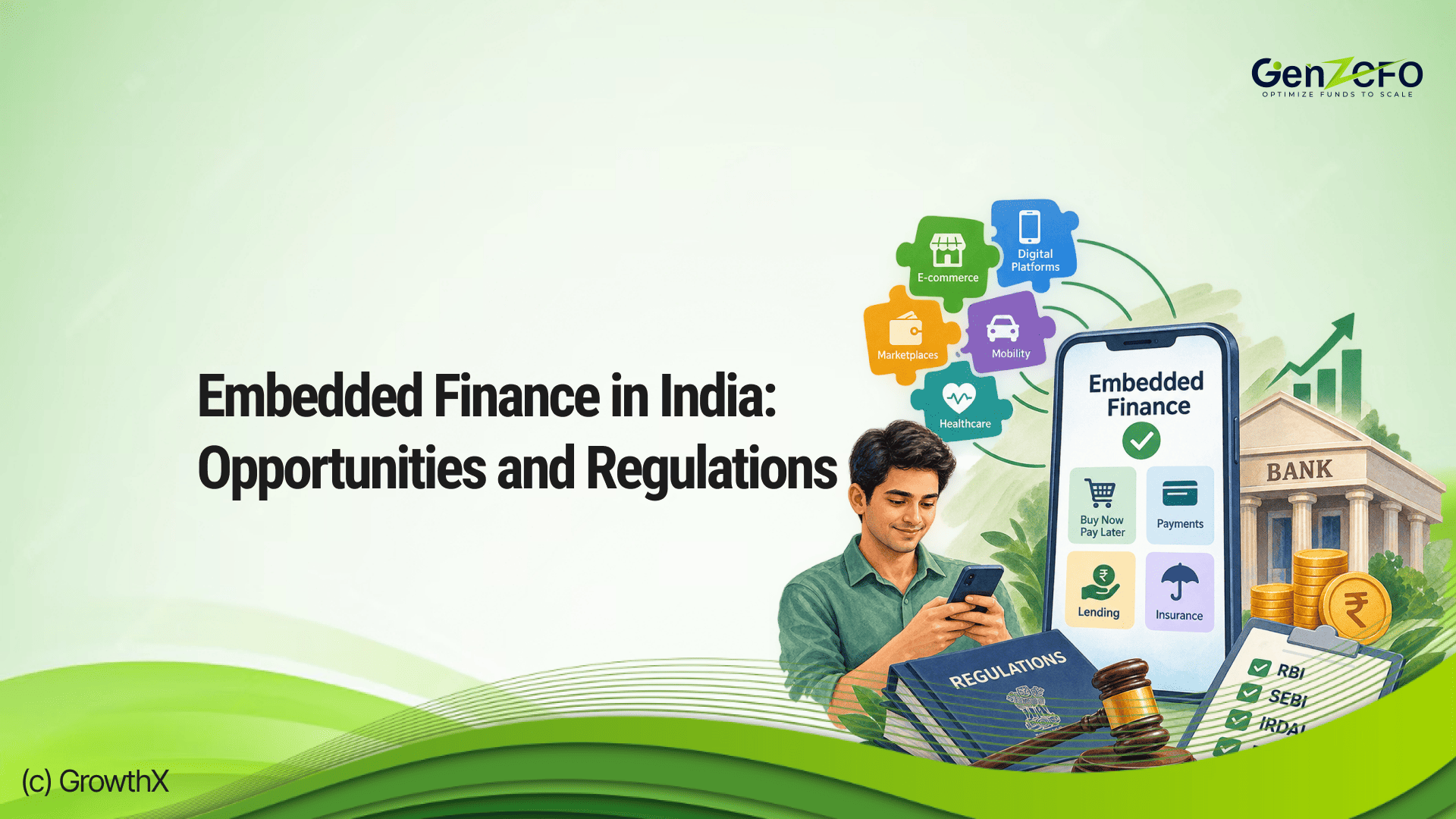
Embedded finance is transforming how financial services are accessed in India by integrating payments, loans, insurance, and other financial products directly into non-financial digital platforms. Instead of visiting a separate bank, NBFC, or insurer, customers can use financial services while shopping online, booking travel, running a business, or using digital applications. Examples include instant checkout payments, Buy Now Pay Later options, working-capital finance for sellers, and travel insurance offered during ticket booking. This makes financial services faster, more convenient, and closely connected to the customer’s actual needs.
India offers significant opportunities for embedded finance due to strong digital payment infrastructure, growing fintech adoption, Account Aggregator systems, and partnerships between technology companies and regulated institutions. However, embedded finance is not a separate licence. The applicable regulations depend on the underlying activity and may involve RBI, IRDAI, KYC, cybersecurity, payment, lending, and data-protection requirements. Businesses must therefore structure such products carefully and compliantly.
In this article, CA Manish Mishra talks about Embedded Finance in India: Opportunities and Regulations.
What is Embedded Finance?
Embedded finance refers to the integration of financial products or services into the platform, application, website or commercial journey of a business whose primary activity may not itself be financial services. The financial service is therefore offered within the customer's normal transaction experience instead of requiring the customer to separately visit a financial institution. Consider an online marketplace where a small business purchases inventory. At checkout, the platform may provide an option to pay immediately or obtain a short-term business loan from a partner NBFC. The merchant does not have to leave the marketplace, independently approach a lender and restart the application process.
The lending product has effectively been embedded into the marketplace. Similarly, when a customer books a holiday and is offered travel insurance during checkout, insurance has been embedded into the travel journey. The important legal distinction is that the platform displaying or facilitating the service is not necessarily the entity legally providing the financial product. The underlying financial activity may be undertaken by an appropriately regulated bank, NBFC, payment system operator, insurer or intermediary.
How Embedded Finance Works
Most embedded-finance arrangements involve cooperation between three broad participants: the customer-facing platform, a technology or infrastructure provider and a regulated financial institution. The customer-facing company controls the primary customer relationship. It may be an e-commerce company, mobility platform, marketplace, SaaS provider, retailer, travel company or another digital business.
The regulated financial institution provides the regulated financial product. Depending on the service, this could be a bank, NBFC, payment system operator, insurer or another authorised financial entity. Technology providers may connect the two through APIs, digital onboarding tools, underwriting technology, payment infrastructure, identity verification or other services. The customer may therefore experience one integrated interface even though several entities operate behind it. This structure creates convenience, but it also creates regulatory questions concerning which entity is responsible for customer onboarding, disclosures, KYC, consent, data processing, grievance handling, cybersecurity and regulatory compliance.
Major Types of Embedded Finance in India
Embedded finance is not limited to one financial product. It can appear across payments, lending, insurance and financial-data services.
Embedded Payments
Embedded payments allow customers to complete payments directly inside a digital product or commercial journey. For example, a food-delivery application may allow customers to pay without being redirected to an external banking website. A marketplace may integrate UPI, cards or other payment methods into its checkout process. From a commercial perspective, embedded payments reduce friction because payment becomes part of the underlying transaction.
However, the regulatory position depends on how the platform participates in the payment flow. Merely providing a technical interface can have different regulatory consequences from collecting customer funds and settling them with merchants. The Payment and Settlement Systems Act, 2007 and RBI's payment-system are therefore central to embedded-payment structures. Where a non-bank entity functions as a payment aggregator and handles customer funds before settlement with merchants, RBI authorisation and applicable payment-aggregator requirements may become relevant. RBI's regulates matters including authorisation, merchant onboarding, escrow arrangements, settlement and customer protection.
Embedded Lending
Embedded lending allows credit to be offered within a non-financial platform. A seller on an e-commerce marketplace may be offered working-capital finance based on sales data. A consumer purchasing electronics may be offered instalment-based finance at checkout. A business software platform may provide its users access to loans through a partner bank or NBFC. In India, the regulatory for this model became significantly clearer with the Reserve Bank of India (Digital Lending) Directions, 2025, issued on May 8, 2025. These Directions apply to digital lending activities of commercial banks, specified cooperative banks, NBFCs including housing finance companies and All-India Financial Institutions.
Under many embedded-lending structures, the customer-facing technology company may function as a Lending Service Provider (LSP) while the actual loan is provided by a regulated bank or NBFC. This distinction is critical. An LSP facilitates activities connected with lending but does not automatically become the lender merely because the loan is offered through its platform.
Lending Service Providers and Embedded Lending
The RBI Digital Lending Directions define and regulate arrangements between regulated lenders and Lending Service Providers. An LSP may support functions such as customer acquisition, underwriting support, servicing, monitoring or recovery, depending upon its agreement with the regulated lender. However, outsourcing these functions does not remove the responsibility of the regulated financial institution. RBI's approach places continuing responsibility upon the regulated lender for compliance with applicable lending requirements.
This means a bank or NBFC cannot simply argue that improper conduct occurred because its technology partner controlled the customer interface. The regulated entity must conduct appropriate due diligence before entering into or renewing arrangements with an LSP and must appropriately oversee the activities performed through that arrangement.
Transparency When Multiple Lenders Are Available
Embedded-finance platforms may partner with multiple lenders rather than offering credit from only one financial institution. The 2025 Digital Lending Directions specifically address arrangements where an LSP works with multiple regulated lenders. Where multiple loan offers matching the borrower's request are available, the customer should receive an appropriate digital view of the available offers. The RBI requires transparency regarding matters such as the lender, loan amount, tenor, annual percentage rate and other relevant conditions.
Also seeks to prevent the interface from using manipulative design or dark patterns to push borrowers towards a particular product that may not suit their requirements. This is especially important for embedded finance because the customer may perceive the platform itself as recommending the credit product.
Borrower Creditworthiness Must Still Be Assessed
Convenience does not eliminate responsible lending requirements. Before extending a digital loan, the regulated lender must obtain necessary information to assess the borrower's creditworthiness. A platform may use transaction histories, cash-flow patterns and other legitimate information to support underwriting, but the lending process must remain compliant with applicable regulatory requirements.
Embedded lending should therefore not be structured merely to maximise loan conversion at checkout. The financial institution must continue to apply appropriate credit assessment and risk management.
Key Facts Statement and Pricing Transparency
Customers obtaining a digital loan must receive clear information regarding the cost and terms of the credit. RBI's digital lending requires appropriate disclosures and integrates the requirement for a Key Facts Statement (KFS) containing material information about the loan. The KFS enables the customer to understand important matters such as the Annual Percentage Rate, charges and repayment terms.
This is important because embedded credit may appear at the exact point when the customer is purchasing something. The convenience and speed of checkout should not prevent a borrower from understanding the financial obligation being accepted. Platforms therefore need to design customer journeys in which disclosure is meaningful rather than hidden behind several screens or links.
Loan Disbursement and Repayment
One of RBI's important safeguards in digital lending concerns the movement of money. As a general principle under the Digital Lending Directions, loan disbursal should be made directly into the borrower's bank account, subject to specified exceptions, and repayment should ordinarily flow directly between the borrower and the regulated lender rather than through an uncontrolled third-party pool account.
This requirement reduces the risk that unregulated technology intermediaries improperly control borrowers' loan funds. Embedded-lending platforms must therefore carefully design their fund flows. A seamless customer interface does not justify routing money through an account structure inconsistent with RBI requirements.
Cooling-Off Period for Digital Loans
Digital lending can happen extremely quickly. A consumer may accept a loan in seconds without fully considering its implications. To address this, RBI requires borrowers to be provided a cooling-off period during which they can exit the digital loan by paying the principal and proportionate Annual Percentage Rate, subject to the applicable conditions.
Under the 2025, the period is determined by the regulated entity under its policy but cannot be less than the regulatory minimum prescribed by RBI. An embedded-finance interface should therefore clearly explain this right instead of treating loan acceptance as irreversible immediately after a customer clicks the confirmation button.
Embedded Buy Now, Pay Later Products
Buy Now, Pay Later, commonly called BNPL, is one of the most familiar forms of embedded credit. A consumer purchasing a product may be permitted to pay later or divide the payment into instalments. However, describing a product as BNPL does not remove the need to determine its legal character. Where the arrangement involves extension of credit or a loan through an RBI-regulated entity, relevant digital-lending, credit reporting, customer-protection and disclosure requirements may apply. Businesses designing BNPL arrangements should therefore examine who is actually extending the credit, how funds move, what charges are imposed, how the arrangement is reported and what happens when repayment is delayed.
Embedded Insurance
Insurance can also be embedded into non-financial customer journeys. Examples include travel insurance while booking a flight, device protection when purchasing electronics, motor-related insurance through mobility platforms or insurance products offered through other digital ecosystems. However, distribution of insurance is a regulated activity. The Insurance Regulatory and Development Authority of India (IRDAI) regulates insurers and insurance intermediaries, including recognised distribution channels.
Insurance Web Aggregators are specifically regulated intermediaries that operate digital interfaces for comparison and information concerning insurance products. IRDAI confirms that Insurance Web Aggregators operate under a regulatory and require registration. IRDAI also recognises electronic insurance distribution mechanisms such as the Insurance Self Network Platform for eligible insurers and insurance intermediaries. Therefore, an online platform cannot assume that it may sell, solicit or distribute insurance merely because insurance is displayed alongside another product. The appropriate insurance distribution structure, intermediary status, agreements, disclosures and regulatory permissions must be examined.
Embedded Wallets and Prepaid Payment Instruments
Some platforms may wish to provide stored-value wallets, gift instruments or other prepaid functionality. RBI regulates Prepaid Payment Instruments (PPIs) under the Master Directions on PPIs. PPIs can facilitate purchases, remittances and other financial functions against stored value. RBI distinguishes regulated PPIs from certain closed-system instruments that can only be used to purchase goods or services from the issuing entity itself.
Non-bank entities issuing regulated PPIs generally require RBI authorisation and must comply with applicable net-worth, KYC, operational, safeguarding and customer-protection requirements. Consequently, a commercial platform should not label a product simply as a “wallet” and assume it falls outside financial regulation. The actual functionality determines the regulatory treatment.
Account Aggregator and Embedded Finance
The Account Aggregator ecosystem is another important component of India's digital financial infrastructure. An NBFC-Account Aggregator enables consent-based sharing of specified financial information between Financial Information Providers and Financial Information Users. RBI's Account Aggregator is designed to facilitate secure and authorised movement of financial data across participating entities. RBI has also prescribed technical standards intended to support secure and seamless sharing.
For embedded finance, this can assist in creating better customer experiences and more informed financial decisions where legally permitted. For example, a borrower may authorise the sharing of financial information that enables a lender to assess cash flows instead of requiring customers to manually collect and upload numerous statements. However, access to such data must remain consent-based and within the applicable Account Aggregator.
KYC and Anti-Money Laundering Compliance
Financial services cannot be embedded in a way that bypasses customer identification requirements. RBI-regulated entities remain subject to the Reserve Bank of India Know Your Customer Directions, the Prevention of Money Laundering Act, 2002 and applicable AML requirements. RBI amended its KYC in June 2025 to further address customer service and periodic updating requirements.
Depending on the financial service involved, KYC may require collection and verification of identity information, customer due diligence, risk categorisation, beneficial ownership identification for legal entities, transaction monitoring and periodic updating. A fintech or commercial platform conducting parts of the onboarding process on behalf of a regulated entity must therefore ensure that its technology and processes comply with the requirements imposed by the regulated partner. Customer convenience cannot be achieved by removing mandatory KYC controls.
Data Protection is Central to Embedded Finance
Embedded-finance businesses often have access to unusually rich information. A platform may know what a customer buys, where the customer travels, how much the customer earns, how frequently a merchant sells products, how a business manages cash flow and whether previous repayments have been made on time. When such commercial information is combined with financial data, it can create significant privacy concerns.
India's Digital Personal Data Protection Act, 2023 and the Digital Personal Data Protection Rules, 2025 therefore form an increasingly important part of the compliance environment for embedded-finance platforms. The final DPDP Rules were notified in November 2025, but their substantive requirements are being brought into force in phases. As of September 2026, certain provisions are already operational, while a further phase becomes effective in November 2026 and major substantive provisions are scheduled for a later phase in May 2027. Businesses should therefore distinguish between provisions already legally effective and requirements that are approaching commencement, while building systems capable of meeting the complete.
Consent and Purpose Limitation
Consent is particularly important in an embedded-finance model because customers may interact primarily with the non-financial platform rather than directly with the regulated institution. The user should understand what information is being collected, why it is needed and with whom it may be shared. A broad statement saying that customer information may be used for “financial services” may not always provide the transparency expected under evolving privacy standards.
Businesses should design consent flows that clearly distinguish between information necessary for the primary commercial service and data being processed for lending, payments, insurance or other financial services. This also reduces the risk that financial information obtained for one purpose is subsequently reused for unrelated advertising or profiling without an appropriate legal basis.
RBI's Specific Data Requirements for Digital Lending
Digital lending also contains sector-specific data restrictions independent of the broader DPDP. The RBI Digital Lending Directions contain requirements concerning the collection, use, sharing and storage of borrower information. The seeks to limit unnecessary collection and requires the regulated entity to ensure proper controls around data obtained through LSPs and Digital Lending Apps. The Directions also require comprehensive privacy policies and appropriate technology standards.
Therefore, an embedded-lending provider cannot treat every piece of information accessible through the customer's smartphone or commercial account as automatically available for underwriting. Data collection should be linked to legitimate lending functions and the applicable consent and regulatory.
Payment Data Localisation
Payments create an additional layer of data regulation. RBI's directive on the Storage of Payment System Data requires authorised payment system providers to ensure that the entire data relating to payment systems operated by them is stored in systems located in India, subject to the and limited treatment of foreign transaction legs. RBI has clarified that the requirement applies to payment system providers authorised or approved by the RBI under the Payment and Settlement Systems Act.
Embedded-payment models therefore require careful technical architecture, particularly where cloud infrastructure, overseas processors or multinational technology providers are involved.
Card Data and Tokenisation
Platforms that embed card payments must also pay particular attention to card credentials. RBI has restricted storage of actual Card-on-File data by entities in the payment chain other than permitted card issuers and card networks. Tokenisation enable merchants and payment platforms to facilitate repeat transactions without storing the underlying card credentials themselves.
This is particularly important for subscription services and marketplaces seeking frictionless repeat payments. The user experience may appear seamless, but the underlying technical architecture must comply with card-data security requirements.
Cybersecurity and Technology Risk
Embedded finance creates a larger technology supply chain. The customer may access a financial product through a merchant's application, which connects to fintech middleware, cloud services, payment infrastructure and a regulated financial institution. A vulnerability in any part of that chain can potentially compromise financial data or customer transactions.
RBI has issued digital-payment security requirements for regulated entities and separate Master Directions on Cyber Resilience and Digital Payment Security Controls for non-bank Payment System Operators. Accordingly, regulated entities and their technology partners should maintain strong access controls, encryption, vulnerability management, incident response processes, vendor-risk assessment and business continuity arrangements. Outsourcing technology does not eliminate financial-sector cybersecurity risk.
Consumer Protection and Grievance Redressal
Embedded finance can create confusion regarding responsibility. A customer may believe that the marketplace provided the loan, while the marketplace may argue that the bank is responsible. The bank may rely upon the platform to operate the customer interface. Regulatory increasingly seek to prevent customers from becoming trapped between different parties.
For digital lending, both the regulated entity and an LSP that interfaces with borrowers are required to establish appropriate grievance-redressal arrangements under the RBI. The platform should clearly tell customers who the actual lender or financial provider is, where complaints can be submitted and how unresolved complaints can be escalated.
Default Loss Guarantee Arrangements
Some embedded-lending partnerships involve the fintech or LSP sharing a portion of the credit risk with the lender through a Default Loss Guarantee (DLG) arrangement. RBI permits DLG structures only within prescribed conditions.
The generally limits DLG cover and regulates matters such as eligible providers, forms of guarantee, invocation, disclosure and treatment of the underlying loan portfolio. RBI's regulatory material identifies a 5% cap of the loan portfolio for covered DLG arrangements. Embedded-finance companies should therefore not casually promise to reimburse a lender for any amount of borrower defaults. Such arrangements need to be structured within RBI's permitted.
Opportunities Created by Embedded Finance in India
One of the strongest opportunities lies in financial inclusion. A customer or small business that may not actively search for a financial product can access one at the moment it becomes commercially relevant. For example, a small seller requiring funds to replenish stock could receive a working-capital offer directly through the marketplace where its sales occur. Another major opportunity is better contextual underwriting. Traditional lending often relies heavily on financial statements and credit history. Embedded platforms may possess legitimate transactional information that, with appropriate consent and regulatory compliance, can help lenders understand business activity more accurately.
Embedded finance also improves customer convenience. Payments, lending or insurance can become part of one continuous digital journey rather than requiring separate applications and repeated information entry. For businesses, financial products can also create additional revenue opportunities and strengthen customer retention. A platform offering payments, finance or insurance can become more deeply integrated into the customer's commercial activity.
Opportunities for MSMEs
Embedded finance can be particularly important for micro, small and medium enterprises. Many MSMEs experience temporary working-capital shortages even when their underlying businesses are viable. Digital marketplaces, accounting software providers and supply-chain platforms may possess transaction information capable of supporting quicker credit assessment by partner financial institutions.
For example, a supplier regularly receiving purchase orders through a B2B platform may be able to access invoice or working-capital finance based on its demonstrated commercial activity. This can shorten the distance between the need for finance and the availability of finance. However, lending decisions must still comply with applicable credit, KYC, disclosure and data-protection requirements.
Embedded Finance for E-Commerce
E-commerce platforms are natural environments for embedded financial products because they already control the customer purchase journey. Possible products include integrated payments, instalment credit, merchant finance, consumer lending, insurance and seller financial services.
However, e-commerce businesses should carefully distinguish between facilitating a regulated service and undertaking the regulated activity themselves. The more a platform controls fund flows, credit decisions, insurance solicitation or customer financial accounts, the greater the need to analyse licensing and regulatory exposure.
Embedded Finance in Mobility and Travel
Mobility and travel platforms can integrate payment collection, driver financial products, fuel-related payments, travel insurance and other services. For example, a ride platform may facilitate earnings-linked financial products for drivers through a regulated lender.
A travel application may offer insurance during booking through an authorised insurance distribution arrangement. These models can create strong commercial value because the platform has contextual information about the customer's activity. Nevertheless, consent, fair disclosure and clear identification of the regulated provider remain essential.
Embedded Finance in SaaS Platforms
Software-as-a-Service providers serving businesses are increasingly well positioned to integrate finance. Accounting software may offer invoice financing. Payroll software may connect employers to financial services. Procurement systems may integrate trade-credit solutions. Because the financial product is connected directly to business operations, customers may receive finance exactly when cash-flow requirements arise.
This represents a significant opportunity, but SaaS companies should determine whether they are acting merely as technology service providers, Lending Service Providers, payment intermediaries or regulated entities themselves. The contractual and regulatory role should be defined before launching the product.
Banking-as-a-Service and Embedded Finance
Banking-as-a-Service, or BaaS, is frequently associated with embedded finance. Under such arrangements, technology infrastructure may enable businesses to connect with banking products through APIs while the actual regulated banking functions remain with an authorised bank.
However, “Banking-as-a-Service” is a commercial and technological description; it does not itself create a separate exemption from Indian banking regulation. A non-bank platform cannot accept deposits, represent itself as a bank or conduct regulated banking activities merely because those functions are technology-enabled. The contractual structure should clearly identify which functions are performed by the regulated bank and which are provided by the technology partner.
Regulatory Responsibility Cannot Be Outsourced Away
One of the most important principles across embedded finance is that regulated institutions remain accountable for outsourced financial functions. Banks, NBFCs and other regulated entities can use technology partners to improve distribution and customer service, but regulatory responsibility does not disappear simply because the customer's interaction takes place through a third-party application.
This means regulated entities need strong vendor due diligence, contractual controls, audit rights, monitoring, information-security standards and termination mechanisms. Technology companies, on the other hand, should understand that being “only a fintech” does not protect them from contractual or regulatory consequences when they perform functions within a regulated financial chain.
Avoiding Mis-Selling and Dark Patterns
Embedded finance creates particular risks of mis-selling because financial products can be placed directly into purchasing decisions. A customer buying a ₹20,000 product might be shown a loan option that emphasises only the monthly instalment while making the total cost less visible. An insurance product might be pre-selected automatically during checkout.
A platform might place one lender's offer more prominently because it earns higher commission. These practices can create consumer-protection concerns. Product interfaces should therefore provide balanced disclosures and avoid manipulative design. RBI's 2025 Digital Lending Directions expressly address the use of dark patterns in multi-lender loan displays.
Key Regulatory Authorities
Embedded finance may involve more than one regulator depending upon the product. The Reserve Bank of India is central to banking, NBFC lending, payment systems, PPIs, payment aggregators and related financial activities. The Insurance Regulatory and Development Authority of India regulates insurance companies and insurance intermediaries. The Ministry of Electronics and Information Technology administers India's digital personal data protection.
Other regulators can become relevant depending upon the financial product. For example, investment or securities products may trigger the regulatory jurisdiction of SEBI, while pension-related services can involve PFRDA requirements. A company should therefore begin regulatory analysis with the actual financial product being embedded.
Is a Separate Embedded Finance Licence Required in India?
India does not currently operate a general regulatory licence called an “Embedded Finance Licence.” The correct regulatory analysis is activity-based. If a company is issuing a regulated PPI, it must examine PPI authorisation requirements. If it is acting as a payment aggregator, payment-aggregator rules apply. If it is actually lending, banking or NBFC requirements become relevant. If it operates as an LSP, the lender-LSP digital-lending becomes important. If it distributes insurance, IRDAI requirements must be considered. Accordingly, the word “embedded” changes the distribution experience but does not alter the legal character of the underlying financial service.
Compliance Structure Before Launching an Embedded Finance Product
Before launching an embedded-finance service, businesses should begin with a regulatory mapping exercise.
The first question should be: What financial activity is actually being performed?
The company should then identify which entity is the legal provider of that service, which regulator governs it and whether a licence, authorisation or registration is required. The entire fund flow should be documented so that it is clear where customer money originates, who receives it, where it is held and how settlement or repayment occurs. Data flows should be mapped separately. Businesses should know which customer information is collected, which entities receive it, how consent is obtained, where the information is stored and when it is deleted.
Customer-facing disclosures should clearly identify the regulated financial institution and explain key product terms. Contracts between the financial institution, platform and technology providers should allocate responsibilities for KYC, complaints, cybersecurity, data protection, audit, regulatory reporting, outsourcing and incident response. Only after these regulatory and operational controls are designed should the product be integrated into the customer interface.
Major Compliance Risks in Embedded Finance
One significant risk is regulatory misclassification. A technology company may believe that it is only providing software when its actual activities amount to payment aggregation, loan servicing or insurance distribution. Another risk is inadequate customer disclosure. Customers should not be left uncertain about who actually provides the financial product.
Data misuse is also a major concern because embedded-finance providers can combine commercial and financial information. Cybersecurity and third-party dependency create additional risks because multiple organisations may access customer information or participate in financial transactions. Mis-selling, unfair loan terms, hidden charges, poor grievance redressal and inappropriate use of customer information can all attract regulatory scrutiny and damage customer trust.
Future of Embedded Finance in India
Embedded finance is likely to become increasingly integrated into India's digital economy. Customers may gradually stop thinking about financial services as separate products and instead access them as features within broader digital experiences. For businesses, this creates opportunities to improve customer journeys and offer highly contextual financial solutions. For financial institutions, partnerships with digital platforms can create new distribution channels and improve access to customers.
At the same time, the regulatory environment is moving towards greater accountability in areas such as digital lending, financial-data use, customer consent, cybersecurity and transparent product design. The long-term success of embedded finance will therefore depend not only on technological innovation but also on the ability of businesses and financial institutions to build compliant, transparent and trustworthy models.
Conclusion
Embedded finance is becoming an important part of India’s digital financial ecosystem by combining technology, commerce, and regulated financial services on a single platform. It allows customers and businesses to access payments, credit, insurance, and other financial products directly within e-commerce platforms, SaaS applications, marketplaces, mobility services, and travel platforms. This reduces transaction friction, improves convenience, and creates new opportunities for banks, NBFCs, insurers, fintech companies, and MSMEs to reach customers at the right stage of their commercial journey.
At the same time, embedded finance must operate within India’s existing regulatory. Businesses should carefully identify whether their model involves lending, payment aggregation, PPI issuance, insurance distribution, account aggregation, or another regulated activity. Compliance with RBI directions, IRDAI requirements, KYC norms, cybersecurity standards, and data-protection laws may be necessary. Therefore, regulatory planning, customer consent, transparent pricing, secure data handling, and proper governance should be built into the product from the beginning.
Frequently Asked Questions (FAQs)
Q1. What is embedded finance?
Ans. Embedded finance means integrating financial services such as payments, loans, insurance, or banking features directly into non-financial digital platforms. Customers can access these services during their normal purchase or business journey without separately visiting a bank or financial institution.
Q2. Is embedded finance regulated in India?
Ans. Yes. Embedded finance is regulated according to the underlying financial activity. Lending may attract RBI rules, insurance distribution may require IRDAI compliance, payments may require RBI authorisation, while customer information may also be subject to data protection and cybersecurity requirements.
Q3. Is there a separate embedded finance licence in India?
Ans. No general licence called an “Embedded Finance Licence” currently exists in India. The required authorisation depends on the activity performed. Lending, payment aggregation, prepaid instruments, insurance distribution, or other regulated financial services may each require specific registrations, licences, or partnerships.
Q4. What are some examples of embedded finance?
Ans. Common examples include loans offered during online checkout, travel insurance provided while booking tickets, integrated digital payments, seller financing on marketplaces, working-capital loans through business platforms, and financial products offered directly through accounting, payroll, mobility, or e-commerce applications.
Q5. Who regulates embedded lending in India?
Ans. Embedded lending involving banks, NBFCs, and other RBI-regulated lenders is primarily governed by the Reserve Bank of India. RBI’s Digital Lending Directions prescribe requirements relating to Lending Service Providers, customer disclosures, fund flows, data collection, grievance redressal, and borrower protection.
Q6. What is a Lending Service Provider in embedded finance?
Ans. A Lending Service Provider, or LSP, is an intermediary that performs certain digital lending functions for a regulated lender. It may assist with customer acquisition, underwriting support, servicing, monitoring, or recovery, while ultimate regulatory responsibility generally remains with the regulated financial institution.
Q7. Can a fintech company directly provide loans through embedded finance?
Ans. A technology company cannot simply begin lending as an unregulated business where the activity requires RBI regulation. Embedded lending is commonly structured through partnerships with banks or NBFCs, while the technology platform may operate as an LSP or service provider.
Q8. How does embedded finance benefit MSMEs?
Ans. Embedded finance can help MSMEs access working capital, invoice financing, payments, and other financial services directly through platforms they already use. Transaction history and cash-flow information may support faster credit assessment, subject to appropriate consent, underwriting, and regulatory requirements.
Q9. What are the data privacy concerns in embedded finance?
Ans. Embedded finance involves significant personal, transactional, and financial information. Businesses should clearly explain what information is collected, why it is required, who receives it, how consent is obtained, how long data is retained, and what security measures protect customer information.
Q10. Does KYC apply to embedded financial services?
Ans. Yes. Where the underlying financial product is subject to KYC requirements, embedding it within another platform does not remove those obligations. Banks, NBFCs, payment entities, and other regulated institutions must continue complying with applicable customer identification and anti-money laundering requirements.
- 16 Sep, 2026
 CA Manish Mishra
- Easing Finance
CA Manish Mishra is the Co-Founder & CEO at GenZCFO. He is the most sought professional for providing virtual CFO services to startups and established businesses across diverse sectors, such as retail, manufacturing, food, and financial services with over 20 years of experience including strategic financial planning, regulatory compliance, fundraising and M&A.