Search GrowthX Learning Content


Financial Stability and Systemic Risk in BFSI Sector
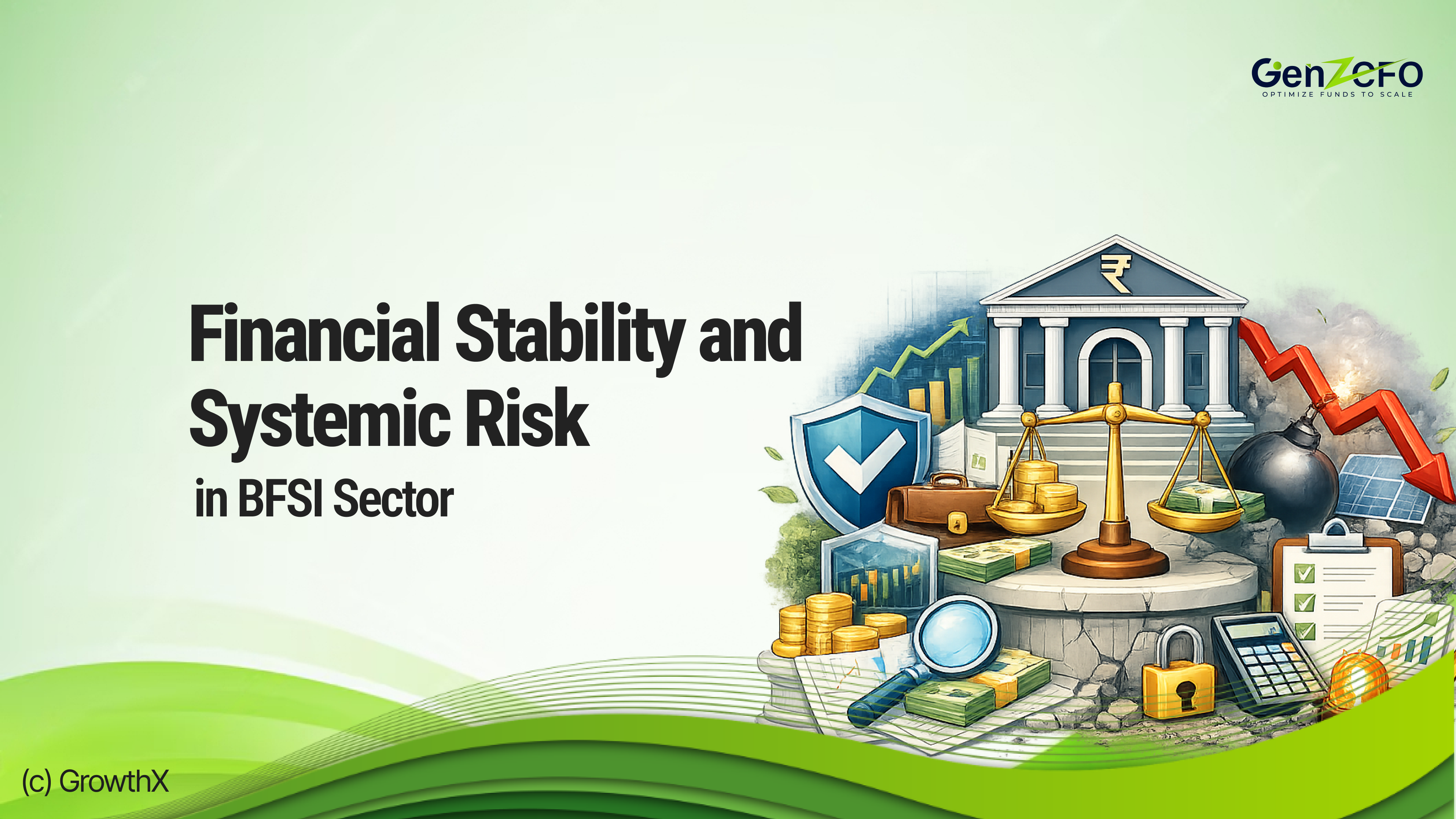
The BFSI sector, which includes Banking, Financial Services and Insurance, plays a very important role in the growth of any economy. Banks provide loans, insurance companies protect people and businesses from financial losses, NBFCs support credit access, mutual funds help in investment, and payment systems make financial transactions faster and easier.
When the BFSI sector works properly, businesses get funds, consumers feel confident, investors trust the market, and the economy grows smoothly. However, if this sector faces stress, the impact can spread very quickly. A problem in one bank, NBFC, insurance company, payment system, or financial market can affect the entire financial ecosystem. This is why financial stability and systemic risk management are extremely important in the BFSI sector. They help protect public confidence, maintain smooth financial operations, and reduce the chances of a financial crisis.
In this article, CA Manish Mishra talks about Financial Stability and Systemic Risk in BFSI Sector.
Meaning of Financial Stability
Financial stability means that the financial system is strong enough to perform its main functions even during difficult times. These functions include accepting deposits, giving loans, processing payments, settling financial transactions, providing insurance cover, and supporting investment activities. In simple words, financial stability means that banks, insurance companies, NBFCs, mutual funds, stock markets, and payment systems are able to continue their work without major disruption.
For example, if a bank faces loan defaults but still has enough capital and liquidity to continue operations, it is considered financially stable. Similarly, if an insurance company receives many claims but can still pay policyholders on time, it shows financial strength. A stable BFSI sector builds trust. People deposit money in banks, businesses take loans, investors invest in markets, and policyholders buy insurance only when they believe that the system is safe.
Meaning of Systemic Risk
Systemic risk means the risk that failure or stress in one part of the financial system may spread to other parts and create a larger crisis. It is not limited to one institution. It can affect banks, NBFCs, insurers, investors, businesses, and customers together. For example, if a large NBFC fails to repay its borrowings, banks that gave loans to that NBFC may suffer losses. Mutual funds holding its debt securities may face redemption pressure. Investors may lose confidence in similar companies. This chain reaction is called systemic risk.
Systemic risk becomes more serious when financial institutions are highly interconnected. In today’s financial system, banks, NBFCs, fintech companies, insurers, mutual funds, stock exchanges, clearing corporations, and payment platforms are closely linked. Therefore, stress in one area can easily move to another.
Importance of Financial Stability in BFSI Sector
Financial stability is important because the BFSI sector is directly connected with the real economy. If banks stop lending, businesses may not get working capital. If NBFCs face a liquidity crisis, small borrowers and MSMEs may struggle. If insurance companies are weak, policyholders may not receive timely claims. If payment systems fail, trade and commerce may slow down.
A stable financial system helps in:
Supporting Economic Growth
The BFSI sector provides funds to businesses, industries, startups, exporters, traders, and individuals. When credit is available at reasonable cost, businesses expand, employment increases, and economic activity improves.
Protecting Public Confidence
People trust banks and financial institutions with their money. If financial institutions fail frequently, public confidence reduces. This can lead to panic withdrawals, lower investments, and instability in the economy.
Maintaining Smooth Payments
Digital payments, UPI transactions, card payments, fund transfers, cheque clearing, and settlement systems are important for daily business and personal transactions. Financial stability ensures that these systems work without disruption.
Supporting Investment and Savings
A stable financial system encourages people to save and invest. Mutual funds, insurance products, pension funds, fixed deposits, bonds, and equity markets all depend on investor confidence.
Reducing Crisis Impact
Financial stability does not mean that there will be no risk. It means that the system is strong enough to absorb shocks and recover without causing large-scale damage.
Major Sources of Systemic Risk in BFSI Sector
Credit Risk
Credit risk is one of the most common risks in the BFSI sector. It arises when borrowers fail to repay loans or interest on time. Banks, NBFCs, housing finance companies, microfinance institutions, and other lenders face credit risk. If credit risk is limited to a few borrowers, it may be manageable. However, if defaults happen across a large sector, it can become a systemic problem. For example, if many real estate companies, infrastructure borrowers, or MSME borrowers default at the same time, banks and NBFCs may face heavy losses.
Poor credit appraisal, weak borrower background checks, over-lending, sector concentration, economic slowdown, fraud, and improper monitoring can increase credit risk. To control credit risk, financial institutions must assess borrower capacity properly, monitor loan accounts regularly, maintain adequate security, classify stressed accounts on time, and follow proper recovery procedures.
Liquidity Risk
Liquidity risk means the inability of a financial institution to meet its short-term payment obligations. Even if an institution has good assets, it may face crisis if it does not have enough cash or liquid funds at the required time. Liquidity risk is especially important for banks and NBFCs. Banks must be able to meet withdrawal requests from depositors. NBFCs must be able to repay lenders and investors. Mutual funds must meet redemption requests from unit holders.
A liquidity crisis can spread quickly. If one financial institution fails to repay its dues, lenders may become cautious about similar institutions. This can reduce market confidence and make borrowing difficult for the entire sector. To manage liquidity risk, BFSI entities must maintain sufficient liquid assets, match asset and liability maturities, prepare emergency funding plans, and conduct regular stress testing.
Market Risk
Market risk arises due to changes in interest rates, equity prices, bond yields, foreign exchange rates, and commodity prices. Banks, insurers, mutual funds, pension funds, and investment companies are exposed to market risk. For example, if interest rates rise sharply, the value of existing bonds may fall. If stock markets decline, mutual funds and insurance companies may suffer investment losses. If exchange rates change suddenly, companies with foreign currency exposure may face losses.
Market risk becomes systemic when many institutions hold similar assets and suffer losses at the same time. This can lead to panic selling, fall in asset prices, and wider financial instability. Proper investment limits, diversification, hedging, valuation practices, and risk monitoring are important to manage market risk.
Operational Risk
Operational risk arises due to failure of internal processes, systems, people, or external events. It includes fraud, employee mistakes, technology failure, cyber incidents, outsourcing failure, legal errors, and weak internal controls. In the BFSI sector, operational failure can affect a large number of customers. For example, failure of a banking server, payment gateway, insurance claim system, or trading platform can disrupt financial services.
Operational risk may also arise from poor documentation, weak compliance, incorrect reporting, lack of audit controls, and failure to follow regulatory instructions. Strong internal controls, standard operating procedures, audit systems, employee training, business continuity plans, and technology monitoring are necessary to reduce operational risk.
Cybersecurity Risk
Cybersecurity risk has become one of the biggest challenges for the BFSI sector. Banks, NBFCs, insurers, fintech companies, stock brokers, payment aggregators, and investment platforms handle large amounts of customer data and financial transactions. Cyberattacks may lead to data theft, financial fraud, service disruption, identity theft, ransomware attacks, and loss of customer trust. A major cyberattack on a large financial institution or payment infrastructure can create systemic risk.
With increasing use of mobile banking, UPI, digital lending, online insurance, investment apps, cloud systems, and APIs, the exposure to cyber risk has increased. BFSI companies must invest in cybersecurity systems, data protection, fraud monitoring, incident response plans, employee awareness, and regular technology audits.
Interconnectedness Risk
The BFSI sector is highly interconnected. Banks lend to NBFCs. NBFCs lend to customers. Mutual funds invest in debt securities of financial companies. Insurance companies invest in bonds and equities. Fintech companies depend on banks and payment infrastructure. Stock markets depend on clearing and settlement systems. This interconnection improves financial efficiency, but it also increases the risk of contagion. If one important institution fails, others may also face stress due to direct or indirect exposure.
For example, if a large financial company defaults, banks may face credit losses, mutual funds may face investor withdrawals, rating agencies may downgrade similar companies, and investors may lose confidence in the sector. Therefore, regulators and financial institutions must closely monitor inter-institution exposure and concentration.
Concentration Risk
Concentration risk arises when a financial institution has too much exposure to one borrower, group, industry, geography, product, or service provider. If that borrower, sector, or service provider fails, the institution may suffer serious losses. For example, if a bank gives a large portion of its loans to one corporate group, failure of that group may affect the bank’s financial position. Similarly, if an NBFC focuses heavily on one sector such as real estate or unsecured retail lending, stress in that sector can create major risk.
In the modern BFSI sector, concentration risk is not limited to lending. It also includes dependence on a few technology vendors, cloud service providers, payment platforms, data processors, and outsourcing agencies. Diversification, exposure limits, vendor risk management, and regular risk review are important to reduce concentration risk.
Governance Risk
Governance risk arises when the management, board, or key officials of a financial institution fail to act responsibly. Weak governance can lead to fraud, connected lending, poor risk control, regulatory violations, inaccurate disclosures, and excessive risk-taking.
In BFSI, governance failure can damage public trust. Since financial institutions handle public money, they must follow high standards of transparency, accountability, and ethical conduct. Strong board oversight, independent directors, risk committees, internal audit, compliance function, whistleblower mechanism, and proper disclosure practices help in maintaining good governance.
Role of RBI in Financial Stability
The Reserve Bank of India plays a central role in maintaining financial stability in the banking, NBFC, and payment system segments. RBI regulates banks, NBFCs, housing finance companies, payment systems, and certain financial markets.
RBI monitors capital adequacy, liquidity position, non-performing assets, governance standards, customer protection, cybersecurity, and systemic risks. It also issues guidelines from time to time to strengthen the financial system.
RBI’s role includes:
-
Regulation and Supervision: RBI frames rules for banks and NBFCs regarding capital, liquidity, lending, governance, asset classification, provisioning, audit, and risk management. It also conducts inspections and supervisory reviews.
-
Monetary Stability: RBI manages monetary policy to control inflation, support growth, and maintain financial stability. Interest rate decisions affect lending, borrowing, investment, and liquidity in the economy.
-
Payment System Oversight: RBI regulates and supervises payment systems to ensure safety, security, and efficiency. This is important because digital payments are now deeply connected with daily economic activities.
-
Crisis Management: During financial stress, RBI may take steps to provide liquidity, restructure weak institutions, protect depositors, and maintain confidence in the financial system.
Role of SEBI in Financial Stability
SEBI plays an important role in maintaining stability in the securities market. It regulates stock exchanges, listed companies, mutual funds, stock brokers, portfolio managers, investment advisers, research analysts, and other market intermediaries.
A stable securities market is important for the BFSI sector because banks, insurers, mutual funds, pension funds, and investors are connected with capital markets. SEBI promotes financial stability by ensuring fair trading, transparency, investor protection, disclosure standards, market surveillance, and action against market manipulation.
Role of IRDAI in Financial Stability
IRDAI regulates the insurance sector in India. Insurance companies collect premiums from policyholders and provide protection against life, health, motor, property, business, and other risks. If insurance companies are weak, policyholders may suffer.
Therefore, IRDAI ensures that insurers maintain solvency margins, manage investments properly, settle claims fairly, and follow governance standards. Insurance stability is also important because insurers are large institutional investors. Their investment decisions affect bond markets, equity markets, and long-term savings.
Tools Used to Manage Systemic Risk
Capital Adequacy
Capital acts as a safety cushion. Banks, NBFCs, and insurers must maintain minimum capital to absorb losses. Strong capital allows institutions to survive loan defaults, market losses, operational losses, and unexpected shocks. If capital is weak, even a small loss can create serious problems. Therefore, capital adequacy is one of the most important tools for financial stability.
Stress Testing
Stress testing means checking how a financial institution will perform under difficult situations. These situations may include high loan defaults, market crash, interest rate shock, liquidity shortage, economic slowdown, or cyber disruption. Stress testing helps management and regulators understand whether the institution is prepared for adverse conditions.
Liquidity Management
Liquidity management ensures that financial institutions have enough funds to meet short-term obligations. Banks and NBFCs must carefully manage cash flows, borrowing sources, repayment schedules, and emergency funding options. Good liquidity management prevents panic and reduces the chance of default.
Asset-Liability Management
Asset-liability management means matching the maturity and cash flow of assets and liabilities. For example, if a company borrows money for 1 year but lends it for 5 years, it may face refinancing risk. Proper asset-liability management helps reduce liquidity stress and interest rate risk.
Exposure Limits
Exposure limits prevent excessive dependence on one borrower, group, sector, or product. These limits help reduce concentration risk and protect financial institutions from large losses.
Internal Control and Audit
Internal control systems help detect errors, fraud, process gaps, and compliance failures. Internal audit provides independent review of operations, risk management, and governance practices. A strong audit system is very important in BFSI because even small errors can create major financial or regulatory consequences.
Business Continuity Planning
Business continuity planning ensures that financial services continue even during emergencies such as cyberattacks, natural disasters, system failure, pandemics, or operational disruptions. Every BFSI entity must have backup systems, disaster recovery plans, alternative communication channels, and emergency response teams.
Emerging Systemic Risks in BFSI Sector
Fintech Risk
Fintech has changed the way financial services are delivered. Digital lending, online payments, investment apps, insurance technology, robo-advisory, and digital KYC have improved convenience and financial inclusion. However, fintech also creates risks related to data privacy, customer protection, outsourcing, algorithmic decision-making, recovery practices, and technology failure. Since many fintech companies work with regulated entities, their risks can affect banks, NBFCs, and customers.
Digital Lending Risk
Digital lending has made loans faster and easier. However, it may create problems if lending decisions are based only on automated models without proper borrower assessment. Hidden charges, high interest rates, aggressive recovery practices, misuse of customer data, and unregulated lending apps can create customer harm and reputational risk for the financial system.
Artificial Intelligence Risk
Artificial intelligence is increasingly used in credit scoring, fraud detection, insurance underwriting, customer service, investment analysis, and compliance monitoring. AI can improve efficiency, but it also creates risks. These include biased decisions, lack of transparency, wrong predictions, data misuse, and excessive dependence on technology. If many institutions depend on similar AI models, model failure can become a systemic issue.
Climate-Related Financial Risk
Climate change can affect the BFSI sector through floods, heatwaves, droughts, crop failures, natural disasters, and damage to infrastructure. These events can increase loan defaults, insurance claims, and asset losses. Banks may face stress in agricultural loans, housing loans, infrastructure finance, and business loans. Insurance companies may face higher claims. Therefore, climate risk is becoming an important part of financial stability planning.
Cyber Fraud and Digital Payment Risk
Digital payments have become a major part of India’s financial system. UPI, cards, mobile wallets, net banking, payment gateways, and online platforms are used daily by millions of users. Any major disruption in digital payment systems can affect consumers, merchants, banks, fintech companies, and the wider economy. Fraud, phishing, identity theft, malware, and fake apps are serious concerns.
How BFSI Institutions Can Strengthen Financial Stability
BFSI institutions must build strong risk management systems. They should not focus only on growth and profitability. They must also focus on safety, governance, customer protection, and long-term sustainability. Banks and NBFCs should improve credit appraisal, monitor stressed accounts early, avoid excessive exposure, and maintain strong liquidity. Insurance companies should maintain proper reserves, solvency margins, and claim settlement systems.
Mutual funds and investment firms should manage market risk, liquidity risk, and investor communication properly. All BFSI entities should invest in cybersecurity, compliance systems, employee training, data protection, and technology resilience. Board members and senior management must actively review risk reports and ensure that business growth does not happen at the cost of financial stability.
Conclusion
Financial stability is the foundation of a strong BFSI sector. It ensures that banks, NBFCs, insurance companies, mutual funds, capital markets, fintech platforms, and payment systems continue to support the economy even during difficult times. Systemic risk is dangerous because it can spread from one institution to the entire financial system. Credit defaults, liquidity pressure, market volatility, cyberattacks, governance failures, fintech risks, and operational disruptions can all create systemic risk.
In India, the BFSI sector has become stronger due to better regulation, improved supervision, digital development, and stronger compliance standards. However, new risks are emerging from technology, climate change, artificial intelligence, cyber fraud, and interconnected financial activities. Therefore, financial stability must remain a continuous priority. Regulators, financial institutions, boards, management teams, auditors, compliance officers, and technology partners must work together to protect the trust and strength of the BFSI sector. A stable BFSI sector does not only protect financial institutions. It protects depositors, investors, policyholders, businesses, employees, and the entire economy.
Frequently Asked Questions (FAQs)
Q1. What is financial stability in the BFSI sector?
Ans. Financial stability in the BFSI sector means that banks, NBFCs, insurance companies, mutual funds, stock markets, fintech platforms, and payment systems are able to work smoothly even during difficult economic conditions. It ensures that people can access loans, make payments, invest money, receive insurance claims, and use financial services without major disruption.
Q2. What is systemic risk in BFSI?
Ans. Systemic risk means the risk that failure or stress in one financial institution or financial segment may spread to the wider financial system. For example, if a large bank or NBFC fails, it may affect other lenders, investors, depositors, mutual funds, and businesses connected with it.
Q3. Why is systemic risk dangerous?
Ans. Systemic risk is dangerous because it does not remain limited to one institution. It can create a chain reaction across the financial system. This may lead to panic withdrawals, credit slowdown, market volatility, payment disruption, loss of investor confidence, and wider economic damage.
Q4. What are the main causes of systemic risk in the BFSI sector?
Ans. The main causes of systemic risk include credit defaults, liquidity shortages, market crashes, cyberattacks, operational failures, governance issues, excessive interconnectedness, concentration of exposure, and dependence on third-party technology providers.
Q5. How does credit risk affect financial stability?
Ans. Credit risk affects financial stability when borrowers fail to repay loans on time. If defaults increase across many borrowers or sectors, banks and NBFCs may face losses, higher non-performing assets, reduced capital, and lower capacity to lend further.
Q6. What is liquidity risk in BFSI?
Ans. Liquidity risk means the inability of a financial institution to meet its short-term payment obligations. For example, if a bank cannot meet deposit withdrawals or an NBFC cannot repay its lenders on time, it may face liquidity stress.
Q7. How can liquidity risk become systemic?
Ans. Liquidity risk can become systemic when one institution’s failure creates fear among lenders, investors, and depositors. This may result in sudden withdrawals, refusal of refinancing, redemption pressure in mutual funds, and reduced confidence in similar financial institutions.
Q8. What role does RBI play in financial stability?
Ans. RBI plays a key role in maintaining financial stability by regulating banks, NBFCs, payment systems, and certain financial markets. It monitors capital adequacy, liquidity, asset quality, governance, cybersecurity, and systemic risk in the financial system.
Q9. What is the role of SEBI in reducing systemic risk?
Ans. SEBI helps reduce systemic risk in capital markets by regulating stock exchanges, listed companies, mutual funds, stock brokers, investment advisers, research analysts, and other market participants. It promotes transparency, fair trading, investor protection, and market discipline.
Q10. What is the role of IRDAI in financial stability?
Ans. IRDAI maintains stability in the insurance sector by regulating insurance companies, ensuring solvency requirements, protecting policyholders, monitoring claim settlement practices, and ensuring proper governance in insurance businesses.
- 03 Jun, 2026
 CA Manish Mishra
- Easing Finance
CA Manish Mishra is the Co-Founder & CEO at GenZCFO. He is the most sought professional for providing virtual CFO services to startups and established businesses across diverse sectors, such as retail, manufacturing, food, and financial services with over 20 years of experience including strategic financial planning, regulatory compliance, fundraising and M&A.