Search GrowthX Learning Content


NBFC Takeover Process in India: A Step-by-Step Guide
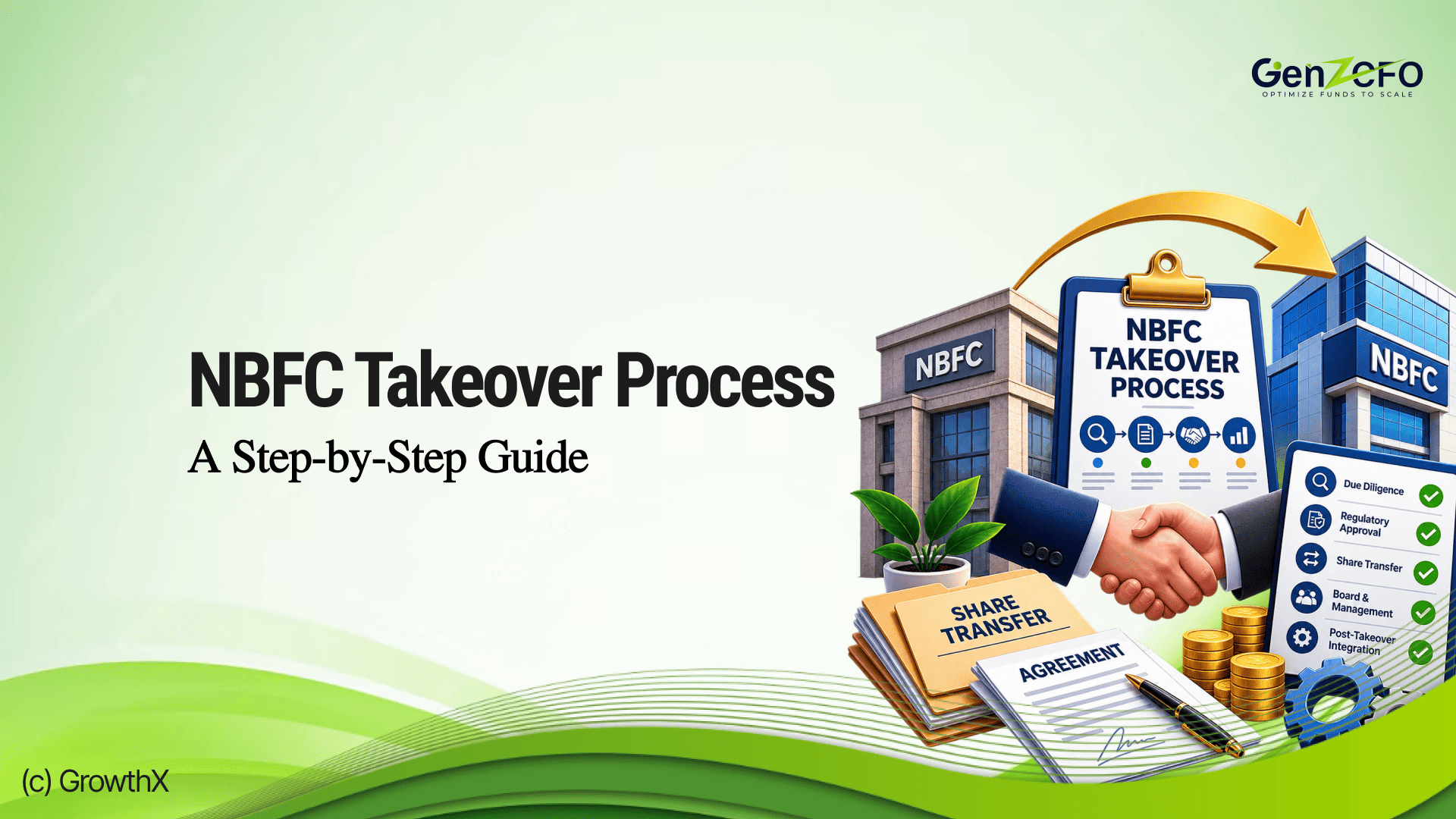
An NBFC takeover in India involves acquiring ownership, significant shareholding, or control of an existing Non-Banking Financial Company. Unlike an ordinary company acquisition, an NBFC takeover is closely regulated by the Reserve Bank of India (RBI) because NBFCs operate in the financial sector and deal with lending, investment, and other regulated activities. Depending on the proposed change in control, shareholding, or management, prior RBI approval may be required before the transaction is completed.
The regulatory structure was further consolidated through the RBI (Non-Banking Financial Companies Acquisition of Shareholding or Control) Directions, 2025. These Directions specify when RBI approval is needed, the documents to be submitted, the procedure for filing the application, and public notice requirements. Therefore, investors planning to acquire an NBFC must carefully conduct due diligence, structure the transaction, obtain regulatory approval where applicable, complete the prescribed notice process, and fulfil post-takeover compliances before taking effective control of the company.
In this article, CA Manish Mishra talks about NBFC Takeover Process in India: A Step-by-Step Guide.
What is an NBFC Takeover?
An NBFC takeover generally refers to a transaction through which an individual, company, investor or group obtains a significant ownership interest or control over an existing RBI-registered NBFC. The takeover may occur through the acquisition of shares, transfer of promoter holdings, acquisition of voting rights, contractual rights giving control, a restructuring of ownership, or another arrangement under which the incoming investor gains control over the NBFC.
This distinction is important because RBI approval is not determined merely by the percentage of shares purchased. Under the 2025 Directions, any takeover or acquisition of control of an NBFC requires prior written permission from RBI, whether or not it results in a change of management. Therefore, a transaction involving less than 26% of equity may still require prior RBI approval if it gives the investor “control” over the NBFC.
Regulatory Structure Governing NBFC Takeovers
The most important regulatory context for an NBFC takeover presently includes the Reserve Bank of India Act, 1934, the Companies Act, 2013, the RBI’s NBFC Directions and other regulations applicable to the transaction. The principal RBI instrument dealing specifically with ownership changes is the Reserve Bank of India (Non-Banking Financial Companies – Acquisition of Shareholding or Control) Directions, 2025, effective from November 28, 2025. The Directions expressly provide that their requirements operate in addition to other applicable laws. Therefore, depending upon the structure of a particular takeover, additional requirements under the Companies Act, FEMA, securities laws, competition law, taxation law and sector-specific regulations may also have to be examined.
The 2025 takeover Directions generally cover NBFC categories including NBFC-ICCs, NBFC-MFIs, NBFC-Factors, NBFC-IFCs, IDF-NBFCs, Housing Finance Companies, Core Investment Companies, NBFC-P2Ps and Account Aggregators, subject to the specific applicability provisions. Mortgage Guarantee Companies and Non-Operative Financial Holding Companies are excluded from these particular Directions and are governed under their respective frameworks.
When is Prior RBI Approval Required for an NBFC Takeover?
This is the most important question that must be determined before executing the transaction.
Takeover or Acquisition of Control
Prior written permission from RBI is required for any takeover or acquisition of control of an NBFC, whether or not the transaction results in a change in management. This means that simply keeping the shareholding below a numerical threshold does not necessarily remove the RBI approval requirement. If contractual arrangements, voting agreements, board nomination rights or similar rights effectively give the acquirer control, regulatory approval needs to be examined.
Acquisition or Transfer of 26% or More Shareholding
Prior RBI permission is required where a change in shareholding, including progressive increases over time, results in an acquisition or transfer of 26% or more of the paid-up equity capital of the NBFC. For example, if an investor initially purchases 20% and subsequently proposes to increase the holding to 30%, the transaction crosses the 26% threshold and RBI approval becomes relevant.
The rule covers progressive acquisitions specifically to prevent a transaction from being divided into smaller stages merely to remain below the regulatory threshold. The Directions provide a limited exception where the shareholding exceeds 26% because of a buy-back or reduction of capital approved by a competent Court. In such a situation prior approval is not required under that specific provision, although the event must be reported to RBI/NHB within the prescribed period.
Change of More Than 30% of Directors
Ownership approval should not be confused with RBI's separate requirement regarding management changes. Under the RBI NBFC Governance Directions, 2025, prior written RBI permission is required where a change in management would result in a change in more than 30% of the directors, excluding independent directors. Re-election of directors retiring by rotation is excluded from this prior-approval requirement. The application for such management change is also made through the PRAVAAH portal.
Thus, a takeover transaction may involve two separate RBI questions: whether the ownership/control change requires approval and whether the proposed board restructuring separately crosses the management-change threshold.
Special Rule for Certain Housing Finance Companies
For a Housing Finance Company accepting or holding public deposits, the 2025 Directions prescribe an additional threshold where acquisition or transfer by or to a foreign investor results in 10% or more of the paid-up equity capital being acquired or transferred. Transactions involving HFCs therefore require additional category-specific review rather than applying only the general 26% rule.
NBFC Takeover Process in India
Step 1: Identify a Suitable NBFC Target
The takeover begins by identifying an existing RBI-registered NBFC whose licence, business profile, financial condition and permitted activities are compatible with the buyer's intended business model. It is not enough to acquire any company that describes itself as an NBFC. The buyer should verify that the target continues to hold a valid Certificate of Registration (CoR) and that its regulatory category and business activities correspond with the proposed post-acquisition business.
RBI currently categorises NBFCs not only according to their activities and deposit status but also under its Scale Based Regulation framework into Base, Middle, Upper and Top Layers. This classification can materially affect governance, capital and compliance requirements after the transaction.
Step 2: Conduct Preliminary Regulatory Screening
Before commercial negotiations progress too far, the buyer should conduct a preliminary regulatory assessment of the target. One particularly important consideration in 2026 is the Net Owned Fund (NOF) position. RBI's current FAQ states that the general minimum NOF for an NBFC seeking registration is ₹10 crore, while existing NBFCs covered by the transition are required to attain ₹10 crore by March 31, 2027. Different minimum capital requirements apply to specialised categories such as HFCs, IFCs, IDF-NBFCs, Mortgage Guarantee Companies, Account Aggregators and P2P entities.
Accordingly, an NBFC that appears inexpensive to acquire may require substantial additional capital after takeover to comply with the applicable NOF or prudential requirements. A prospective buyer should therefore examine the regulatory category, CoR, NOF, asset size, permitted activities, borrowing arrangements, deposit status and past RBI correspondence before determining the acquisition price.
Step 3: Sign a Term Sheet or Letter of Intent
Once an appropriate target has been identified, the buyer and seller generally document the preliminary commercial understanding through a Term Sheet, Memorandum of Understanding or Letter of Intent. At this stage, the parties typically agree upon the proposed valuation, percentage of shares to be acquired, consideration, proposed management structure, exclusivity period, due-diligence rights and responsibilities for obtaining regulatory approvals.
Importantly, the transaction documentation should clearly provide that completion is subject to prior RBI approval wherever applicable. The parties should avoid transferring control, implementing management rights or otherwise giving effect to the acquisition before satisfaction of the required regulatory conditions.
Step 4: Conduct Detailed Due Diligence
Due diligence is one of the most important stages of an NBFC acquisition because the purchaser acquires not merely the shares but also the historical liabilities and regulatory exposure of the company.
A comprehensive investigation should cover the following major areas:
-
RBI Certificate of Registration and category of NBFC;
-
present and historical shareholding;
-
Net Owned Fund and capital adequacy position;
-
audited financial statements and statutory audit observations;
-
RBI returns and regulatory filings;
-
loan portfolio and asset quality;
-
Non-Performing Assets and provisioning;
-
KYC and Anti-Money Laundering compliance;
-
customer complaints and regulatory grievances;
-
fair practices and lending policies;
-
related-party transactions;
-
outstanding borrowings and security interests;
-
tax liabilities and assessments;
-
pending litigation;
-
notices or observations received from RBI or other regulators;
-
digital lending arrangements and Lending Service Providers, where applicable;
-
data protection, cybersecurity and IT systems;
-
outsourcing arrangements;
-
employee obligations;
-
material contracts;
-
frauds, defaults and write-offs; and
-
compliance with applicable corporate governance requirements.
RBI regulates NBFCs across prudential, governance, KYC/AML, conduct, disclosure and other areas, making regulatory due diligence particularly important in an NBFC transaction. RBI also has powers to take penal action for violations, including cancellation of an NBFC's CoR in appropriate cases. Any historical irregularity should therefore be quantified and appropriately covered through conditions precedent, indemnities or purchase-price adjustments.
Step 5: Determine Whether RBI Approval is Triggered
After the proposed transaction structure has been finalised, the parties should formally analyse whether the takeover satisfies any regulatory trigger.
A simplified position is:
|
Proposed Change |
RBI Requirement |
|
Takeover or acquisition of control |
Prior RBI approval required |
|
Acquisition/transfer reaching 26% or more of paid-up equity capital |
Prior RBI approval required |
|
Progressive acquisitions eventually reaching 26% or more |
Prior RBI approval required |
|
Change in management replacing more than 30% of directors, excluding independent directors |
Separate prior RBI approval requirement under Governance Directions |
|
Foreign investor acquiring/transferring 10% or more in certain deposit-taking HFCs |
Special prior approval provision applies |
|
SPD shareholding/capital structure change |
Specific prior RBI approval applies |
The exact transaction should nevertheless be examined individually because control rights, indirect ownership structures and the category of NBFC can affect the analysis.
Step 6: Prepare the RBI Application
Where prior approval is required, the NBFC must prepare a detailed application for submission to RBI. The 2025 Directions prescribe submission through the RBI PRAVAAH portal on the company's letterhead. Among the documents specifically required under the current Directions are information concerning the proposed shareholders in the prescribed Annexure, details regarding the source of funds, prescribed declarations concerning association with unincorporated bodies accepting public deposits, declarations concerning association with companies whose NBFC registration applications have been rejected, declarations regarding criminal proceedings including specified cheque-dishonour offences, and bankers' reports concerning the proposed shareholders.
Depending upon the transaction and the PRAVAAH process requirements, additional transaction and corporate information may also have to be provided. Accordingly, parties should prepare the application only after the transaction structure, ultimate beneficial ownership, funding route and proposed management are clear.
Step 7: RBI's Fit-and-Proper Assessment
RBI's examination is not merely a procedural approval of a share transfer. The regulatory objective is to ensure that persons acquiring influence or control over a regulated financial company are suitable to operate within the financial sector. Accordingly, the information sought regarding the incoming shareholder's identity, financial position, funding sources, banking record and regulatory/criminal background becomes critical.
For proposed directors, the Governance Directions also emphasise fit-and-proper assessment and continuing due diligence, particularly for NBFCs falling within the applicable Middle and Upper Layer governance framework. Factors include qualifications, expertise, track record and integrity. RBI may seek additional information or clarification during examination of the application. The parties should therefore avoid structuring their transaction with an unrealistic fixed closing date dependent upon a presumed regulatory processing period.
Step 8: Check Source of Funds and FATF Restrictions
One of the notable features of the 2025 framework is the explicit treatment of investments coming from or through FATF non-compliant jurisdictions. The Directions provide that a new investor from or through a FATF non-compliant jurisdiction should not directly or indirectly acquire significant influence in an NBFC. The framework generally requires fresh investors from such jurisdictions, in aggregate, to remain below 20% of the voting power, including potential voting power, subject to the detailed provisions of the Directions.
This makes the ownership chain particularly important in transactions involving overseas funds, holding companies, private equity structures or foreign strategic investors. In addition to RBI's takeover approval requirements, foreign-investment transactions must separately be examined for compliance with applicable FEMA and foreign-investment rules.
Step 9: Obtain RBI Prior Approval
The proposed acquisition should not be treated as completed merely because the parties have executed contractual documents. Where approval is required, the parties must first obtain RBI's prior written permission before giving effect to the acquisition or transfer of control.
Any Share Purchase Agreement signed before approval should therefore appropriately treat RBI approval and other regulatory permissions as conditions precedent to closing. The approval may also contain transaction-specific conditions that must be fulfilled before completion.
Step 10: Publish the Mandatory Public Notice
After RBI permission is obtained, the public-notice stage becomes important. Under the 2025 Acquisition of Shareholding or Control Directions, a public notice must generally be issued at least 30 days before effecting the transfer of ownership through a sale of shares or the transfer of control, with or without a sale of shares. The notice is required to be published in at least one leading national newspaper and one leading local vernacular newspaper covering the location of the registered office.
The Directions further specify that the notice is to be given by the NBFC and the transferee party, either separately or jointly, after obtaining RBI's prior permission. It should indicate the intention to sell or transfer ownership/control, provide particulars of the transferee and explain the reasons for the transaction. Therefore, the sequence is critical:
RBI Approval → Public Notice → 30-Day Period → Transaction Closing
The share/control transfer should not be completed before the applicable notice requirement has been satisfied.
Step 11: Complete the Share Transfer and Transaction Closing
After RBI approval, satisfaction of the applicable notice period and fulfilment of all contractual conditions precedent, the transaction can proceed to closing. At closing, the parties generally complete payment of consideration, execute the required share-transfer documentation, update the company's statutory records, give effect to the approved shareholding structure and implement the approved management changes.
The final shareholding should correspond with the structure placed before RBI. Any material departure from the approved transaction should be carefully reviewed before implementation. Depending upon whether the NBFC is listed or unlisted and whether foreign investment is involved, separate securities, FEMA, depository and corporate-law procedures may also apply. The RBI Directions themselves expressly preserve the applicability of other laws.
Step 12: Reconstitute the Board and Management
The acquirer may wish to nominate new directors after takeover. This should be done carefully because RBI's governance rules remain applicable independently of the ownership approval. If the management change results in replacement of more than 30% of directors, excluding independent directors, RBI's prior written permission is required. The Governance Directions also require NBFCs to continue informing RBI or, in relevant HFC cases, NHB about changes in directors or management.
The post-acquisition Board must also continue to satisfy regulatory governance requirements applicable to the NBFC's category and layer. For example, the current Governance Directions require at least one director of an NBFC to have relevant experience of having worked in a bank or NBFC and prescribe additional governance mechanisms for specified categories/layers.
Step 13: Complete ROC and Corporate Compliances
An NBFC continues to remain a company governed by the Companies Act, 2013 even though it is regulated by RBI. Accordingly, after closing, the company should complete all applicable corporate actions relating to transfer of securities, appointment or resignation of directors, beneficial ownership, maintenance of statutory registers, Board resolutions and prescribed filings with the Registrar of Companies.
The Articles of Association, shareholders' agreements and statutory records should also be checked to ensure that the post-acquisition governance structure is correctly reflected. Where consideration is paid to non-residents or the transaction involves foreign investment, additional FEMA reporting and pricing requirements should be separately assessed.
Step 14: Make Post-Takeover RBI Intimations
Regulatory compliance does not end after RBI gives its approval. NBFCs are required to continue communicating prescribed changes concerning directors, management and other corporate particulars to the relevant regulator. Under the governance framework, changes in directors/management continue to be reportable even where they do not cross the >30% prior-approval threshold.
Current RBI miscellaneous requirements also contemplate intimation of changes in matters such as directors, principal officers, authorised signatories and auditors within the prescribed. The company should therefore maintain a detailed post-closing compliance checklist rather than assuming that completion of the share transfer concludes the regulatory process.
Important Areas to Review During NBFC Takeover Due Diligence
A purchaser should pay particular attention to the quality of the target's loan portfolio. A company may possess an RBI registration but still carry a weak portfolio containing overdue loans, inadequately provided assets, related-party exposures or documentation problems. The buyer should also verify whether the NBFC has historically maintained its applicable NOF and capital requirements. This is particularly relevant because existing NBFCs within the general transitional regime are moving towards the ₹10 crore NOF requirement by March 31, 2027.
KYC and AML compliance should be examined at borrower-file level rather than only checking whether policies exist. Deficiencies in customer identification, suspicious transaction controls or beneficial-ownership verification can create significant post-acquisition remediation requirements. Technology and digital lending arrangements require equal attention where loans are originated digitally. The buyer should review the relationship with Lending Service Providers, data flows, collection systems, customer-consent processes, cybersecurity controls and outsourcing arrangements against the applicable RBI structure.
Documents Commonly Required for an NBFC Takeover
Although the precise documentation depends on the transaction and the relevant PRAVAAH process, RBI's current Acquisition Directions expressly call for prescribed information on the proposed shareholders, disclosure of their sources of funds, specific declarations regarding public-deposit-taking unincorporated bodies and previously rejected NBFC applicants, criminal-case declarations, and bankers' reports.
In practice, a transaction file will ordinarily also need to clearly establish the proposed pre- and post-acquisition shareholding, identity and ownership chain of the incoming investor, commercial structure of the acquisition, management changes and the transaction documents that explain how control will operate after closing. The important point is that all documents should tell a consistent story. Differences between the shareholding proposed in the RBI application, commercial agreement, source-of-funds documents and final closing structure can result in regulatory complications.
Can an NBFC be Purchased Without RBI Approval?
Not every minority share transaction necessarily requires an RBI takeover approval. However, simply acquiring less than 26% cannot automatically be treated as exempt. The critical questions are whether the transaction results in control, whether progressive changes reach the 26% threshold, whether special category-specific rules apply, and whether associated management changes trigger the governance approval requirement. Therefore, each proposed transaction should be analysed before the parties conclude that RBI approval is unnecessary.
Can an NBFC Licence be Sold Separately?
An NBFC's Certificate of Registration should not be treated as a standalone tradable asset detached from the regulated company. A takeover generally involves acquiring shares or control of the company that holds the CoR. The company continues to remain subject to RBI's regulatory requirements after the ownership change.
RBI states that a company cannot commence or carry on the business of a non-banking financial institution without a Certificate of Registration and the applicable minimum Net Owned Fund. Accordingly, acquiring a corporate entity without a valid CoR does not by itself provide the buyer with NBFC status.
Advantages of Acquiring an Existing NBFC
For a suitable buyer, acquisition can provide access to an already established regulated corporate entity with existing systems, workforce, lending infrastructure, borrower relationships, funding arrangements and operating history. However, those advantages must always be balanced against inherited liabilities.
An existing NBFC also carries its past regulatory history, customer obligations, loan-book risks, litigation, tax matters and contractual commitments. Consequently, the real value of an NBFC should be determined not merely by the existence of its CoR but by the quality of its compliance record, financial position and portfolio.
Common Mistakes to Avoid During an NBFC Takeover
One of the most serious errors is transferring shares or control first and seeking RBI approval afterwards. The relevant approval, where triggered, is expressly a prior written permission. Another mistake is assuming that a transaction below 26% automatically falls outside RBI regulation even where extensive management or contractual rights effectively transfer control. Buyers also sometimes focus heavily on the RBI licence while conducting insufficient due diligence on the loan portfolio, NPAs, KYC records, tax exposures, related-party transactions and historical regulatory correspondence.
Other problems can arise where the source of acquisition funds is unclear, ultimate beneficial owners are not properly disclosed, the actual closing structure differs from the RBI application, the public notice is issued at the wrong stage, or management changes are implemented without separately considering the >30% director-change requirement.
Indicative NBFC Takeover Flow
A properly structured transaction normally follows this sequence:
Target Identification → Preliminary Regulatory Review → Term Sheet → Detailed Due Diligence → Transaction Structuring → Definitive Agreements Subject to RBI Approval → PRAVAAH Application → RBI Review and Approval → 30-Day Public Notice → Satisfaction of Other Conditions → Share Transfer and Closing → Board/Management Changes → ROC and Other Regulatory Filings → Post-Takeover RBI Compliance
The precise sequence may vary depending upon whether the transaction involves a foreign purchaser, listed company, HFC, SPD, merger, indirect acquisition or another regulated financial-services entity.
Conclusion
An NBFC takeover in India is a regulated acquisition rather than an ordinary share-transfer transaction. The buyer must examine both the commercial value of the company and its regulatory history before proceeding. Under the current framework, the most important triggers are the acquisition of control and the 26% or more shareholding threshold, while a management restructuring involving a change of more than 30% of directors, excluding independent directors, is separately regulated under RBI's Governance Directions. Applications requiring prior approval are now submitted through the PRAVAAH portal, and covered ownership/control transfers generally require a 30-day public notice after RBI permission and before closing.
A well-planned takeover therefore requires proper target screening, extensive due diligence, transaction structuring, source-of-funds verification, RBI approval, public notice, corporate closing formalities and continuing post-acquisition compliance. For investors intending to enter India's lending and financial-services market by acquiring an existing NBFC, regulatory planning should begin at the same time as commercial negotiations not after the transaction documents have already been finalised.
Frequently Asked Questions
Q1. Is RBI approval mandatory for every NBFC takeover?
Ans. Prior RBI approval is required where the transaction constitutes a takeover or acquisition of control or otherwise falls within the specific shareholding triggers prescribed by the 2025 Directions.
Q2. What is the RBI shareholding threshold for an NBFC takeover?
Ans. For NBFCs covered by the general rule, prior approval is required where a change in shareholding, including progressive increases, results in acquisition or transfer of 26% or more of paid-up equity capital.
Q3. Is RBI approval required if only 25% shares are purchased?
Ans. Not necessarily on the 26% shareholding test alone. However, RBI approval may still be required if the transaction gives the purchaser control over the NBFC or triggers another category-specific regulatory condition.
Q4. Where is the NBFC takeover application filed?
Ans. The 2025 Directions require the application for prior approval to be filed through RBI's PRAVAAH portal on the NBFC's letterhead with the prescribed documents.
Q5. Is public notice compulsory after RBI approval?
Ans. For the ownership/control transfers covered by the public-notice requirement, notice must generally be published at least 30 days before the transaction is effected, after RBI permission has been obtained.
Q6. In which newspapers should the public notice be published?
Ans. The current Directions prescribe at least one leading national newspaper and one leading local vernacular newspaper covering the place of the NBFC's registered office.
Q7. Does replacement of directors require RBI approval?
Ans. Where the change in management results in a change of more than 30% of directors, excluding independent directors, prior RBI permission is required under the Governance Directions, subject to the prescribed exception for re-election on retirement by rotation.
Q8. Does a foreign purchaser have additional compliance requirements?
Ans. Yes. Apart from RBI's NBFC ownership/control requirements, foreign acquisitions must be examined under the applicable foreign-investment and FEMA framework. The 2025 Directions also contain special restrictions concerning investments from or through FATF non-compliant jurisdictions.
Q9. Is a new RBI Certificate of Registration always required after takeover?
Ans. A share acquisition does not, merely by itself, mean that a completely new NBFC registration process must necessarily be undertaken. The existing company continues to hold its CoR subject to RBI's approval and continuing compliance.
Q10. What is the most important step before purchasing an NBFC?
Ans. Comprehensive legal, financial and regulatory due diligence is critical. The buyer should verify not only the CoR but also the target's capital position, asset quality, regulatory filings, KYC/AML compliance, litigation, loan documentation, tax exposure, source and quality of funding and past regulatory history.
- 12 Aug, 2026
 CA Manish Mishra
- Corporate Actions
CA Manish Mishra is the Co-Founder & CEO at GenZCFO. He is the most sought professional for providing virtual CFO services to startups and established businesses across diverse sectors, such as retail, manufacturing, food, and financial services with over 20 years of experience including strategic financial planning, regulatory compliance, fundraising and M&A.