Search GrowthX Learning Content


How to Build a Regulatory-Ready Fintech Business
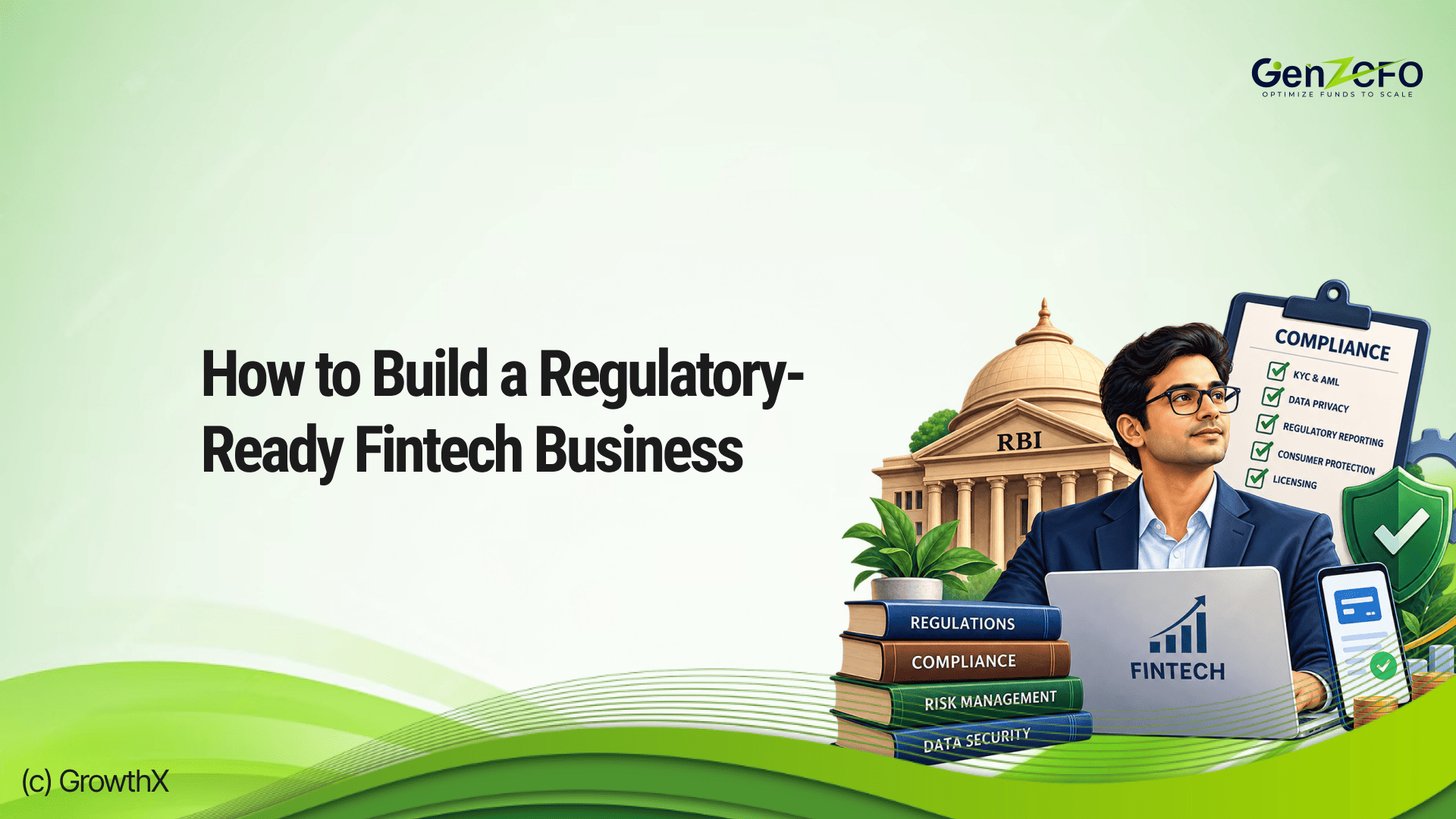
Fintech has transformed the way people borrow, invest, make payments, purchase insurance, manage wealth, and access financial services. From instant digital lending and UPI-based payments to investment platforms, account aggregators, and embedded finance solutions, technology has made financial services faster, more accessible, and more convenient. However, building a successful fintech business requires much more than developing an attractive mobile application or creating an innovative technology platform. Since fintech businesses often deal with customer money, personal information, financial data, credit decisions, investments, and payment infrastructure, they operate in an environment where regulatory compliance is extremely important.
A regulatory failure can affect not only the company but also its customers, financial partners, investors, and reputation. Therefore, fintech businesses should build compliance into their business model from the beginning rather than treating it as something that can be added after the product has been launched. In India, there is no single licence known as a “Fintech Licence.” The regulatory requirements depend on the actual activities performed by the business. A fintech company may fall under the regulatory framework of the Reserve Bank of India (RBI), Securities and Exchange Board of India (SEBI), Insurance Regulatory and Development Authority of India (IRDAI), Ministry of Electronics and Information Technology (MeitY), Financial Intelligence Unit–India (FIU-IND), or other relevant authorities. Therefore, becoming regulatory-ready begins with understanding exactly what the fintech business does, how customer money moves through the platform, what type of financial service is offered, and what categories of customer data are processed.
In this article, CA Manish Mishra talks about How to Build a Regulatory-Ready Fintech Business.
Start With Regulatory Mapping Before Building the Product
Regulatory analysis should ideally begin during the planning stage of the fintech business. Many founders make the mistake of developing the entire product first and examining legal and regulatory requirements only before launch. This approach can result in significant redesign costs if the business model is later found to require a licence, authorisation, regulated partner, or different transaction structure. The business should first identify the exact nature of its financial activity. For example, a company should determine whether it intends to lend its own money, connect borrowers with banks or NBFCs, operate as a Lending Service Provider, collect and settle merchant payments, issue prepaid instruments, offer investment advice, distribute insurance, facilitate peer-to-peer lending, aggregate financial information, or simply provide technology services to a regulated financial institution.
These distinctions are important because different financial activities are governed by different regulations. A payment-related platform may be regulated differently from a digital lending platform, while an investment advisory platform may require compliance with SEBI regulations. Therefore, founders should prepare a complete regulatory map before committing significant resources to product development.
Decide Whether You Will Be Regulated Directly or Work with a Regulated Entity
A fintech business should determine at an early stage whether it wants to obtain regulatory approval directly or operate in partnership with an existing regulated financial institution. Under the directly regulated model, the fintech itself may need to obtain the required registration, licence, or authorisation and become responsible for maintaining ongoing regulatory compliance. Depending on the business model, a fintech may operate or seek registration as an NBFC, NBFC-P2P platform, payment-related entity, account aggregator, investment adviser, research analyst, insurance intermediary, or another recognised category.
Alternatively, the company may choose to operate as a technology or service provider to an existing bank, NBFC, insurer, or other regulated entity. For example, a digital lending platform may work as a Lending Service Provider for an RBI-regulated lender instead of lending directly from its own balance sheet. However, working with a regulated partner does not eliminate compliance responsibilities. Banks, NBFCs, and other regulated entities conduct extensive due diligence before entering into partnerships with fintech companies. They may examine cybersecurity systems, data protection practices, customer grievance handling, vendor arrangements, audit reports, business continuity systems, and contractual responsibilities. Therefore, even fintech businesses that are not directly licensed should build operations that are capable of meeting institutional compliance standards.
Choose the Correct Legal and Corporate Structure
The legal structure of the fintech company should support its intended regulatory activity. Many financial services businesses are required to operate through a company incorporated under the Companies Act and may also be subject to specific capital, net worth, ownership, governance, or promoter-related conditions. The company should maintain a transparent ownership structure and proper documentation relating to promoters, shareholders, directors, beneficial owners, and sources of funds. Where foreign investment is involved, applicable foreign investment regulations and sectoral conditions should also be examined.
Corporate records should be maintained properly from the beginning. These records may include incorporation documents, shareholder agreements, board resolutions, intellectual property assignment agreements, statutory registers, employee agreements, tax registrations, and beneficial ownership records. A clean corporate structure can significantly simplify regulatory applications, investor due diligence, banking relationships, and future fundraising. On the other hand, unclear shareholding, undocumented loans, ownership disputes, or poorly documented intellectual property can create problems during regulatory review.
Build a Regulatory Responsibility
Once the applicable regulations have been identified, the fintech should convert them into internal responsibilities. Compliance becomes effective only when every regulatory obligation has a specific person or department responsible for implementing it. For example, customer KYC may be handled by the compliance team, cybersecurity may be managed by the Chief Technology Officer or information security team, vendor assessments may be handled jointly by technology and risk teams, and customer complaints may be assigned to a designated grievance officer.
The organisation should also define how frequently each compliance activity must be performed and what evidence must be maintained. Regulatory returns should have filing calendars, cybersecurity assessments should have review schedules, customer complaints should be recorded, and board-level compliance reporting should be documented. This type of responsibility framework creates accountability within the organisation and reduces the possibility of important compliance tasks being overlooked.
Design KYC and Customer Due Diligence Properly
Know Your Customer, commonly known as KYC, is a fundamental part of financial services regulation. Fintech companies involved in regulated activities must ensure that customers are properly identified and verified before services are provided. A proper KYC system should go beyond simply collecting PAN, Aadhaar, photographs, or other identity documents. The company should understand who the customer is, whether the identity is genuine, who ultimately owns or controls an entity customer, and what level of risk the customer presents.
Depending on the nature of the financial service, customer due diligence may include identity verification, address verification, PAN validation, beneficial ownership identification, risk classification, periodic KYC updates, and enhanced due diligence for higher-risk customers. KYC should therefore be integrated into the customer-risk management framework instead of being treated merely as a document upload process.
Create a Strong AML and Transaction Monitoring Framework
Fintech platforms can be exposed to risks such as money laundering, identity fraud, mule accounts, suspicious transactions, account takeovers, and misuse of financial channels. For this reason, Anti-Money Laundering controls and transaction monitoring are essential parts of a regulatory-ready fintech business. The company should develop systems capable of identifying unusual customer behaviour and suspicious transaction patterns. Customers may be classified according to their risk profile, and higher-risk customers may be subject to additional verification or enhanced monitoring.
Transaction monitoring systems should generate alerts when transactions fall outside normal or expected patterns. These alerts should then be properly investigated, escalated, and documented. The company should also maintain clear records of why a customer or transaction was flagged, who reviewed the case, what action was taken, and the reasons for the final decision. Compliance systems should therefore create an auditable trail rather than simply producing automated alerts.
Build Data Privacy into the Product Architecture
Fintech companies process significant volumes of personal and financial data. This may include names, contact details, identity documents, bank account information, transaction history, financial details, device information, credit information, and behavioural data. Therefore, privacy compliance should not be limited to publishing a privacy policy on the website. Data protection should be integrated into the design of the product itself.
The company should clearly understand what personal data it collects, why the data is required, where it is stored, who can access it, whether it is shared with third parties, how long it will be retained, and how it will be deleted or anonymised when no longer required. The fintech should also establish mechanisms for managing consent, responding to data-related requests, controlling internal access, and responding to data breaches. This approach is often referred to as “privacy by design,” because privacy controls become part of the technology architecture rather than an additional compliance layer added afterwards.
Follow the Principle of Data Minimisation
Fintech businesses should avoid collecting more customer information than is genuinely required for providing their services. Mobile applications often have the technical capability to request access to contacts, photographs, location data, microphones, call logs, and other device information, but the availability of such access does not mean that collecting all of it is justified.
Every additional category of data creates additional security, privacy, and regulatory risks. If the information is not necessary for the product or regulatory requirement, the company should reconsider whether it should be collected. A strong data minimisation approach means collecting only necessary information, using it for an identified purpose, restricting access to authorised persons, protecting it properly, and deleting or retaining it only in accordance with legal and operational requirements.
Build Cybersecurity Before Launch
Cybersecurity is one of the most important elements of fintech compliance because financial platforms are frequent targets for cyberattacks. Threats may include phishing, ransomware, malware, API attacks, credential theft, account takeover, cloud misconfiguration, insider misuse, and payment fraud. Fintech businesses should therefore establish cybersecurity controls before launching the product.
These controls may include strong authentication mechanisms, role-based access, encryption, secure coding practices, API security, vulnerability testing, penetration testing, endpoint protection, security monitoring, backup systems, and disaster recovery procedures. The company should also prepare an incident response plan explaining how cybersecurity incidents will be detected, reported, investigated, contained, and resolved. It is important that cybersecurity systems are regularly tested. Having written policies alone is not sufficient if the organisation cannot actually respond effectively to a security incident.
Make Digital Lending Customer-Centric
Fintech businesses involved in digital lending should pay particular attention to borrower protection. Digital lending platforms can create risks where customers are not properly informed about interest rates, charges, recovery practices, loan terms, or the identity of the actual lender. A regulatory-ready digital lending platform should clearly disclose the name of the lender, applicable interest and charges, repayment obligations, loan tenure, annual percentage rate, and other important terms before the borrower accepts the loan.
The customer journey should also include appropriate consent mechanisms, grievance redressal information, transparent disbursement and repayment flows, and responsible data collection. Loan offers should be presented in a manner that allows customers to understand and compare them. The platform should not use misleading design practices to push customers toward expensive or unsuitable products. The overall objective should be to ensure that customers understand the financial commitment before borrowing.
Avoid Dark Patterns
User interface design can influence customer behaviour significantly. Fintech companies should therefore avoid design practices that manipulate customers into making financial decisions they may not fully understand. Examples may include hidden charges, pre-selected consent boxes, misleading countdown timers, difficult cancellation processes, confusing comparison screens, or repeated prompts encouraging customers to select more expensive products.
The interface should instead provide clear, neutral, and easily understandable information. Customers should be able to identify applicable charges, compare options, withdraw consent where permitted, and understand the consequences of their decisions. Compliance teams should therefore review product design and customer journeys in addition to reviewing legal documents.
Understand Payment Regulations Before Handling Money
Any fintech company involved in handling customer money should carefully analyse payment regulations before commencing operations. The regulatory requirements will depend on whether the company operates as a payment aggregator, payment gateway, prepaid payment instrument issuer, payment system operator, cross-border payment participant, technology provider, or another category of payment intermediary.
Businesses should clearly understand whether they are merely providing technology or whether they are actually receiving, holding, routing, or settling customer funds. Payment-related activities may involve requirements relating to merchant onboarding, escrow arrangements, settlements, refunds, chargebacks, cybersecurity, fraud monitoring, KYC, and customer grievance handling. Therefore, payment architecture should be reviewed from a regulatory perspective before transactions begin.
Separate Customer Funds From Company Money
A fintech company should maintain clear separation between customer funds and its own operating money wherever the applicable regulatory framework requires it. Customer payments should move through appropriately structured accounts rather than being mixed with general company funds. This becomes particularly important where escrow accounts, designated accounts, or other settlement arrangements are required.
The fintech should also maintain proper reconciliation mechanisms. Every incoming payment should be matched with the corresponding customer, merchant, lender, or beneficiary transaction. Daily reconciliation helps identify missing transactions, duplicate payments, settlement delays, or accounting errors before they become larger operational problems. As transaction volumes increase, strong reconciliation systems become essential for financial integrity.
Build Strong Vendor and Outsourcing Governance
Fintech companies frequently rely on external service providers such as cloud companies, KYC vendors, payment processors, cybersecurity firms, analytics providers, call centres, collection agencies, software companies, and credit information providers. Each vendor creates operational and regulatory dependency. Therefore, vendors should be assessed before they are appointed.
The fintech should evaluate the vendor's cybersecurity standards, data handling practices, financial stability, regulatory history, service capabilities, and business continuity arrangements. Contracts should clearly define confidentiality obligations, data protection responsibilities, service levels, audit rights, incident notification obligations, subcontracting restrictions, termination processes, and data-return or deletion requirements. Vendor performance should also be monitored after onboarding rather than assuming that due diligence is a one-time process.
Establish Proper Consumer Grievance Redressal
Customer grievance management is a fundamental part of financial services compliance. Customers should have a clear and accessible way to report problems and seek resolution. A fintech should therefore provide the contact details of its grievance officer or customer support team and establish a structured complaint-management process. Complaints should be acknowledged, assigned a reference number, tracked, resolved within applicable timelines, and escalated where necessary.
The fintech should also analyse complaint trends. For example, repeated complaints relating to unauthorised transactions, incorrect loan information, delayed refunds, aggressive recovery practices, or unexplained charges may indicate a wider compliance or operational problem. Customer complaints should therefore be treated as valuable risk-management information rather than merely customer service issues.
Make Marketing Compliance Part of Regulatory Compliance
Marketing communications can create regulatory exposure even when the underlying financial product itself is compliant. Fintech businesses should avoid misleading statements such as “guaranteed loan approval,” “zero-risk investment,” “guaranteed return,” or claims that the business is “RBI approved” unless such statements are factually and legally accurate.
Advertisements, landing pages, influencer promotions, referral campaigns, push notifications, and social media posts should be reviewed before publication. Marketing teams should work closely with compliance teams, especially where communications relate to loans, investments, insurance, financial returns, or regulatory status. The objective should be to provide customers with accurate information rather than creating unrealistic expectations.
Build Governance Before Investors or Regulators Demand It
Corporate governance should not be delayed simply because a fintech company is still at an early stage. As the company grows, governance becomes essential for managing regulatory, operational, financial, cybersecurity, and reputational risks. The company should establish clear decision-making authority, compliance reporting lines, risk management responsibilities, conflict-of-interest procedures, internal controls, whistleblower mechanisms, related-party transaction procedures, and approval processes.
Important decisions should be properly documented through board or management records. Good governance allows the company to demonstrate who made a decision, what information was considered, which risks were identified, and what controls were implemented.
Maintain a Compliance Evidence Repository
Compliance is not only about performing regulatory obligations; the organisation must also be capable of proving that those obligations were performed. Fintech companies should therefore maintain an organised repository containing licences, regulatory correspondence, policies, board approvals, KYC records, employee training records, cybersecurity reports, vendor assessments, customer complaints, consent records, audit reports, regulatory filings, and remediation documents.
Whenever a compliance requirement is implemented, the company should ask what evidence would be produced if an auditor, financial partner, or regulator requested proof. Without appropriate documentation, it can become difficult to demonstrate that a control actually existed or was followed.
Build an Audit Trail into the Technology
Technology systems should maintain logs of significant customer, employee, and system activities. For example, the company should be able to determine when a customer gave consent, what version of the disclosure was displayed, who accessed customer information, who modified records, when a transaction was approved, and whether an automated decision was overridden.
Audit trails are particularly important during customer disputes, fraud investigations, cybersecurity incidents, internal audits, and regulatory inspections. Strong audit logging also helps management understand how systems are being used and whether internal controls are functioning properly.
Create a Business Continuity and Disaster Recovery Plan
Fintech companies depend heavily on technology infrastructure. Therefore, they should prepare for situations where systems, networks, cloud providers, payment partners, or internal platforms become unavailable. A business continuity plan should identify critical services and determine how the company will continue operating during disruption.
The organisation should define acceptable downtime, recovery timelines, backup requirements, alternative infrastructure, emergency communication procedures, and responsibilities during a crisis. Disaster recovery systems should also be tested periodically. A plan that exists only on paper may fail when an actual outage occurs. Operational resilience therefore requires both planning and regular testing.
Treat AI and Algorithms as Governed Systems
Artificial intelligence and automated systems are increasingly used by fintech companies for credit assessment, fraud detection, risk profiling, customer support, investment analytics, and underwriting. However, automated decision-making should be properly governed.
The company should understand what data is used to train or operate the system, how decisions are generated, whether the model can produce unfair or biased outcomes, and whether employees can review or override decisions where appropriate. The fintech should maintain an inventory of important models, define approval procedures, monitor model performance, validate outputs, control access, and document material changes. AI should assist decision-making without eliminating accountability.
Prepare for Regulatory Change
Fintech regulation continues to evolve as financial technology becomes more sophisticated. A company that was compliant when it launched may later become non-compliant if regulatory requirements change and its policies or systems are not updated. Fintech businesses should therefore maintain a regulatory monitoring process. The compliance team should regularly review circulars, master directions, notifications, amendments, FAQs, consultation papers, regulatory announcements, enforcement actions, and industry developments.
Whenever new regulatory requirements are introduced, the company should determine whether changes are required to its product, contracts, policies, technology systems, or customer communications. Regulatory compliance should therefore be treated as a continuous process rather than a one-time exercise.
Consider the Regulatory Sandbox for Innovative Products
Fintech businesses developing genuinely innovative products may sometimes face uncertainty about how existing regulations apply to their model. In appropriate cases, regulatory sandbox programmes may allow innovative products to be tested within a controlled environment.
A regulatory sandbox can help businesses understand regulatory expectations, test technology on a limited scale, identify customer risks, and improve the product before wider deployment. However, a sandbox should not be treated as a way to avoid regulation. Its objective is to promote responsible innovation while allowing regulators and businesses to understand new technology and potential risks.
Build Compliance into Fundraising Due Diligence
Regulatory readiness can significantly affect a fintech company's ability to attract investment. Professional investors commonly evaluate the regulatory status of a fintech business before investing. They may examine licences, legal opinions, regulator correspondence, cybersecurity reports, compliance policies, customer complaints, partnership agreements, data protection systems, and pending regulatory matters.
Companies with proper records and clearly documented regulatory structures are generally easier to evaluate during due diligence. Fintech founders should therefore organise compliance documentation continuously rather than attempting to prepare everything immediately before a funding round.
Do Not Depend Entirely on the Regulated Partner
A fintech operating with a bank, NBFC, insurer, or another regulated entity should not assume that all compliance responsibilities belong to the regulated partner. The financial institution may remain responsible for certain regulatory obligations, but contractual agreements usually impose significant responsibilities on the fintech service provider.
A compliance failure by the fintech may lead to suspension of customer onboarding, additional audits, corrective action requirements, partnership termination, reputational damage, or difficulty obtaining future partnerships. Therefore, fintech companies should build their own strong compliance systems even when operating through regulated partners.
Conduct a Regulatory Readiness Review Before Launch
Before publicly launching the fintech product, the company should conduct a comprehensive regulatory readiness assessment. The review should examine whether the corporate structure is complete and whether shareholder records, founder arrangements, intellectual property ownership, and required registrations are properly documented. The regulatory review should confirm which regulator governs the activity, whether licences or authorisations are required, whether the financial partner has the appropriate regulatory status, and whether capital or net worth requirements apply. The customer onboarding process should also be reviewed to ensure proper KYC, consent, disclosures, eligibility checks, and customer agreements.
Data protection controls should be tested to ensure that privacy notices, access restrictions, retention policies, and data-sharing practices are appropriately implemented. Cybersecurity testing should examine APIs, applications, authentication, encryption, backups, vulnerability assessments, monitoring, and incident response. The company should also verify that customer grievance procedures, vendor agreements, marketing communications, payment flows, and business continuity systems are ready before operations begin. A structured pre-launch review allows the fintech to identify and correct gaps before those gaps affect customers or attract regulatory attention.
What Makes a Fintech Truly Regulatory-Ready?
A fintech does not become regulatory-ready simply because it has received a licence or completed a registration. True regulatory readiness exists when compliance is embedded in the company's daily operations, technology architecture, decision-making systems, customer processes, and corporate culture. The company should always know why it is legally permitted to provide a financial service, which authority regulates the activity, what customer information it collects, how customer funds move through the platform, who can access financial data, how fraud is detected, how complaints are handled, how vendors are monitored, and what happens during a system failure or cybersecurity incident.
The organisation should also be able to provide evidence showing that its regulatory controls actually operate in practice. Regulatory readiness therefore represents an ongoing system of governance, controls, documentation, monitoring, and accountability.
Common Mistakes Fintech Founders Should Avoid
One of the most common mistakes is launching a product before determining whether regulatory approval is required. Some startups incorrectly assume that describing themselves as technology companies automatically places them outside financial regulation. However, regulators generally examine the actual activity performed by the company rather than how the company describes itself. Another common mistake is excessive data collection. Gathering unnecessary customer information creates additional privacy and cybersecurity risks. Similarly, treating KYC only as document collection rather than a broader risk-management process can weaken the company's compliance framework.
Fintech businesses also face risks when they rely completely on banks or NBFC partners for regulatory compliance. Even where a partner holds the financial licence, the fintech must maintain appropriate systems and controls. Other frequent mistakes include inadequate vendor due diligence, misleading advertising, weak cybersecurity monitoring, poor reconciliation of customer funds, insufficient complaint analysis, inadequate regulatory documentation, and major product changes without compliance review.
Using automated algorithms without proper governance can create additional legal, customer-protection, and reputational risks. Most importantly, fintech founders should avoid treating compliance as a one-time registration exercise. Regulatory requirements continue throughout the life of the business.
A Better Fintech Development Model
A traditional startup approach may involve developing an idea, building a product, launching it, acquiring customers, and examining regulatory issues only afterwards. For fintech businesses, a more sustainable approach begins with regulatory mapping. Once the business model has been analysed, the founders should determine the appropriate corporate structure, identify licensing or partnership requirements, develop compliance architecture, and then design the product around those requirements.
Before launch, the company should conduct cybersecurity testing, legal review, customer-protection assessment, and operational readiness checks. After launch, the fintech should continuously monitor regulatory developments, customer complaints, cybersecurity threats, operational performance, and compliance effectiveness. This approach may require more planning initially, but it significantly reduces the possibility of costly redesigns, regulatory restrictions, and operational disruption later.
Conclusion
Building a fintech business is ultimately about building trust. Customers trust fintech platforms with their money, identities, personal information, financial records, and important financial decisions. Banks and other institutions trust fintech partners with their customers, infrastructure, and reputation. Regulators expect innovation to take place without compromising financial integrity, consumer protection, cybersecurity, or privacy. For this reason, regulatory compliance should not be viewed as an obstacle to fintech innovation. It should be treated as part of the business architecture itself.
A regulatory-ready fintech combines technology, compliance, cybersecurity, governance, customer protection, and operational resilience from the beginning. Before launching a fintech product in India, founders should clearly identify the regulated activity, determine whether a licence or regulated partner is required, establish KYC and AML controls, protect customer data, implement cybersecurity systems, structure customer-fund flows properly, establish grievance mechanisms, manage vendors carefully, and maintain detailed compliance documentation. Companies that build these foundations early are not only better prepared for regulatory scrutiny but are also better positioned for institutional partnerships, fundraising, scalability, and long-term customer trust.
Frequently Asked Questions (FAQs)
Q1. What does “regulatory-ready fintech” mean?
Ans. A regulatory-ready fintech is a business designed to comply with applicable financial laws from the beginning. It maintains proper licensing, KYC, AML, cybersecurity, data protection, customer grievance, governance, documentation, and audit systems required for safe and compliant financial operations.
Q2. Is there a separate fintech licence in India?
Ans. No, India does not have one specific fintech licence. The required approval depends on the activity performed. Lending, payments, investment advisory, insurance distribution, account aggregation, and other financial services may require different registrations or authorisations from RBI, SEBI, or IRDAI.
Q3. Which regulator regulates fintech companies in India?
Ans. Fintech regulation depends on the business activity. RBI regulates banking, payments, NBFCs, and digital lending, while SEBI regulates securities-related services. IRDAI regulates insurance activities. Other authorities may regulate data protection, cybersecurity, anti-money laundering, and consumer protection obligations.
Q4. Should regulatory compliance be considered before launching a fintech product?
Ans. Yes. Regulatory compliance should be considered during the planning stage. Early regulatory analysis helps identify licences, approvals, capital requirements, customer protection obligations, and operational restrictions before investment is made in technology, reducing the risk of costly redesigns later.
Q5. Can a fintech operate without obtaining its own licence?
Ans. Yes, depending on the business model. A fintech may operate as a technology or service provider to a regulated bank, NBFC, insurer, or financial institution. However, it must still comply with contractual, cybersecurity, data protection, outsourcing, and customer protection requirements.
Q6. What is regulatory mapping in fintech?
Ans. Regulatory mapping involves analysing every business activity and identifying the applicable laws, licences, regulators, reporting obligations, and compliance requirements. It examines how money moves, what financial service is provided, which customer data is processed, and which regulated entities are involved.
Q7. Why is KYC important for fintech businesses?
Ans. KYC helps fintech businesses verify customer identity and reduce risks relating to fraud, money laundering, impersonation, and misuse of financial services. Effective KYC may include identity verification, address verification, beneficial ownership checks, customer risk classification, and periodic updating of information.
Q8. What is the role of AML compliance in fintech?
Ans. Anti-Money Laundering compliance helps prevent fintech platforms from being used for illegal financial activities. It includes customer risk assessment, transaction monitoring, suspicious activity detection, record maintenance, escalation procedures, and regulatory reporting where applicable under relevant financial and anti-money laundering laws.
Q9. How important is data protection for fintech companies?
Ans. Data protection is critical because fintech companies handle sensitive financial and personal information. They should collect only necessary data, maintain secure storage, restrict access, manage customer consent, monitor data sharing, define retention periods, and establish procedures for responding to breaches.
Q10. What is data minimisation in fintech?
Ans. Data minimisation means collecting only the customer information genuinely required for providing a financial service or meeting legal obligations. Avoiding unnecessary access to contacts, location, photographs, or device information reduces privacy risks, cybersecurity exposure, and overall regulatory responsibility for fintech businesses.
- 17 Sep, 2026
 CA Manish Mishra
- Easing Finance
CA Manish Mishra is the Co-Founder & CEO at GenZCFO. He is the most sought professional for providing virtual CFO services to startups and established businesses across diverse sectors, such as retail, manufacturing, food, and financial services with over 20 years of experience including strategic financial planning, regulatory compliance, fundraising and M&A.