Search GrowthX Learning Content


The Founder’s Guide to India’s Financial Regulatory System
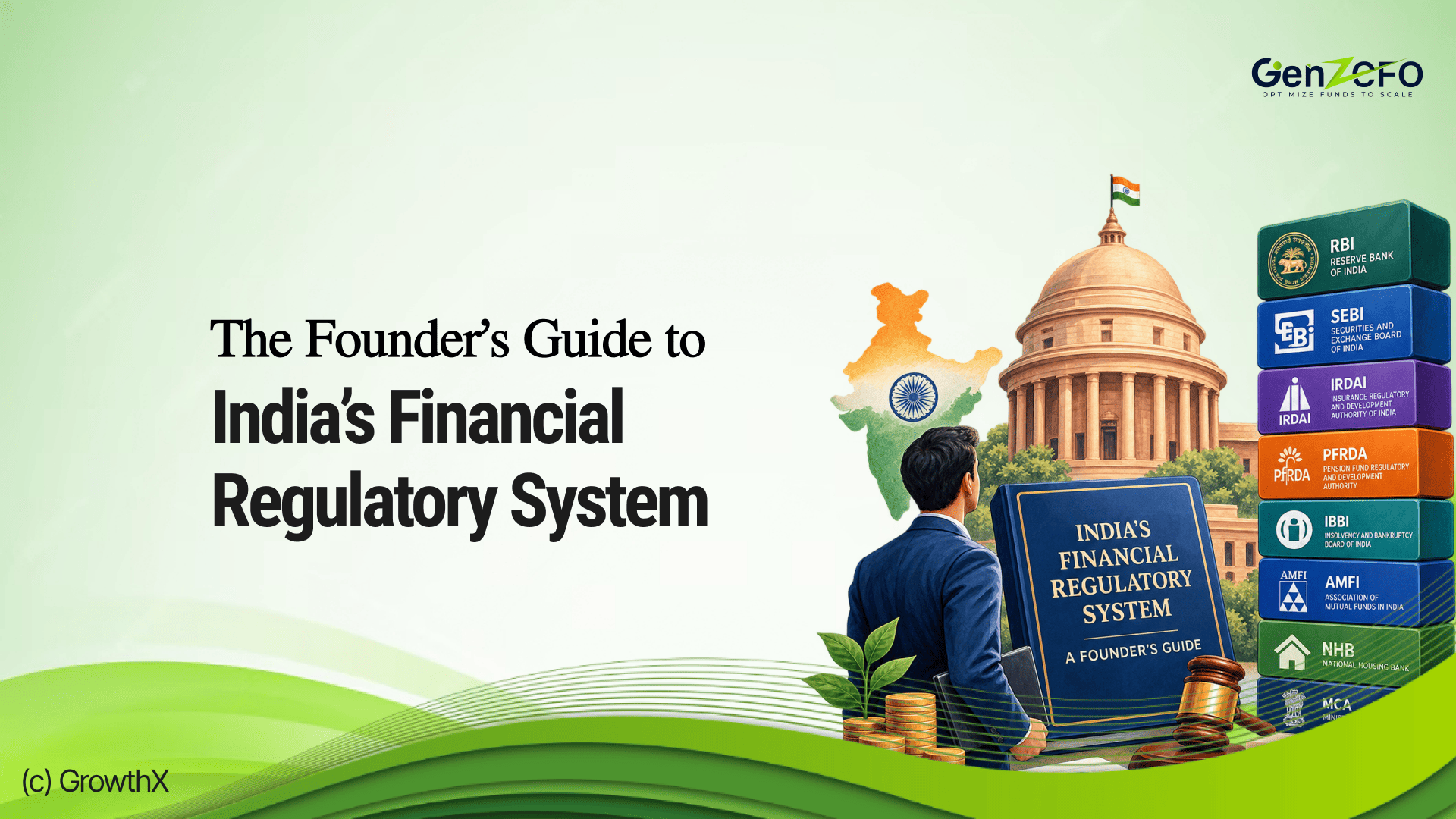
India has one of the world’s fastest-growing startup and fintech ecosystems. From digital lending and payment platforms to wealth-tech, insurance technology and cross-border investment businesses, founders are increasingly building companies that interact directly or indirectly with the financial system. However, operating a financial or fintech business in India involves much more than incorporating a company, building a product and acquiring customers. Depending on the nature of the business, a startup may have to comply with regulations issued by multiple authorities, including the Reserve Bank of India (RBI), Securities and Exchange Board of India (SEBI), Insurance Regulatory and Development Authority of India (IRDAI), Pension Fund Regulatory and Development Authority (PFRDA), International Financial Services Centres Authority (IFSCA), Financial Intelligence Unit-India (FIU-IND), Ministry of Corporate Affairs (MCA) and Competition Commission of India (CCI).
For founders, the most important regulatory question is therefore not simply whether their startup is a “fintech company.” What matters is the actual activity being performed. A company that lends money, handles customer funds, facilitates securities investments, distributes insurance products or receives foreign investment may fall within completely different regulatory. Understanding these rules early can help founders avoid licensing problems, penalties, funding delays, restructuring costs and compliance disputes as the business scales.
In this article, CA Manish Mishra talks about The Founder’s Guide to India’s Financial Regulatory System.
Understanding India’s Financial Regulatory Architecture
India follows a sector-based financial regulatory system. Instead of placing the entire financial sector under a single authority, regulatory responsibility is divided among specialised institutions based on the nature of the activity. The Reserve Bank of India primarily regulates banking, non-banking financial companies, payment systems, certain fintech activities and foreign exchange transactions. SEBI supervises securities markets, stock exchanges, investment intermediaries, mutual funds, Alternative Investment Funds and various capital-market activities. IRDAI regulates insurance companies and insurance intermediaries, while PFRDA supervises the pension ecosystem.
IFSCA acts as the unified regulator for financial services conducted within International Financial Services Centres, particularly GIFT IFSC. FIU-IND plays an important role in India's anti-money laundering by receiving and analysing information relating to suspicious financial transactions. The Ministry of Corporate Affairs remains relevant to almost every incorporated startup because fundraising, share issuance, corporate governance, director responsibilities and financial statements are governed by company law. The Competition Commission of India may also become relevant where major acquisitions, mergers or investment transactions cross prescribed competition thresholds.
This structure means that one startup can simultaneously be subject to several different regulatory frameworks. For example, a fintech company receiving investment from overseas investors while partnering with an NBFC may have to consider the Companies Act, FEMA, RBI regulations, anti-money laundering requirements, taxation, data protection and contractual compliance. For this reason, founders should ideally undertake regulatory mapping at the business-model stage rather than waiting until the company has already launched.
Reserve Bank of India and Its Importance for Founders
The Reserve Bank of India is one of the most important regulators for startups operating in lending, banking technology, payments and foreign exchange. RBI regulation can become relevant where a business provides loans, facilitates digital lending, operates payment infrastructure, issues prepaid instruments, handles payment settlement, facilitates cross-border transactions or carries on activities that resemble regulated financial services.
Founders should therefore determine at the very beginning whether their company is merely providing technology to a regulated institution or whether it is actually performing a regulated financial activity itself. This distinction is extremely important because the regulatory consequences can be significantly different.
RBI Regulation of NBFCs
A Non-Banking Financial Company, commonly known as an NBFC, is a company engaged primarily in specified financial activities without holding a banking licence. A company may potentially fall within the NBFC framework where its principal business involves providing loans and advances, financing, acquiring securities, leasing or carrying on other financial activities covered by the applicable regulatory.
However, every company that occasionally extends credit does not automatically become an NBFC. The nature and scale of the financial activity, as well as whether it constitutes the principal business of the company, are important considerations. For example, a manufacturing company providing normal credit terms to its distributors is fundamentally different from a startup whose main revenue comes from lending money to consumers.
This is why founders planning lending products should carefully analyse how their business operates. They should identify who actually provides the loan, whose balance sheet funds the transaction, who bears the risk of non-payment and who collects repayments from customers. If the startup itself is undertaking regulated lending as its principal business, RBI registration requirements may become relevant.
Technology Provider vs Regulated Lender
Many fintech startups operate through partnerships with banks and NBFCs. In such arrangements, the startup may describe itself as a technology provider or Lending Service Provider rather than a lender. However, the commercial description given to the company does not by itself determine its legal status. Regulators are more concerned with what the company actually does.
For example, a fintech platform may assist a regulated lender by acquiring customers, providing technological infrastructure, facilitating digital onboarding, conducting preliminary credit analysis and supporting loan servicing. The regulated bank or NBFC may remain the entity that formally sanctions and disburses the loan. Founders should nevertheless ensure that the contractual arrangement and actual operating model are consistent. If the startup begins independently determining credit terms, holding loan funds, collecting unauthorised charges or assuming risks that belong to the lender, regulatory concerns may arise. Therefore, founders should examine the complete customer journey rather than focusing only on contractual labels.
Digital Lending and Regulatory Compliance
Digital lending has transformed the Indian financial market by making loans available through mobile applications and online platforms. However, technology does not remove the regulated nature of lending. A loan remains a financial product whether it is provided through a branch office, mobile application, website or automated artificial intelligence system. Digital lending platforms generally need to clearly identify the regulated entity that is actually providing the loan. Customers should understand who their lender is, the applicable interest rate, fees, repayment obligations and grievance mechanism.
The movement of funds is equally important. Lending arrangements should be structured so that loan disbursements and repayments follow the applicable regulatory framework rather than being unnecessarily routed through the accounts of unregulated intermediaries. Founders operating digital lending businesses should also pay close attention to data collection, customer consent, recovery practices, transparency of charges and the responsibilities allocated between the fintech platform and the regulated lender. A badly designed digital workflow can therefore create regulatory problems even where the underlying commercial partnership appears legitimate.
Payments and Payment Systems
India's digital payment ecosystem has grown rapidly due to UPI, cards, wallets and online merchant payments. As a result, many startups participate in the payment process even when payments are not their primary product. RBI regulates payment and settlement systems in India, and certain businesses may require regulatory authorisation depending on how they handle payment transactions. The most important factor for founders is whether their startup merely provides technology or actually receives, holds, controls or settles customer funds.
A technology company that only transmits payment instructions may have a different regulatory position from a company that collects money from customers and subsequently settles it with merchants. This distinction is particularly relevant in the context of payment gateways and payment aggregators. A payment gateway primarily provides technological infrastructure that enables communication between different participants in a payment transaction. A payment aggregator, on the other hand, may facilitate receipt of payments from customers and their subsequent settlement to merchants. Because the second model involves greater control over money flows, it may attract a higher degree of financial regulation. Before launching any payment product, founders should therefore map the entire movement of money from the customer to the final merchant.
Foreign Exchange Management Act and Foreign Investment
The Foreign Exchange Management Act, 1999, commonly known as FEMA, is one of the most important laws for Indian startups dealing with foreign investors or international transactions. FEMA becomes relevant when an Indian company receives investment from a non-resident, issues securities to a foreign investor, transfers shares between residents and non-residents, makes overseas investments, establishes a foreign subsidiary or undertakes specified cross-border financial transactions.
For a growing startup, foreign investment is often a major milestone. However, founders should not treat FEMA compliance as a post-funding documentation exercise. The regulatory position should ideally be examined before the transaction is completed.
FEMA Due Diligence Before Receiving Foreign Funding
Before accepting foreign investment, founders should verify whether the proposed investment is permitted under India's foreign investment. One important issue is the sector in which the company operates. Certain sectors permit foreign investment freely up to prescribed limits, while others may require government approval or be subject to additional conditions. The identity and jurisdiction of the investor may also matter.
The company should also check whether the proposed investment instrument is legally permitted. Equity shares, preference shares and convertible instruments may be subject to different regulatory requirements. Pricing and valuation are also important. Transactions between Indian companies and non-residents may be required to comply with applicable pricing rules. After the investment is received and securities are issued, regulatory reporting through the prescribed RBI framework may also be necessary. Therefore, FEMA compliance should be integrated with the funding process from the beginning rather than handled after closing.
Share Transfers Involving Non-Residents
FEMA does not apply only when new shares are issued. It can also become relevant when existing shareholders transfer securities to or from non-residents. For example, if an Indian founder sells shares to a foreign investor, pricing and reporting requirements may have to be considered. Similar issues can arise when an overseas investor exits by transferring its shares to an Indian resident. Founders should therefore ensure that secondary transactions forming part of a funding round receive the same regulatory attention as primary share issuances.
Securities and Exchange Board of India
SEBI is the principal regulator of India's securities markets. It regulates stock exchanges, listed companies and numerous securities-market intermediaries. Its regulatory framework also covers areas such as mutual funds, Alternative Investment Funds, investment advisers, research analysts and portfolio-management services.
For most early-stage startups, SEBI regulation does not automatically apply merely because the company raises venture capital. A private company raising capital from investors generally follows the Companies Act and, where foreign investment is involved, FEMA. However, SEBI can become directly relevant where the startup itself conducts securities-related activities or eventually accesses the public market.
Private Fundraising vs Public Capital Markets
A private startup raising money from angel investors or venture capital funds is different from a listed company raising capital from the public. Private companies generally issue securities through mechanisms such as private placement, rights issues or other permitted corporate routes. Once a company proposes to list its securities or access the public market, the regulatory environment changes significantly.
SEBI requirements may then apply to disclosures, corporate governance, public offers, insider trading, shareholding patterns and continuing obligations after listing. For founders considering an IPO as a future exit or growth strategy, SEBI compliance may therefore become increasingly important as the business matures.
Investment Advice and Wealth-Tech Platforms
Investment and wealth-tech platforms should pay particular attention to SEBI's regulatory. A startup may begin as an educational financial platform but gradually introduce recommendations, model portfolios, personalised advice or securities research. At this stage, the business may move closer to regulated investment-advisory or research activities. The regulatory analysis generally depends on the substance of what the company provides. If a platform simply explains general financial concepts, its position may be different from a platform that tells a specific customer which securities to buy or sell based on that customer's financial profile.
Similarly, publishing general market information is different from selling research reports containing specific securities recommendations. Founders should therefore review their content, customer journeys, revenue model and marketing claims carefully before launching advisory features. Describing a service as “AI-powered”, “educational” or “community based” does not automatically remove regulatory requirements where the underlying service amounts to regulated advice or research.
Alternative Investment Funds and Fund Management
Founders sometimes move from running operating companies to managing investment capital. When money is pooled from multiple investors and invested according to a defined investment policy, the structure may potentially fall within the regulatory framework governing Alternative Investment Funds. AIFs are regulated investment vehicles used for purposes such as venture capital, private equity, debt investments, hedge strategies and other alternative investment activities.
The regulatory position is very different from that of an ordinary startup. An entrepreneur creating a startup investment platform, syndicate, pooled vehicle or fund should therefore not assume that using a special purpose vehicle automatically removes investment-fund regulation. The structure must be examined based on how capital is collected, who manages it, how investors participate in returns and whether the arrangement amounts to a pooled investment vehicle.
Insurance Regulatory and Development Authority of India
IRDAI regulates India's insurance sector. It supervises insurance companies as well as different categories of intermediaries involved in the sale, distribution and servicing of insurance products. This makes IRDAI particularly important for insurtech founders.
A startup may not itself underwrite insurance risk but may still carry on activities connected with insurance distribution. For example, a platform may allow customers to compare policies, receive recommendations, complete proposal forms, pay premiums or obtain policy-servicing support. Depending on the business model, such activities may fall within a regulated insurance-intermediary framework.
Insurance Technology vs Insurance Distribution
The distinction between providing technology and distributing insurance is important. A software company may provide technology infrastructure to an insurance company without interacting directly with customers in a regulated manner. However, the situation changes where the startup actively solicits insurance customers, recommends policies, assists in completing insurance purchases or earns distribution-based compensation.
Founders should therefore examine exactly where their company sits in the customer journey. The closer the startup comes to recommending or selling an insurance product, the greater the need for a detailed regulatory review.
Pension Fund Regulatory and Development Authority
PFRDA regulates India's pension sector and the National Pension System ecosystem. The regulator becomes relevant for businesses participating in pension management, NPS distribution and other regulated retirement-related activities. A startup merely providing retirement calculators or educational content may not be in the same regulatory position as a company actually facilitating investment into regulated pension products.
For founders, this again demonstrates the importance of distinguishing between financial information and financial intermediation. Whenever a startup begins executing transactions, collecting investment instructions or earning compensation for distributing pension products, regulatory requirements should be examined carefully.
IFSCA and GIFT IFSC
The International Financial Services Centres Authority regulates financial services carried on within India's International Financial Services Centres. GIFT IFSC in Gujarat has emerged as an important jurisdiction for international financial services originating from India. IFSCA functions as a unified regulator in the IFSC and supervises areas including banking, capital markets, fund management, insurance, finance companies, fintech and certain leasing activities.
For founders seeking to build international financial businesses, GIFT IFSC can provide opportunities to serve global investors and markets from India. However, the regulatory framework inside an IFSC is specialised. A company cannot assume that the ordinary domestic regulatory structure applies identically simply because the entity is incorporated in India. Founders considering an IFSC structure should therefore evaluate the regulatory category, permissible activities, capital requirements and operational conditions before setting up the business.
FIU-IND and Anti-Money Laundering Compliance
Financial regulation is not limited to obtaining a licence. Many financial businesses must also comply with anti-money laundering and counter-terrorist financing requirements. FIU-IND is India's central agency responsible for receiving and analysing information relating to suspicious financial transactions. Entities falling within the definition of reporting entities under the Prevention of Money Laundering Act may be required to establish detailed compliance systems.
These systems can involve customer identification, beneficial ownership verification, transaction monitoring, record maintenance and reporting of suspicious transactions. Therefore, KYC should not be viewed merely as collecting copies of identification documents. A proper AML framework involves understanding who the customer is, assessing risk, identifying unusual transactions and maintaining sufficient records to demonstrate compliance.
Beneficial Ownership
One particularly important area is beneficial ownership. A company or customer may formally be owned by one entity while being ultimately controlled or economically owned by another individual. Financial institutions and regulated businesses are therefore expected to identify the individuals who ultimately own or control the customer where the applicable rules require such identification.
For founders, beneficial ownership becomes especially important when dealing with complex corporate structures, foreign investors, investment funds or overseas entities. Failure to properly identify ultimate ownership can create serious KYC and regulatory concerns.
Virtual Digital Asset Businesses
Virtual Digital Asset businesses, including certain crypto-related service providers, have become subject to India's anti-money laundering. This means that qualifying businesses operating in areas such as exchange, transfer or custody of virtual digital assets may have obligations relating to FIU-IND registration, customer due diligence, recordkeeping and suspicious transaction reporting.
For founders, this is particularly important because crypto businesses may sometimes view themselves primarily as technology companies. However, when the platform facilitates financial transactions involving virtual digital assets, regulatory obligations can arise even if the underlying technology is decentralised. Therefore, VDA founders should treat AML compliance as a core operational requirement rather than simply a documentation exercise.
Ministry of Corporate Affairs and Company Law Compliance
Almost every incorporated startup operates under the Companies Act, 2013. Therefore, even where a startup does not require RBI, SEBI or IRDAI registration, it remains subject to corporate law obligations. The Companies Act affects important founder decisions, including issuing shares, changing authorised capital, appointing directors, conducting board meetings, maintaining statutory registers and filing annual returns.
Fundraising is another major area where company law applies. When a startup issues securities to investors, proper approvals, offer documentation, allotment procedures and statutory filings must generally be completed. If the investor is foreign, the transaction may simultaneously involve FEMA. If the startup operates in a regulated financial sector, sector-specific approvals may also become relevant. This is why founders should treat regulatory compliance as an integrated exercise rather than handling company law, foreign exchange and sector regulations separately.
Competition Commission of India
The Competition Commission of India regulates competition and merger control in India. CCI compliance generally becomes relevant to startups during significant mergers, acquisitions and investment transactions rather than ordinary day-to-day business operations. Certain transactions crossing prescribed thresholds may be treated as combinations requiring competition-law assessment.
India's merger-control also includes a deal-value threshold. This is especially relevant to startups because some technology businesses can achieve very high valuations even when their physical assets or historical turnover remain comparatively modest. Therefore, founders negotiating a substantial acquisition or exit should not assume that CCI analysis is unnecessary merely because the target is a startup. Competition-law review should form part of transaction due diligence where the applicable thresholds or conditions may be triggered.
Insolvency and Bankruptcy Board of India
The Insolvency and Bankruptcy Board of India plays a central role in India's insolvency. For founders, insolvency law becomes particularly relevant when a company develops serious financial difficulties and is unable to meet its obligations to creditors. The Insolvency and Bankruptcy Code provides mechanisms for resolving distressed companies and, where resolution is not viable, liquidation.
Once formal insolvency proceedings begin, control over important company decisions can shift substantially. This is why founders should address financial stress before it reaches the point of insolvency. Early restructuring, creditor negotiations and cash-flow planning may provide more options than waiting until legal proceedings have commenced.
Licence, Registration and Continuing Compliance
One of the biggest misconceptions among founders is that regulatory compliance ends once a licence or registration has been obtained. In reality, licensing is usually only the beginning. A regulated financial company must often satisfy entry requirements before commencing business. These may include minimum capital, net-worth requirements, promoter eligibility, governance conditions, infrastructure standards and regulatory approvals. After the licence is issued, continuing obligations usually apply.
The company may have to submit periodic regulatory returns, maintain minimum capital, conduct audits, appoint compliance personnel, establish customer-grievance procedures and maintain proper internal controls. Certain events can also create additional filing or approval requirements. For example, a change in control, major shareholding change, appointment of key management personnel, merger, acquisition or launch of a new regulated product may require regulatory attention. Compliance should therefore be viewed as a continuous lifecycle rather than a one-time approval process.
Fundraising and Regulatory Compliance
Fundraising is one of the areas where several regulatory can overlap. When an Indian startup receives investment from domestic investors, it must generally consider the Companies Act, appropriate approvals, valuation requirements where applicable, securities issuance procedures and taxation. Where the investor is a non-resident, FEMA becomes an additional layer.
The startup must then consider foreign investment restrictions, sectoral caps, pricing guidelines, eligible investment instruments and regulatory reporting. Where an investor is itself a regulated fund such as a SEBI-registered AIF, the fund may also have investment restrictions or documentation requirements that affect the transaction. Founders should therefore begin compliance planning when negotiating the term sheet rather than after the money has arrived. This allows commercial terms and regulatory requirements to be aligned from the beginning.
Financial Regulation Should Begin at Product Design
One of the most important principles for founders is that regulatory analysis should begin during product design. Many compliance problems arise because companies build a complete product before determining whether the underlying business model is legally permissible. A fintech startup may spend months developing a lending application only to later discover that its fund-flow structure creates a regulatory problem.
Similarly, a wealth-tech company may build personalised recommendation features without first examining whether the service could fall within investment-advisory regulation. A better approach is to first define the product, identify applicable regulations and then design technology and contractual relationships around the regulatory. This reduces the risk of expensive restructuring after launch.
Mapping the Product and Customer Journey
Founders should begin regulatory analysis by describing exactly what happens when a customer uses the product. The description should avoid marketing terms. Instead of saying, “We are an AI-enabled financial wellness platform,” the company should describe the actual transaction.
For example, it may say that the customer submits financial information, the platform analyses the information, recommends securities, facilitates the transaction and receives a percentage-based fee. This description makes it much easier to determine whether regulated investment advice or intermediary activities may be involved. The same approach should be applied to lending, insurance, payments and other financial services.
Mapping the Movement of Money
The next step is to identify how funds move through the platform. Founders should know exactly who receives customer money, which bank account is used, whether the startup temporarily holds funds and who ultimately settles the transaction.
This is especially important in payment and lending businesses because regulatory obligations can depend heavily on whether the startup itself handles customer funds. A diagram showing the flow of money can often reveal regulatory issues that are not obvious from legal documents alone.
Mapping Financial Risk
Founders should also determine which entity bears financial risk. In a lending structure, the relevant question is who suffers the loss if the borrower fails to repay. In insurance, the question is who ultimately carries the insured risk. In investment management, the analysis may focus on who controls investment decisions. Understanding risk allocation helps identify the economic substance of the business and therefore the likely regulatory category.
Common Regulatory Mistakes Founders Should Avoid
One of the most common mistakes is launching a product without determining whether regulatory approval is required. Once customers have been onboarded and money is flowing through the system, restructuring becomes far more difficult. Another common mistake is assuming that being a technology company automatically removes financial regulation. A mobile application does not stop a loan from being a loan, an investment recommendation from being advice or an insurance sale from being insurance distribution. Founders should also avoid copying competitors without understanding their legal structure. Two apps may appear almost identical to customers while operating through completely different licences, partnerships and legal arrangements.
Foreign investment is another frequent area of concern. Startups sometimes accept money first and address FEMA compliance later. Such historical non-compliance can create problems during subsequent funding rounds or due diligence. AML and KYC requirements are also often underestimated. Collecting identification documents alone does not create an effective anti-money laundering programme. Finally, founders should remember that continuing compliance is just as important as initial registration. Missed filings, outdated policies or failure to obtain regulatory approvals for business changes can create significant long-term risks.
Regulatory Due Diligence Before Launch
Before launching a financial product, founders should conduct a comprehensive regulatory review. The purpose of this review is to understand exactly which licences, registrations and policies are required. The company's constitutional documents should first be reviewed to ensure that its objects permit the proposed activities. Promoters, directors and key managerial personnel should be assessed against any applicable eligibility or fit-and-proper requirements. The company should also review capital and net-worth requirements where regulated activities are involved.
Customer-facing documents are equally important. Terms of service, privacy policies, lending agreements, investment disclosures and grievance procedures should accurately explain the product and the rights of customers. Technology systems should also support compliance. For example, the platform may need appropriate consent management, audit trails, cybersecurity controls and transaction records. Conducting these reviews before launch significantly reduces regulatory risk.
Regulatory Due Diligence Before Fundraising
Investors increasingly conduct detailed compliance reviews before investing in financial and fintech startups. A founder should therefore maintain an organised regulatory data room. The data room should contain incorporation documents, licences, regulatory registrations, statutory filings, board approvals and shareholder approvals.
Where foreign investment has previously been received, FEMA filings and supporting documentation should be properly maintained. Policies relating to AML, KYC, privacy, cybersecurity and customer grievances should also be available where relevant. Any correspondence received from regulators should be preserved along with evidence of how the company responded. Maintaining proper documentation makes investor due diligence faster and demonstrates that compliance is being taken seriously.
Importance of a Compliance Calendar
Financial regulation typically involves multiple recurring deadlines. Depending on the business, filings may be required monthly, quarterly, half-yearly or annually. There may also be licence-renewal deadlines, board meetings, audits and periodic policy reviews. Relying on individual employees to remember every deadline creates unnecessary risk.
A structured compliance calendar should therefore identify each requirement, the due date, the responsible person and the person who will review completion. The company should also preserve evidence showing that each compliance requirement was completed. A strong compliance calendar becomes increasingly important as the startup grows because the number of regulatory obligations usually increases with the size and complexity of operations.
Assigning Regulatory Responsibility
Compliance can fail even when the company understands what is required if nobody is clearly responsible for completing the work. In many startups, responsibilities are divided informally between finance, legal, operations and external consultants. This can lead to confusion.
For example, the finance team may assume that the company secretary is handling FEMA reporting while the company secretary believes that the finance team is coordinating with the authorised dealer bank. To prevent this, founders should create a clear responsibility matrix. Each important compliance function should have a named owner, reviewer and escalation process. External consultants can assist the business, but accountability within the company should remain clear.
When Founders Should Obtain Regulatory Advice
Founders should seek regulatory advice before making decisions that may change the legal nature of the business. Launching a new lending product is an obvious example, but regulatory advice may also be required before handling customer funds, introducing wallet functionality, offering investment recommendations or distributing insurance. Receiving foreign investment, creating a pooled investment structure, entering GIFT IFSC or acquiring another regulated financial business can also require detailed review.
Even changes to an existing business model may create new obligations. For example, a software company that previously charged subscription fees may introduce transaction-based commissions and become more deeply involved in the regulated activity. Obtaining advice early allows the business model to be structured efficiently rather than repaired later.
A Simple Regulatory Test for Founders
Whenever a startup launches a new financial feature, the founder should analyse the activity from several angles. The first question is whether the business is touching customer money. If funds are being received, held or settled, payment regulations may become important. The second question is whether the startup is lending money or assuming credit risk. If it is, the RBI and NBFC framework should be examined.
The third question is whether the platform is dealing with securities, investments or personalised financial recommendations. If so, SEBI regulation may become relevant. The fourth question is whether insurance or pension products are being distributed. IRDAI or PFRDA requirements should then be considered. Finally, if funds or investments are moving across Indian borders, FEMA must be reviewed. These questions do not replace a legal analysis, but they help founders identify regulatory risk at an early stage.
Financial Regulation and Technology
Financial regulation is becoming increasingly technology driven. Modern regulators expect businesses to maintain reliable digital records, audit trails, transaction data and customer information. As a result, compliance is no longer something that can be handled entirely through paperwork after a transaction has occurred. The technology platform itself should be designed to support regulatory requirements.
For example, if customer consent must be recorded, the software should capture and preserve that consent. If a regulated entity must provide customers with certain disclosures, those disclosures should be incorporated into the user journey. If suspicious transactions must be monitored, the company's systems should provide the relevant information to compliance teams. For fintech companies, legal compliance is therefore closely connected with product design and software architecture.
Compliance as a Competitive Advantage
Founders sometimes consider financial regulation to be only a burden or cost. In reality, a strong compliance culture can become an important competitive advantage. Banks and NBFCs are often more comfortable partnering with fintech companies that have mature compliance systems. Institutional investors are also more likely to invest in businesses where regulatory risks have been properly managed.
The same applies during acquisitions. A buyer may place greater value on a company that has clean licences, complete regulatory filings and well-documented internal controls. Customer trust can also benefit from transparent and responsible financial practices. Therefore, compliance should not be treated merely as something the company does to avoid penalties. For financial businesses, regulatory credibility can directly support growth, fundraising and long-term reputation.
Conclusion
India's financial regulatory system may initially appear complex because several specialised regulators supervise different parts of the financial market. However, the framework becomes easier to understand when founders focus on what their company actually does. RBI is particularly important for banking, NBFCs, lending, payments and foreign exchange. SEBI becomes relevant to securities markets, investment services and regulated funds. IRDAI oversees insurance, while PFRDA regulates the pension ecosystem. IFSCA supervises financial services within India's International Financial Services Centres, and FIU-IND plays an important role in anti-money laundering compliance.
At the same time, financial companies must continue to consider corporate law, FEMA, competition law, taxation, data governance, cybersecurity and consumer-protection obligations. The most important principle for a founder is therefore to look beyond labels such as fintech, SaaS, marketplace, AI platform or technology provider. Regulators will ultimately examine the real activity taking place, including who handles the money, who assumes risk, who enters into the customer contract, who gives financial advice and who earns the financial return. A startup that incorporates regulatory thinking into its product design, fundraising strategy and governance structure from the beginning is much better positioned to scale sustainably.
Frequently Asked Questions
Q1. Does Every Fintech Startup Need an RBI Licence?
Ans. No. Whether RBI authorisation or registration is required depends on the actual business activity. A startup providing software services to a bank or NBFC may be in a different regulatory position from a company that itself lends money, operates a regulated payment system or undertakes another financial activity requiring RBI oversight. The business model, money flow and allocation of financial risk should therefore be examined before determining whether a licence is necessary.
Q2. Does Receiving Venture Capital Make a Startup SEBI-Regulated?
Ans. Merely receiving investment from a venture capital fund does not ordinarily make a private startup a SEBI-regulated company. The startup must still comply with the Companies Act and, where the investor is a non-resident, FEMA. However, the venture capital fund itself may be regulated by SEBI as an Alternative Investment Fund. SEBI becomes more directly relevant to the startup where the company operates in securities markets, provides regulated investment services or proposes to list its securities.
Q3. Can a Startup Lend Its Own Money?
Ans. This depends on the nature of the activity. A company occasionally giving commercial credit may be different from a business whose principal activity consists of providing loans. Where financing constitutes the principal business of the company, the NBFC regulatory framework may need to be considered. Founders should therefore obtain a proper regulatory assessment before operating an independent lending business.
Q4. Who Regulates Payment Companies in India?
Ans. RBI is the principal regulator for payment and settlement systems in India. However, not every company that integrates payment functionality automatically becomes a regulated payment-system operator. The relevant analysis depends on what the company actually does, including whether it holds customer funds, facilitates settlement or merely provides technology.
Q5. Who Regulates Insurance Startups?
Ans. IRDAI regulates India's insurance industry and regulated insurance intermediaries. An insurtech startup may therefore need to examine IRDAI requirements where it sells, distributes, recommends or facilitates the purchase of insurance products. A company providing only back-end software to insurers may have a different regulatory position.
Q6. Who Regulates Investment Advisory Platforms?
Ans. SEBI regulates investment advisers and several other securities-market intermediaries. A platform providing personalised investment recommendations or other regulated investment services should therefore carefully assess whether registration requirements apply. General financial education and personalised investment advice should not be treated as the same activity.
Q7. What Should a Startup Check Before Accepting Foreign Investment?
Ans. Before receiving foreign funding, a startup should first examine whether foreign investment is permitted in its sector and whether any sectoral limits or approval requirements apply. The company should also review investor eligibility, the proposed investment instrument, pricing requirements and valuation. After the investment, proper allotment and regulatory reporting should be completed within the applicable timelines. Company law and tax consequences should also be reviewed as part of the same transaction.
Q8. Why Is Regulatory Planning Important Before Product Development?
Ans. Financial regulation can directly affect how a product must be structured. If regulatory analysis is delayed until after development, the company may be forced to redesign fund flows, agreements, customer journeys or technology systems. Early regulatory planning therefore saves both time and cost. It also improves investor confidence because the company can demonstrate that its business model has been designed with regulatory requirements in mind.
- 05 Sep, 2026
 CA Manish Mishra
- Easing Finance
CA Manish Mishra is the Co-Founder & CEO at GenZCFO. He is the most sought professional for providing virtual CFO services to startups and established businesses across diverse sectors, such as retail, manufacturing, food, and financial services with over 20 years of experience including strategic financial planning, regulatory compliance, fundraising and M&A.