Search GrowthX Learning Content


Buying an Existing NBFC: Benefits, Risks and Compliance
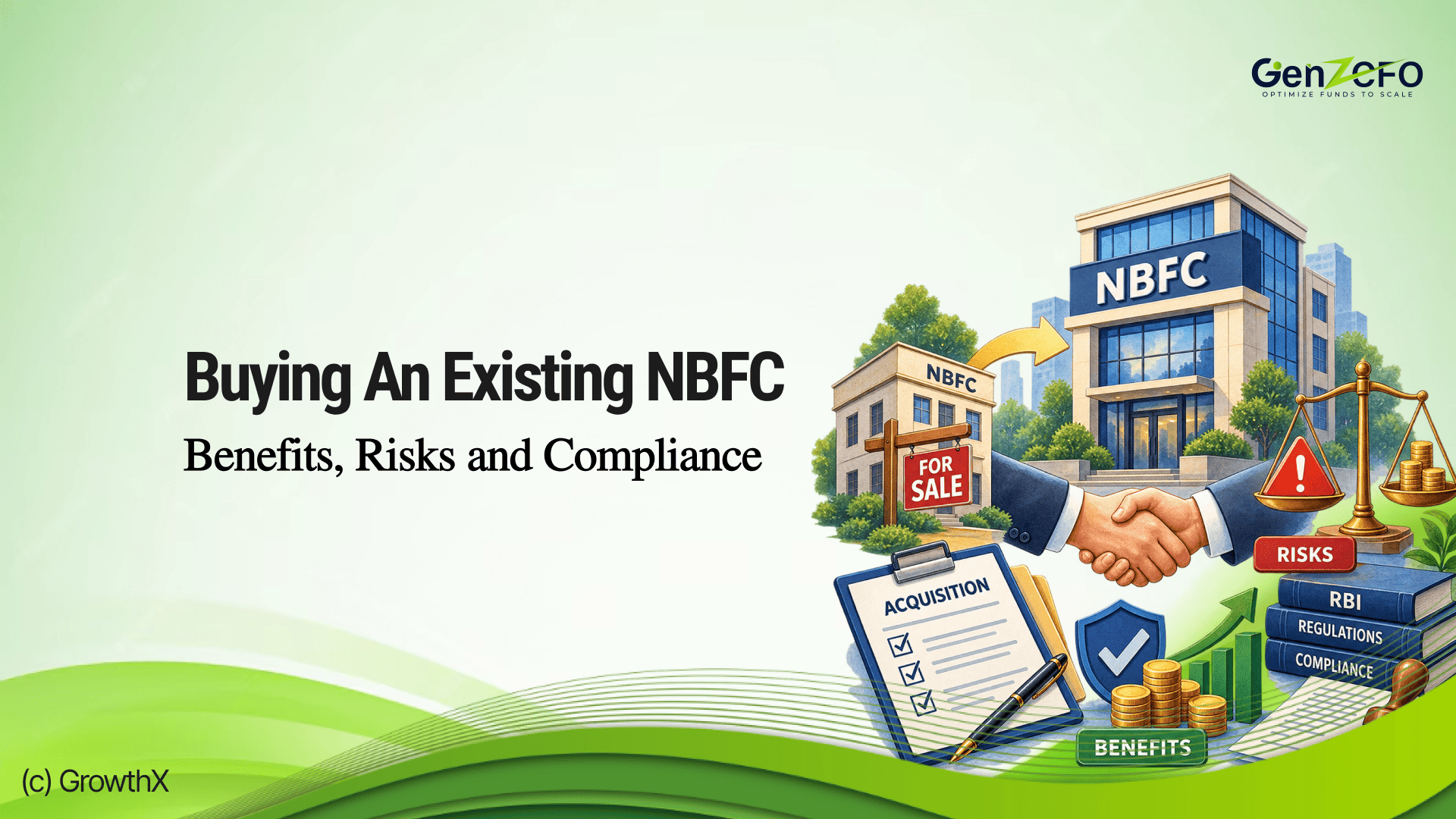
Buying an existing Non-Banking Financial Company (NBFC) can be an attractive route for entrepreneurs, investors, fintech businesses and financial-services groups that want to enter the lending or financial-services sector in India. Instead of incorporating a fresh company and applying for a new NBFC Certificate of Registration (CoR), an acquirer may purchase shares or obtain control of an existing company that is already registered with the Reserve Bank of India.
However, acquiring an existing NBFC should never be viewed as simply “buying an RBI licence.” An NBFC is a regulated financial entity carrying its own corporate history, loan portfolio, regulatory filings, customer obligations, tax exposures, contracts and potential liabilities. RBI has broad powers to regulate, inspect, supervise and penalise NBFCs, including cancellation of registration in appropriate cases. Therefore, the real question is not only whether buying an existing NBFC is faster or commercially attractive, but whether the target company is legally clean, financially sound and capable of meeting RBI requirements after the takeover.
In this article, CA Manish Mishra talks about Buying an Existing NBFC: Benefits, Risks and Compliance.
What Does Buying an Existing NBFC Mean?
Buying an existing NBFC generally involves acquiring shares or control of a company that already holds an RBI Certificate of Registration to conduct non-banking financial business. Depending on the transaction, the buyer may acquire a majority or complete shareholding, obtain management control or introduce new directors and promoters.
The transaction does not ordinarily create a completely new legal entity. The same company continues to exist, along with its historical contracts, assets, liabilities, regulatory filings and compliance record. This continuity can be commercially useful because the buyer obtains an operating corporate vehicle, but it also creates one of the biggest risks of the transaction: historical problems remain attached to the company. An acquirer must therefore evaluate both the value of the existing NBFC registration and the risks hidden inside the company carrying that registration.
Why Do Businesses Consider Buying an Existing NBFC?
One of the principal reasons businesses explore NBFC acquisitions is the regulatory entry process. RBI's current FAQ states that a company proposing to commence the business of a non-banking financial institution generally requires registration under Section 45-IA of the RBI Act, 1934 and must satisfy applicable Net Owned Fund requirements. For a general new NBFC registration, RBI currently states a minimum NOF of ₹10 crore, while specialised categories can have different capital requirements.
Acquiring an already registered NBFC may therefore provide an alternative to building an entity and regulatory history entirely from the beginning. However, takeover approval, due diligence, capital restructuring and compliance remediation can still make an acquisition a substantial regulatory exercise.
Benefit 1: Existing RBI Certificate of Registration
The most obvious benefit is that the target company already possesses an RBI Certificate of Registration. Under Section 45-IA of the RBI Act, a company that is required to be registered as an NBFC cannot carry on non-banking financial business without the prescribed registration and Net Owned Fund. RBI's current guidance also confirms that unauthorised companies carrying on NBFC activities may face penal consequences.
For a buyer, an existing CoR can provide a regulatory foundation on which the acquired business can continue, provided the licence remains valid, the company's classification is suitable and all conditions applicable to the NBFC continue to be satisfied. The buyer should never assume that possession of an old certificate alone means that the NBFC is fully compliant.
Benefit 2: Potentially Faster Market Entry
An existing NBFC may already have its basic regulatory structure, bank accounts, statutory registrations, reporting history, board-approved policies and lending infrastructure. As a practical matter, this can reduce some of the work involved in starting from zero. The buyer may be able to focus on restructuring the existing business, introducing capital, upgrading technology, revising underwriting policies and expanding lending operations.
Nevertheless, an acquisition should not be marketed or understood as a guaranteed “instant NBFC licence.” RBI approval may be necessary for the takeover itself, and substantial compliance deficiencies discovered during due diligence may have to be rectified before the business can be safely expanded.
Benefit 3: Existing Business Infrastructure
An operational NBFC may already possess customer relationships, employees, branches, loan-management systems, accounting systems, lenders, collection arrangements, credit bureau integrations and service-provider contracts. Where these systems are reliable and legally compliant, the buyer can benefit from an established operating platform instead of creating every process from scratch.
This advantage is particularly valuable when the buyer's business strategy is consistent with the existing NBFC's regulatory category and loan portfolio. However, operating infrastructure only has value if the underlying systems comply with RBI requirements relating to lending, KYC, outsourcing, customer protection and other applicable obligations.
Benefit 4: Existing Loan Portfolio
A functioning NBFC may already have a portfolio of loans and receivables. If the portfolio is performing well, appropriately documented and adequately provisioned, it can provide an immediate revenue-generating asset base for the buyer. A quality loan book may also provide historical data concerning borrower behaviour, recoveries, delinquency levels and product performance.
The buyer must nevertheless independently verify the quality of the portfolio. Reported assets should not simply be accepted from the seller's financial statements because loan books can contain overdue accounts, evergreening concerns, poor documentation, inadequate provisioning or weak recovery prospects.
Benefit 5: Existing Regulatory and Operational Track Record
A well-managed NBFC with a strong record of regulatory compliance can be more valuable than a shell NBFC with little or no genuine business activity. An established entity may have a history of RBI returns, audited financial statements, lender relationships and regulatory inspections. These records can help an acquirer understand how the company has historically operated. At the same time, the existence of a long track record increases the scope of due diligence because every historical regulatory period may contain liabilities or compliance deficiencies.
The Biggest Risk: Historical Liabilities Come with the Company
An acquisition of shares normally means that the company itself continues unchanged. Therefore, liabilities do not automatically disappear merely because the shareholders and directors have changed.
Outstanding tax demands, employee claims, customer complaints, loan disputes, regulatory violations, lender defaults, litigation, penalties and contractual obligations may remain enforceable against the NBFC after acquisition. This is why an NBFC purchase should never be valued only by reference to the price demanded for the shares or the existence of an RBI CoR.
The buyer must ask a more important question:
What liabilities are being acquired along with the company?
Risk of RBI Non-Compliance
Historical RBI non-compliance can significantly affect the attractiveness of an NBFC acquisition. RBI has powers to register, regulate, inspect, supervise and take penal action against NBFCs for violations of the RBI Act and regulatory directions. Its FAQ expressly states that regulatory action can extend to cancellation of the Certificate of Registration.
Recent RBI enforcement also demonstrates that ownership and management-related requirements are actively monitored. RBI has imposed monetary penalties where NBFCs failed to obtain prior approval for changes in shareholding exceeding the prescribed threshold. Accordingly, buyers should examine correspondence between the target NBFC and RBI, inspection observations, show-cause notices, penalties, supervisory concerns and delayed regulatory filings.
Risk of a Weak or Stressed Loan Portfolio
For a lending NBFC, the loan portfolio is often its most important asset. It can also be the largest hidden risk. A buyer should examine whether loans appearing as performing assets are actually recoverable. Particular attention should be given to ageing, overdue instalments, restructuring, repeated renewals, connected-party exposures, inadequate security, documentation deficiencies and concentration among particular borrowers or sectors.
The buyer should also compare the loan-management system with the general ledger, bank statements, borrower confirmations and financial statements. A company with a seemingly valuable loan book may be worth substantially less if a significant percentage of the portfolio is difficult to recover.
Risk Relating to Net Owned Fund
Capital compliance should be reviewed before finalising the acquisition price. RBI's current guidance states that general NBFCs seeking fresh registration require Net Owned Fund of ₹10 crore. Existing NBFCs have been provided a transition period up to March 31, 2027 to attain ₹10 crore, while different minimum NOF requirements apply to certain specialised NBFC categories.
This is particularly important for acquisitions taking place during 2026. A target company operating with lower NOF may require a significant capital infusion before March 31, 2027. The purchase price should therefore not be considered independently from the additional capital that the buyer may need to introduce after takeover.
Risk of Wrong NBFC Classification
Not all NBFC registrations permit the same business model. RBI recognises different types of NBFCs depending on liabilities, regulatory layer and business activity. Current RBI guidance includes categories such as Investment and Credit Companies, Infrastructure Finance Companies, Infrastructure Debt Fund NBFCs, Core Investment Companies, NBFC-MFIs, NBFC-Factors, NBFC-P2P platforms and Account Aggregators.
A buyer should therefore confirm that the target's regulatory category aligns with the intended post-acquisition business. Buying one category of NBFC and assuming that it can automatically be used for an entirely different regulated activity can create serious compliance problems.
Principal Business Reasons Must Be Reviewed
An NBFC should continue to satisfy the regulatory characteristics applicable to its business. RBI explains the Principal Business Criteria through the commonly called 50-50 test. More than 50% of the company's total assets should be financial assets and income derived from financial assets should constitute more than 50% of its gross income for the company to meet the relevant NBFC principal-business reasons.
Therefore, after the acquisition, the buyer should not introduce substantial unrelated non-financial activities without first considering how they could affect the company's NBFC status and regulatory classification.
RBI Approval for the Takeover
One of the most important regulatory issues is determining whether prior RBI approval is required before the transaction can be completed. RBI's acquisition and control structure requires regulatory scrutiny where an NBFC is taken over or control changes.
RBI enforcement actions also confirm that prior approval requirements continue to be taken seriously. The parties should therefore assess RBI approval requirements before transferring shares, changing control or substantially restructuring management.
Acquisition or Transfer of 26% or More Shareholding
RBI has taken enforcement action where an NBFC failed to obtain prior written permission for a change in shareholding exceeding 26% of its paid-up equity capital.
Therefore, where the acquisition involves a qualifying change at or beyond the applicable threshold, RBI approval should be addressed as a condition precedent to completion rather than being pursued after the shares have already been transferred.
Acquisition of Control
Shareholding percentage is not the only consideration. A transaction may give an investor control through contractual arrangements, board nomination rights or management rights. RBI's acquisition framework covers takeover or acquisition of control whether achieved through acquisition of shares or otherwise.
Accordingly, parties should review the substance of the shareholders' agreement and governance arrangements rather than relying only on the number of shares transferred.
Change in Directors
Management changes can independently create regulatory issues. RBI has imposed a monetary penalty in a case where an NBFC did not obtain prior approval before appointments resulted in a change of more than 30% of its directors, excluding independent directors.
A buyer proposing to replace the existing board after acquisition should therefore examine the management-change requirement before appointing its nominees.
Public Notice Before Completing the Transfer
A takeover may also involve a public-notice requirement. RBI's NBFC instructions provide for a 30-day prior public notice before effecting a sale or transfer of ownership through shares or transfer of control. The notice can be issued by the NBFC, transferor, transferee or jointly by the concerned parties.
The notice is intended to disclose the proposed change before the transaction becomes effective. Appropriate planning should therefore build the notice period into the acquisition schedule.
Due Diligence Before Buying an NBFC
Due diligence is arguably the most important stage of an NBFC acquisition. A buyer should not proceed merely on the basis of a copy of the RBI CoR, audited balance sheet and seller's assurance that the company is compliant.
RBI Registration Due Diligence
The buyer should verify whether the NBFC's Certificate of Registration remains valid and whether the company appears in the appropriate RBI records. The exact classification of the NBFC should be identified, including whether it falls within the Base, Middle, Upper or another applicable regulatory layer under the current Scale Based Regulation framework. RBI's current FAQ expressly recognises Base Layer, Middle Layer, Upper Layer and Top Layer classifications. Any restrictions or specific conditions associated with the registration should also be identified.
Financial Due Diligence
The buyer should scrutinise audited financial statements, trial balances, bank accounts, borrowings, receivables, investments and contingent liabilities. Particular attention should be given to Net Owned Fund, asset quality, provisioning, profitability, related-party transactions and unreconciled balances. The financial statements should be compared with regulatory returns and actual banking records rather than being examined in isolation.
Loan Portfolio Due Diligence
A sample or full review of the loan book should examine loan agreements, KYC documents, sanction terms, security documents, disbursement evidence, repayment history, overdue accounts and recovery records. Major borrowers and related-party exposures deserve additional scrutiny. Where technology permits, the loan-management system should be reconciled with the accounting system and bank statements.
KYC and AML Due Diligence
Customer onboarding records should be reviewed for compliance with RBI KYC requirements. Weak KYC systems can expose the acquired entity to regulatory, fraud and reputational risks. An acquirer should examine customer identification records, beneficial ownership checks, risk categorisation, periodic updation and transaction-monitoring procedures relevant to the NBFC's operations. RBI continues to maintain and update the Master Direction on KYC and related FAQs for regulated entities.
Regulatory Returns Due Diligence
The buyer should verify whether all applicable RBI returns have been filed correctly and within the prescribed periods. Delayed or inaccurate returns may indicate wider weaknesses in the compliance function. Returns should also be compared with audited financial statements because material inconsistencies may result in future questions from the regulator.
Tax and Corporate Due Diligence
GST, income-tax, TDS and other tax records should be reviewed for pending demands, assessments and litigation. Corporate records under the Companies Act should also be examined, including annual filings, share allotments, share transfers, charges, board meetings, shareholder approvals and statutory registers. Any irregular historical allotment or transfer of shares deserves special scrutiny because it may also have regulatory implications.
Litigation Due Diligence
The buyer should obtain a complete list of ongoing and threatened proceedings involving borrowers, lenders, employees, regulators, vendors and tax authorities. Customer complaints and recovery-related proceedings should also be examined. A large number of complaints may signal deficiencies in lending practices or collection processes even if the financial amount involved in each dispute appears small.
Valuation of an Existing NBFC
The value of an NBFC should not be determined solely by the fact that it has an RBI registration. A commercially sensible valuation should consider its net worth, quality of assets, profitability, loan portfolio, regulatory compliance, operating infrastructure, brand, customer base, liabilities and capital required after acquisition.
For example, an NBFC requiring a significant capital infusion to meet future NOF requirements should generally not be valued in the same manner as a fully capitalised and profitable NBFC. Similarly, a large loan book may add little value if a substantial portion of it is impaired or difficult to recover.
Structuring the Share Purchase Agreement
A well-drafted Share Purchase Agreement (SPA) is critical in an NBFC acquisition. The agreement should clearly specify the purchase consideration, shareholding being transferred, payment mechanism, conditions precedent, RBI approval requirement, representations, warranties, indemnities and completion obligations.
The seller should provide appropriate representations regarding RBI registration, regulatory filings, financial statements, loan assets, litigation, tax liabilities and undisclosed obligations. Indemnity provisions are particularly important because regulatory or financial liabilities discovered after acquisition may relate to periods during which the seller controlled the company. The agreement should also prevent completion before mandatory regulatory approvals are obtained.
Process for Buying an Existing NBFC
The first step is identifying an NBFC whose regulatory category and existing business are compatible with the buyer's proposed financial activity. Verification of the RBI registration status should be undertaken at the beginning rather than after commercial negotiations have substantially progressed.
The second step is comprehensive legal, financial, regulatory and tax due diligence. The buyer should determine whether the company has historical non-compliances, stressed assets, inadequate capital or regulatory correspondence requiring remediation. The third step is valuation and commercial negotiation. The buyer should calculate not merely the share purchase price but also the amount required for capital infusion, technology upgrades, compliance remediation and operational expansion.
The fourth step is determining whether the proposed share transfer, acquisition of control or board restructuring triggers prior RBI approval. The transaction documents should be structured accordingly. The fifth step is preparation and submission of the RBI approval application wherever required. Information regarding incoming shareholders, directors, source of funds and other prescribed matters should be accurately prepared.
The sixth step is obtaining regulatory approval and completing the applicable public-notice process. Where the public-notice requirement applies, the prescribed 30-day period must be appropriately accommodated before completion. The final stage is completion of the share transfer and implementation of the approved management structure, followed by applicable corporate and regulatory filings.
Post-Acquisition Compliance
Compliance does not end when shares are transferred. The new owners should immediately conduct a post-closing compliance review and implement a clear regulatory governance structure. The NBFC should update its board composition, authorised signatories, statutory registers, shareholding records and regulatory information wherever necessary.
Board-approved policies should be reviewed to determine whether they remain suitable for the buyer's proposed business model. Lending policies, credit underwriting, recovery mechanisms, Fair Practices Code, KYC procedures, outsourcing arrangements, grievance redressal, IT controls and regulatory reporting systems should also be examined.
Where the buyer proposes a digital lending model, applicable RBI digital-lending requirements should be separately reviewed. RBI's digital-lending framework places compliance obligations on regulated entities even where Lending Service Providers or other third parties are used.
Outsourcing Does Not Remove the NBFC's Responsibility
Many acquired NBFCs use third-party service providers for collections, call centres, technology, customer acquisition or other functions. RBI's outsourcing framework requires NBFCs to manage strategic, operational, compliance, legal, reputational and concentration risks associated with outsourcing and to conduct appropriate due diligence on service providers.
Therefore, a buyer should review every material outsourcing agreement after acquisition. The existence of an external service provider does not mean that the NBFC can ignore regulatory risks arising from the outsourced activity.
Red Flags That Should Concern an NBFC Buyer
A buyer should exercise particular caution where the target is unable to produce a valid RBI CoR, has unexplained differences between regulatory returns and financial statements, has repeatedly changed directors or shareholders without clear regulatory records, or is unwilling to provide RBI correspondence.
Other major warning signs include unusually high related-party lending, incomplete borrower files, cash transactions lacking explanation, overdue statutory filings, inadequate Net Owned Fund, questionable sources of promoter capital, unresolved customer complaints and loans that appear technically performing but show weak actual recoverability. The seller's refusal to permit independent due diligence is itself a significant transaction risk.
Is Buying an Existing NBFC Better Than Applying for a New Licence?
There is no single answer. Buying an existing NBFC can be commercially attractive where the target has a clean RBI record, adequate capital, strong governance, a good loan portfolio and operating infrastructure that matches the buyer's strategy.
A fresh registration may be preferable where available acquisition targets carry substantial historical risks or where the buyer wants a completely new structure without legacy liabilities. The decision should therefore be made after comparing three factors: time, capital and risk. An acquisition may provide operational continuity, but the buyer inherits historical exposure. A fresh entity may offer a clean corporate history but requires establishment of the business and satisfaction of RBI's registration requirements.
Conclusion
Buying an existing NBFC can provide a valuable entry route into India's regulated financial-services sector, particularly where the target already possesses a valid RBI Certificate of Registration, operating infrastructure, experienced personnel and a performing loan portfolio. It may allow an investor to build upon an existing regulated platform rather than starting every operational process from the beginning. However, the advantages of an existing NBFC should never overshadow the risks. The buyer may inherit historical RBI violations, weak loans, tax disputes, litigation, inadequate KYC systems, poor regulatory reporting and future capital requirements. RBI's current framework also makes capital planning particularly important because general existing NBFCs are moving toward the ₹10 crore NOF requirement by March 31, 2027, subject to applicable category-specific rules.
A successful NBFC acquisition therefore requires comprehensive regulatory, legal, financial and tax due diligence before any final commitment is made. The proposed transaction must also be examined for RBI approval requirements relating to acquisition of control, significant changes in shareholding and changes in management. RBI's enforcement record shows that non-compliance with these requirements can result in monetary penalties and other regulatory consequences. Ultimately, an existing NBFC should be purchased because the company and its regulatory platform are valuable, not merely because it possesses an RBI registration certificate. Proper due diligence, careful valuation, strong contractual protections, prior regulatory approval where applicable and disciplined post-takeover compliance are essential for converting an NBFC acquisition into a sustainable financial-services business.
Frequently Asked Questions
Q1. What does buying an existing NBFC mean?
Ans. Buying an existing NBFC means acquiring shares, ownership or control of a company that already holds an RBI Certificate of Registration. The legal entity generally continues with its existing assets, liabilities, contracts and compliance history.
Q2. Is buying an existing NBFC faster than applying for a new NBFC licence?
Ans. It can be faster in certain cases because the target company already has an RBI registration and operational history. However, the transaction may still require RBI approval, detailed due diligence, public notice and post-takeover compliance before the acquisition is fully implemented.
Q3. What are the main benefits of buying an existing NBFC?
Ans. Major benefits may include an existing RBI registration, established business infrastructure, customer relationships, employees, loan portfolio, systems and regulatory history. These advantages are valuable only when the target NBFC is financially sound and compliant.
Q4. What are the major risks of acquiring an existing NBFC?
Ans. The buyer may inherit historical liabilities such as RBI non-compliance, tax disputes, litigation, customer complaints, weak loan assets, KYC deficiencies and contractual obligations. Therefore, comprehensive legal, financial and regulatory due diligence is essential before purchase.
Q5. Is RBI approval required before buying an existing NBFC?
Ans. RBI approval may be required where the transaction results in acquisition of control, acquisition or transfer of 26% or more of the paid-up equity capital, or a change in management involving more than 30% of the directors, excluding independent directors. Applicability should be checked before completion.
Q6. What due diligence should be conducted before buying an NBFC?
Ans. The buyer should verify the RBI Certificate of Registration, financial statements, Net Owned Fund, loan portfolio, regulatory returns, KYC and AML compliance, tax liabilities, litigation, borrowings, corporate records and past RBI correspondence or penalties.
Q7. Why is the loan portfolio important in an NBFC acquisition?
Ans. The loan portfolio may represent one of the NBFC's most important assets and biggest risks. Buyers should examine overdue accounts, NPAs, borrower documentation, security, recovery history and provisioning to determine the actual quality and recoverability of the loan book.
Q8. Does buying an NBFC remove its previous liabilities?
Ans. No. A change in shareholders or management does not normally eliminate liabilities already belonging to the company. Regulatory defaults, tax demands, customer disputes, loans, contractual obligations and other historical exposures may continue after the acquisition.
Q9. What is the importance of Net Owned Fund in an NBFC takeover?
Ans. Net Owned Fund is an important regulatory capital requirement for an NBFC. A buyer should verify whether the target meets the applicable RBI capital requirement and calculate whether additional capital infusion will be required after the takeover.
Q10. Can an existing NBFC be used for any financial business?
Ans. No. The buyer must confirm the regulatory category and permitted activities of the target NBFC. Different categories of NBFCs are subject to different business, capital and compliance requirements, so the proposed business model must be compatible with the registration.
- 14 Aug, 2026
 CA Manish Mishra
- Corporate Actions
CA Manish Mishra is the Co-Founder & CEO at GenZCFO. He is the most sought professional for providing virtual CFO services to startups and established businesses across diverse sectors, such as retail, manufacturing, food, and financial services with over 20 years of experience including strategic financial planning, regulatory compliance, fundraising and M&A.